The Great Barrier Reef is not dead. I want to be clear about that because the narrative has swung so far toward elegy that people sometimes talk about it in the past tense. It's not gone. But it's badly hurt, and the trajectory is not encouraging.
The reef stretches 2,300 kilometres along the northeast coast of Australia, covering roughly 344,400 square kilometres. That's larger than Italy. It contains over 1,500 species of fish, 411 types of hard coral, and one-third of the world's soft coral species. In 2016, 2017, 2020, 2022, and 2024, it experienced mass bleaching events driven by elevated sea temperatures. During the 2016 event alone, 29% of the reef's shallow-water corals died.
So what if all of that reversed? What if, over the next decade, the Great Barrier Reef fully recovered to its pre-bleaching state?
What recovery actually looks like
Coral recovery isn't like a forest regrowing after a fire. It's slower, more conditional, and far more dependent on external factors staying within tolerance.
Coral grows at varying rates depending on species. Branching corals like Acropora can grow 10-15 centimetres per year in good conditions. Massive corals like Porites grow just 1-2 centimetres annually but live for centuries. A reef that lost its fast-growing branching corals in a bleaching event can see those species return within a decade if water temperatures stabilise. But the massive, slow-growing corals that form the structural backbone? Those take generations.
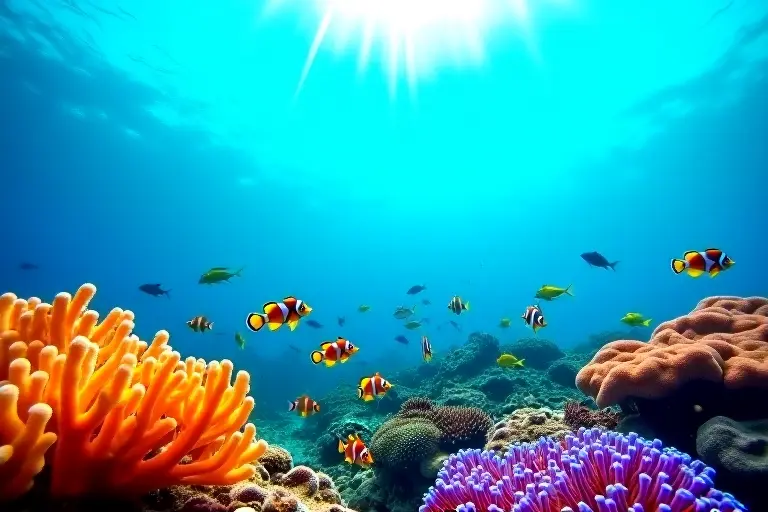
Full recovery means all of it comes back. The branching corals, the massive corals, the soft corals, the associated algae, sponges, and invertebrates. The fish populations that depend on specific coral structures for shelter and breeding. The predator-prey relationships that keep algae from smothering new coral growth. The whole system, functioning as an integrated ecosystem rather than a collection of surviving fragments.
It would be, by a considerable margin, the most significant environmental recovery event in modern history.
The fish come home
Healthy coral reefs are dense with life in a way that damaged reefs are not. A square kilometre of intact reef supports a biomass and species diversity that makes a degraded reef look like a car park. Fish species that abandoned bleached sections and crowded into surviving patches would spread back out. Populations of parrotfish, which are critical to reef health because they graze algae off coral surfaces, would rebound.
Sharks return to recovered sections. The reef shark population on the Great Barrier Reef has declined substantially, with some species down by 60-70% on inshore reefs according to surveys published in Nature. Recovery of coral habitat means recovery of the food web that supports them.
Crown-of-thorns starfish, the coral-eating predator that periodically plagues the reef, would still exist. But on a healthy reef, their numbers are kept in check by predators like the giant triton snail and trigger fish. The outbreaks that devastated weakened reef sections become rarer when the ecosystem is functioning properly.
The economic reality
The Great Barrier Reef generates an estimated $6.4 billion (AUD) annually for the Australian economy, primarily through tourism. That figure comes from a 2017 Deloitte Access Economics report, and it accounts for roughly 64,000 jobs. But the reef's earning power has been declining alongside its health. Tourists don't pay premium prices to see bleached coral.
Full recovery reverses that decline. Dive operators who've been taking visitors to the same surviving patches of reef (because the rest is too depressing to show tourists) can expand their routes again. Snorkelling trips to shallow reef sections become spectacular rather than carefully curated to avoid the worst areas.
Liveaboard dive boats, glass-bottom boat tours, island resorts, equipment hire, the regional airports that serve reef tourism hubs like Cairns and Airlie Beach. All of them benefit from a reef that looks like the photographs in the brochure rather than a pale, algae-covered shadow of them.
What it would prove
Here is where recovery matters beyond the reef itself.
The dominant narrative in environmental science, in media, in public understanding, is that ecological damage is permanent. Once you've lost something, it's gone. The Amazon is shrinking and it won't come back. The ice caps are melting and they won't refreeze. The reef is dying and it won't recover. This narrative is broadly supported by the data, and it drives a particular kind of public response: grief, fatalism, and a quiet sense that the damage is already done.
Full reef recovery shatters that narrative. Not because the narrative is wrong (it mostly isn't), but because it provides a single, visible, unambiguous example of large-scale environmental reversal. You can see it. You can swim through it. You can measure every metric and confirm that yes, an ecosystem the size of a country came back from the brink.

The psychological effect of that on the environmental movement would be enormous. It's the difference between "we're trying to slow the decline" and "decline can actually be reversed." Between fighting a rearguard action and believing that winning is possible.
The conditions that would be required
Coral bleaching is caused by sustained water temperatures above the coral's thermal tolerance, typically just 1-2°C above the normal summer maximum. The coral expels the symbiotic algae (zooxanthellae) that live in its tissue and provide it with food and colour. Without the algae, the coral starves. If temperatures drop quickly enough, the algae return. If they don't, the coral dies.
For the reef to fully recover, ocean temperatures along the Queensland coast would need to stabilise below bleaching thresholds for at least ten to twenty years. That means either global temperatures stop rising (which requires net-zero emissions sustained over decades) or some localised cooling effect protects the reef specifically.
Neither of those is currently happening. Global temperatures are still rising. The reef sits in a warming ocean. Which is why this article is filed under "purely hypothetical" and not "current events."
But there are efforts. Coral IVF, where researchers collect coral spawn and grow larvae in controlled conditions before transplanting them onto degraded reef sections, has shown promising results at small scale. Heat-resistant coral breeding, a kind of selective evolution accelerated by human intervention, is being trialled. Localised cooling experiments, shading technologies, and algae management programmes all exist.
They're not enough. Not yet, and possibly not ever at the scale required for 344,400 square kilometres of reef. But they represent something. The willingness to try, and the knowledge of what recovery would look like if it happened.
The reef as test case
The Great Barrier Reef is the most monitored ecosystem on Earth. Scientists have been tracking it in detail since the 1960s. There is more data on its health, species composition, temperature exposure, and bleaching history than on any comparable ecosystem anywhere. If environmental recovery is possible at this scale, the reef is where we'd see it first and measure it most precisely.
Which makes it either the canary in the coal mine or the proof of concept for planetary restoration. Right now, it's the canary. Bleaching events are getting more frequent, the gaps between them shorter, the recovery windows tighter. The reef is telling us something, and what it's saying isn't encouraging.
But the hypothetical matters. Because if you can't imagine recovery, you won't work toward it. And 344,400 square kilometres of living coral, teeming with 1,500 species of fish and visible from space, is worth the effort of imagining.