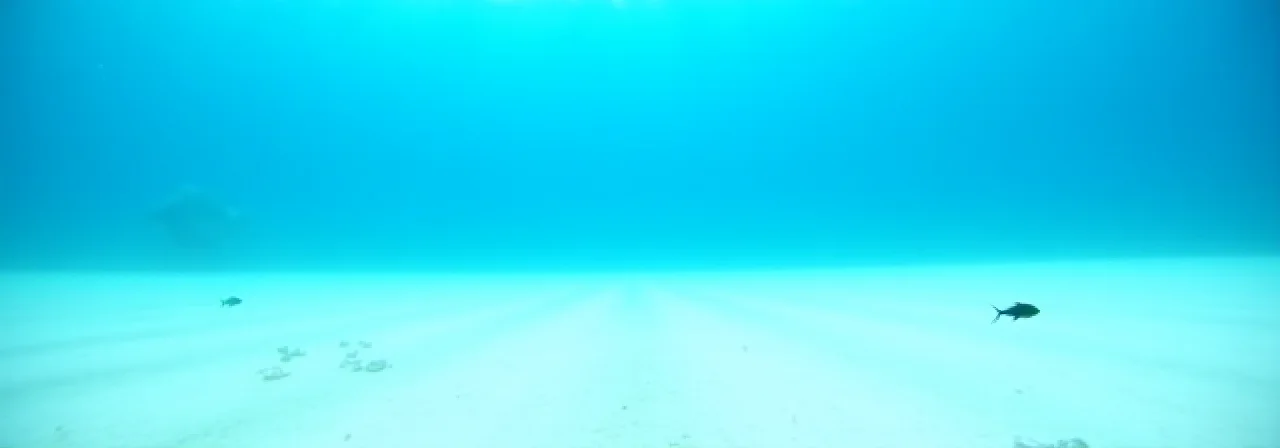
Coral reefs cover less than 1% of the ocean floor. They support roughly 25% of all marine species. That ratio is absurd. It's like saying one street in London houses a quarter of the country's population. But it's true, and it means that removing reefs doesn't just damage the ocean. It collapses the part of the ocean that most of the ocean depends on.
So let's remove them. Overnight. Every reef on Earth, gone.
What vanishes with them
The Great Barrier Reef alone covers 344,400 square kilometres off the coast of Queensland. It's home to over 1,500 species of fish, 400 species of coral (now gone, obviously), 4,000 species of mollusc, and roughly 240 species of bird that depend on the reef ecosystem for food. The Coral Triangle in Southeast Asia is even more biodiverse, supporting more than 3,000 species of fish.
All of these species lose their habitat simultaneously.
Some fish species use reefs as nurseries. Juvenile fish grow up in the sheltered nooks of coral structures, hiding from predators until they're large enough to survive in open water. Without reefs, those juveniles are exposed from birth. Predation rates skyrocket. Entire generations of commercially important fish species (grouper, snapper, parrotfish) fail to reach adulthood.
Cleaning stations disappear. These are specific spots on reefs where small fish and shrimp remove parasites from larger fish. It sounds trivial, like losing your local dry cleaner. It isn't. Parasitic infections in fish populations would increase dramatically without these stations, weakening fish that are already stressed by habitat loss.
The fishing industry collapses
Approximately half a billion people worldwide depend on coral reefs for food or income. That figure comes from the International Coral Reef Initiative and includes subsistence fishers, commercial fishing operations, tourism workers, and coastal communities in over 100 countries.
Southeast Asia gets hit hardest. Indonesia, the Philippines, Malaysia, Papua New Guinea. In the Philippines alone, reef fisheries employ over a million people directly. These aren't industrial trawler operations that can pivot to deep-water species. These are small boats, hand lines, and nets worked by families who fish the same reefs their grandparents fished.
Those families have no reef to fish any more. The fish they caught are gone or scattered. There is no government programme large enough to replace that income overnight. Some migrate inland. Some move to cities already struggling with housing and employment. Some try deep-water fishing with equipment they can't afford and skills they don't have.
In wealthier countries, the economic impact manifests differently. Australia's Great Barrier Reef generates an estimated $6.4 billion annually in tourism revenue and supports over 64,000 jobs. Florida's reef tract (the third largest barrier reef system in the world) contributes about $8.5 billion to the state economy. Both of those numbers become zero.
Coastlines start breaking apart
Reefs are walls. Not metaphorical walls. Actual physical barriers that absorb wave energy before it reaches the shore. A healthy coral reef can reduce wave energy by up to 97% according to research published in Nature Communications. That's not a subtle buffer. That is the difference between a wave hitting your coast at full force and a wave that's been defanged.
Remove the reefs and coastal erosion accelerates immediately. Beaches shrink. Shorelines retreat. Storm surges that were previously absorbed by reef structures now slam directly into coastal infrastructure. In the Maldives, where the average elevation is 1.5 metres above sea level, the reefs aren't just protecting property. They're protecting the country from ceasing to exist as dry land.
Low-lying Pacific island nations face similar maths. Tuvalu, Kiribati, the Marshall Islands. Their reefs are their sea walls. Without them, normal tidal action begins to erode islands that were already precarious. Storm events that were manageable become catastrophic. Saltwater intrusion into freshwater lenses (the thin layers of fresh groundwater that small islands depend on for drinking water) accelerates. Some islands become uninhabitable within years, not decades.
The nitrogen problem
Coral reefs are part of the ocean's nutrient cycling system. They fix nitrogen, recycle phosphorus, and maintain the chemical balance of shallow tropical waters. The reef framework creates zones of varying water flow, temperature, and nutrient concentration that support different communities of organisms at different trophic levels. Remove the reef and you remove the structure that organises this cycling.
Algae fills the gap. Without coral to compete with and without the herbivorous fish that grazed on algae (parrotfish, surgeonfish, sea urchins that sheltered in reefs), algal blooms spread across the shallow tropical ocean. These blooms consume oxygen as they decompose, creating hypoxic zones where nothing much survives except bacteria.
The Caribbean has already seen a preview of this. In areas where coral cover has declined by 80% or more since the 1970s, algae now dominates. Fish populations have dropped. Water quality has deteriorated. What used to be a reef is now a slimy rock covered in green-brown fuzz. It looks like a neglected fish tank. The whole Caribbean shelf starts to look like that, everywhere, all at once.
Pharmaceutical losses nobody talks about
Coral reef organisms are a source of bioactive compounds used in pharmaceutical research. Compounds derived from reef species are being studied for anti-cancer, anti-viral, and anti-inflammatory properties. AZT, the first approved treatment for HIV/AIDS, was developed from compounds originally isolated from a Caribbean reef sponge.
How many future drugs were sitting in reef organisms we haven't studied yet? We don't know. We can't know. The reef is gone. Whatever was there is gone with it. This is the invisible cost of extinction: you don't just lose what you had, you lose what you might have found.
Can the ocean recover?
From total reef loss? Eventually, in geological terms. Coral reefs have gone extinct before. The end-Permian mass extinction 252 million years ago wiped out reef ecosystems entirely. They didn't return for about 10 million years. The end-Triassic extinction did similar damage, with recovery taking roughly 7 million years.
So yes, the ocean would eventually rebuild reef structures. In 10 million years. If you're comfortable with that timescale, everything is fine.
On any human timescale, the loss is permanent. We cannot grow reefs back. Coral restoration projects exist and do good work, but they operate at the scale of individual reef patches, not entire ecosystems. Replanting a hectare of coral is a decade-long project. Replacing 284,300 square kilometres of global reef coverage (the estimated total area) is not something our species can do.
The uncomfortable truth is that we're running a slower version of this experiment right now. The Great Barrier Reef has experienced mass bleaching events in 2016, 2017, 2020, 2022, 2024, and 2025. Each event kills coral. Recovery between events is getting shorter as ocean temperatures continue to rise. We might not lose all reefs overnight, but we could lose most of them within a generation.
The hypothetical isn't as hypothetical as it sounds.