We know it's there. We've known for decades. Something is pulling galaxies together harder than visible matter can account for. Something is bending light around clusters of nothing. Something makes up roughly 85% of all the mass in the universe and we cannot see it, touch it, or detect it directly.
Then one Tuesday morning, you can.
What appears
Dark matter doesn't interact with electromagnetic radiation. That's the whole reason it's dark. It doesn't emit light, absorb light, or reflect light. Making it visible means changing this fundamental property, and the moment you do, the sky transforms.
The night sky, which currently shows us perhaps 5% of what's actually out there, would suddenly reveal the rest. And the rest is enormous.
Dark matter isn't evenly distributed. It forms a vast web of filaments and nodes stretching across the observable universe, a structure cosmologists call the cosmic web. Galaxies sit at the intersections of these filaments like dewdrops on a spider's web. The filaments themselves are hundreds of millions of light-years long, connecting clusters of galaxies across voids that were previously just empty blackness.
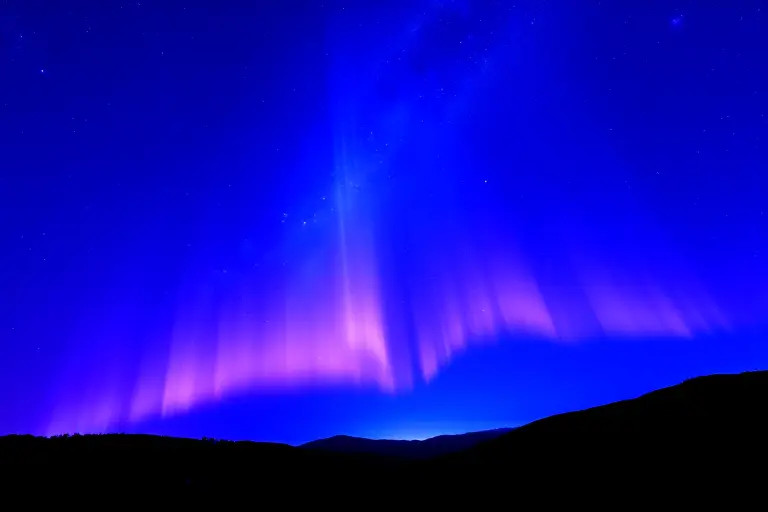
You look up and the sky is no longer black between the stars. It's filled with a faint, diffuse glow arranged in structures. Threads and sheets and knots of something, stretching in every direction, making the Milky Way look like a small bright smear caught in an incomprehensibly larger net.
The Milky Way's hidden skeleton
Our own galaxy is embedded in a dark matter halo that extends far beyond the visible disc of stars. The halo is roughly spherical and contains about ten times more mass than all the stars, gas, and dust in the Milky Way combined. Computer simulations predict it extends about 300 kiloparsecs from the galactic centre. The visible disc of stars reaches only about 15 kiloparsecs.
If you could suddenly see this halo, the Milky Way as you know it would be a thin bright disc inside a massive, faintly glowing sphere. The sphere wouldn't be smooth. It would contain substructure: lumps, streams, and smaller halos orbiting within it, remnants of smaller galaxies that were absorbed over billions of years. Gravitational archaeology, made visible overnight.
The Sagittarius Dwarf Elliptical Galaxy, currently being ripped apart and absorbed by the Milky Way, would be visible as a long tidal stream of dark matter wrapped around our galaxy like a ribbon around a parcel.
Astronomy's busiest week
Every telescope on Earth and in orbit would immediately point at the new structures. Every astronomer would cancel every existing observation programme. Papers would be submitted to journals at a rate that would crash the arXiv server within hours.
The questions that have plagued cosmology for decades would have direct, observable answers. Does dark matter form cusps or cores at the centres of galaxies? Look at it. Is dark matter cold, warm, or hot? Check the distribution. Does it self-interact? Watch how the halos behave during galaxy mergers.
The Bullet Cluster, already famous as one of the strongest pieces of evidence for dark matter's existence, would become even more instructive. In that system, two galaxy clusters collided. The visible gas slowed down and piled up in the middle, but the gravitational mass (inferred through lensing) kept going, separated from the gas. With visible dark matter, you could see both components directly. Two clouds of dark matter that passed through each other while the gas got stuck.
We'd learn more in a week than in the previous fifty years.
What it does to physics
Making dark matter visible doesn't just give us something to look at. It gives us something to measure. Precise measurements of dark matter distribution would immediately constrain or rule out dozens of competing theoretical models.
The Lambda-CDM model (the current standard model of cosmology) predicts specific things about how dark matter should be distributed. Too many small satellite halos around large galaxies. Cusps of density at galactic centres. A particular ratio of dark matter to baryonic matter at different cosmic scales. Some of these predictions have been in tension with observations for years (the "missing satellites problem," the "cusp-core problem"). Suddenly we'd know which predictions are right and which assumptions are wrong.
Modified gravity theories (MOND, TeVeS, and their variants) would face an existential test. These theories propose that dark matter doesn't exist at all and that gravity works differently at large scales. If you can see dark matter, that argument gets difficult to sustain. Not impossible. A MOND advocate could argue that what's become visible is some other form of matter, not the dark matter that standard cosmology predicts. But the conversation would shift from theoretical to observational, and observational evidence tends to settle debates faster than equations do.
The weight of what we've been ignoring
There's something psychologically strange about learning that most of the universe was hidden in plain sight. We built our understanding of cosmology on 15% of the matter content. That's like writing a biography of someone based entirely on their shoes.
Every image of the universe we've ever published (the Hubble Deep Field, the Pillars of Creation, the pale blue dot) would need an asterisk. What you're seeing here represents a small fraction of what exists. The rest was invisible. Now imagine those images reshot with dark matter included. The Hubble Deep Field, already one of the most humbling photographs ever taken, would show each tiny galaxy wrapped in a cocoon of dark matter ten times its visible size, connected to its neighbours by filaments of invisible mass.
The pale blue dot would look even smaller.
Living with it
For ordinary people, the immediate practical effect would be minor. Dark matter doesn't interact with normal matter beyond gravity. You can't touch it, it passes through you and the Earth without noticing. The Sun's dark matter halo doesn't affect your commute. Physicists estimate that about 0.3 GeV/cm³ of dark matter passes through your body at any given time. It was there yesterday too. You just couldn't see it.
But the sky at night would never be the same. The clean emptiness between stars, the vast black voids between galaxies, would all be filled with a faint, structured glow. Dark skies would be harder to find, not because of light pollution from cities but because the universe itself would be brighter. Amateur astronomers would need new equipment. Astrophotographers would lose years of their lives to the new structures.
Philosophically, it would be the largest recontextualisation of human existence since Copernicus. Not "you aren't the centre of the universe." But "you can't even see the universe. Not most of it. You've been staring at the decorations and missing the building."
And somewhere, in a physics department that had spent decades searching for dark matter particles in underground detectors and particle accelerators, someone would laugh. They'd been looking for it in the wrong place the whole time. It was overhead all along, filling the sky from horizon to horizon, and all it needed was permission to be seen.