Earth's atmosphere exerts a pressure of about 101.3 kilopascals at sea level. That's the weight of roughly ten tonnes of air pressing down on every square metre of ground. You don't notice it because your body pushes back with equal force. You've been doing this since birth. Your eardrums, your sinuses, your lungs are all calibrated to this pressure.
Now double it.
The atmosphere is twice as thick. Twice the mass of air above you. Pressure at sea level jumps to about 202.6 kPa, equivalent to being ten metres underwater. And almost everything about life on Earth changes.
Sound
Sound is a pressure wave moving through air. Denser air transmits sound better. In an atmosphere with twice the pressure, sound would travel further, carry more energy, and arrive louder at the same distance.
How much louder? The relationship isn't perfectly linear, but roughly, you'd hear sounds from significantly greater distances. A conversation across a crowded room becomes easier. A car alarm three streets away becomes impossible to ignore. A thunderclap, which already registers around 120 decibels at close range, would hit harder and travel further.
Birdsong would carry for kilometres. Whales, which already communicate across ocean basins, might find their atmospheric cousins finally catching up. The dawn chorus in an English woodland would be audible from the nearest village. Whether that's beautiful or annoying depends entirely on whether you're a morning person.
Cities would be louder. Construction sites, traffic, sirens, aeroplanes, the general background roar of urban life, all of it amplified. Noise pollution regulations would be considerably stricter than what we have now, because the physics would demand it.
The sky
A thicker atmosphere scatters more light. Rayleigh scattering, the process that makes the sky blue, would intensify. The sky would be a deeper, richer blue during the day. But the real change happens at the edges.
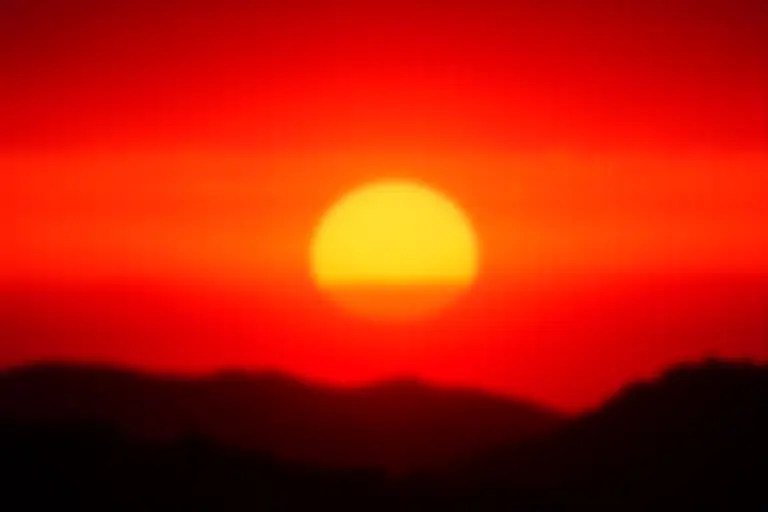
Sunsets already happen because sunlight at low angles passes through more atmosphere, scattering blue light away and letting reds and oranges through. Double the atmosphere and sunsets would last longer, start earlier, and blaze with colours that would make our current versions look washed out. The golden hour that photographers chase would become the golden two hours. Twilight would linger. The gap between "sun's going down" and "it's actually dark" would stretch to well over an hour at mid-latitudes.
Stars, though. You'd lose stars. More atmosphere means more scattering of faint light. The Milky Way, already invisible from most cities, would be gone from everywhere except perhaps the highest mountains. Casual stargazing would be a thing of the past. Astronomy would be harder. We'd probably still have developed telescopes, but everything through the eyepiece would be fuzzier, dimmer, filtered through a thicker blanket of air.
Flight
This is where it gets fun.
Lift is generated by air pressure differences across a wing surface. More air means more lift for the same wing area and speed. In an atmosphere twice as dense, wings can be smaller, or slower, or both. Aircraft would need less runway, burn less fuel to stay aloft, and could carry heavier loads.
The Boeing 737, which needs about 1,500 metres of runway at sea level, might manage with 800. Short runways become viable for commercial aviation. Small islands and mountain towns that currently can't support airports suddenly can.
But the real prize is human-powered flight.
In 1977, the Gossamer Condor became the first human-powered aircraft to complete a controlled flight, piloted by cyclist Bryan Allen. It had a wingspan of 29 metres and flew at about 16 km/h. In our atmosphere, human-powered flight is technically possible but requires extreme engineering and an Olympic-level cyclist.
In a double-density atmosphere, the engineering gets dramatically easier. Wing area could be halved. Speeds could be lower. A reasonably fit person with a well-designed set of wings could potentially take off from a hilltop and glide for kilometres. Not soar like a bird, exactly, but something closer to a hang glider that you power with your own legs.
The image of commuters strapping on wings for the trip to work is ridiculous, but the physics doesn't rule it out. In denser air, the gap between "human power output" and "enough to fly" shrinks to the point where recreational human flight becomes a sport, not a stunt.
Weather
More atmosphere means more weather. A thicker blanket of air holds more water vapour, traps more heat, and generates stronger pressure systems.
Storms would be more intense. Hurricanes, which derive their energy from warm ocean water evaporating into the atmosphere, would have access to a larger energy reservoir. Wind speeds in major storms could exceed anything we currently experience. The strongest recorded hurricane wind gust, 408 km/h during Tropical Cyclone Olivia in 1996, could be baseline rather than exceptional.
Rain would be heavier. More water vapour condenses into more rain. Flash flooding becomes a bigger problem. Deserts might shrink, because more moisture in the air means more precipitation reaching inland areas that currently stay dry. The Sahara might have a wetter fringe. Central Australia might be less barren.
Or not. Climate is complicated and doubling the atmosphere introduces so many variables that honest prediction becomes impossible. The greenhouse effect would be stronger. CO2 and water vapour, both greenhouse gases, would trap more heat. Global temperatures would be higher, possibly much higher. Earth might be closer to Venus than to itself. The exact balance depends on factors I'm not qualified to calculate and neither is anyone else without a very large computer model.
The human body
Humans can adapt to higher air pressure. Divers do it routinely. But living permanently at double atmospheric pressure creates issues that divers avoid by coming back up.
Oxygen toxicity is the main concern. At 202 kPa, the partial pressure of oxygen would be roughly 42 kPa, compared to about 21 kPa now. That's within the range where prolonged exposure causes lung damage, central nervous system problems, and eventually seizures. Divers breathing compressed air at ten metres depth are fine for hours, but they don't live there.
Life evolving from scratch in this atmosphere would simply use less oxygen. The atmospheric composition would probably be different. But if we're imagining the atmosphere doubling overnight, existing humans would face real health problems. We'd adapt over generations, maybe. Our lungs would adjust, or our blood chemistry would shift, or we'd move to the mountains where the pressure is lower.
Mountain cities would boom. Places like La Paz, Bogotá, and Addis Ababa, already high enough that visitors get altitude sickness, would become the most comfortable places on Earth. Sea level would be where you go if you enjoy headaches and shortness of breath. Beachfront property loses its appeal when the beach gives you nitrogen narcosis.
Fire
More oxygen, more fire. At double atmospheric pressure, fires burn hotter, spread faster, and are harder to extinguish. Forest fires in a denser atmosphere would be catastrophic. Firefighting would be one of the most important professions on the planet. Building codes would revolve around fire resistance above all else.
Cooking, on the other hand, would be excellent. Higher pressure raises the boiling point of water. At 202 kPa, water boils at roughly 120°C instead of 100°C. Every kitchen becomes a pressure cooker. Rice cooks faster. Beans cook faster. Steaks sear better. The entire culinary world shifts because the basic physics of boiling water changed.
We'd take longer sunsets, louder birdsong, the possibility of human flight, and faster cooking. We'd also take monster storms, oxygen toxicity, and fire risk that would keep us up at night. Whether that's a good trade depends on how much you like sunsets and how close you live to a forest.