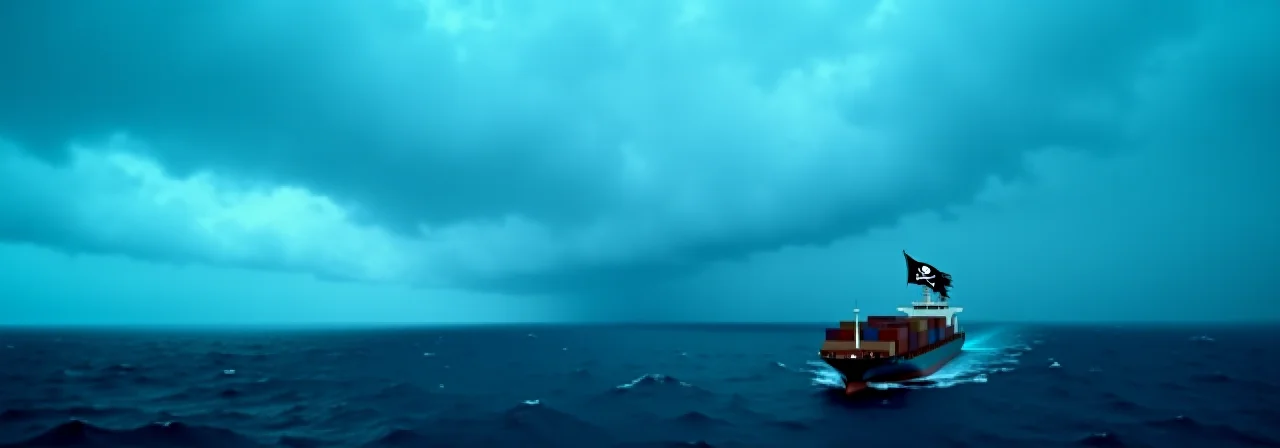
The Pirate Code gets a bad reputation, mostly from people who've never read one. The actual articles drawn up by real pirate crews in the early 18th century were, by the standards of their time, staggeringly democratic. Every man got a vote. The captain was elected and could be removed. Plunder was divided by a published formula. Compensation was paid for injuries sustained in battle: 600 pieces of eight for a lost right arm, 500 for the left, 100 for an eye.
They had a disability benefits scheme. In 1720.
The Royal Navy, by contrast, was running on press gangs and flogging. Parliament wouldn't abolish the slave trade for another ninety years. And here were pirates, the supposed villains of the sea, operating what amounted to a constitutional democracy with a welfare state.
So what if we never moved on? What if pirate law still governed international waters?
The articles of agreement, updated
Every pirate ship operated under its own articles, a written contract that every crew member signed (or marked, if illiterate) before sailing. Bartholomew Roberts' articles from 1721 are the most complete surviving example. They covered voting rights, profit shares, working hours, dispute resolution, and what happened if you were caught cheating at cards (you got marooned, which is exactly as bad as it sounds).

Apply this to modern shipping and you get something that resembles a workers' cooperative crossed with maritime law, written by someone who really doesn't trust management.
The captain of a modern container ship under pirate law would be elected by the crew. Not appointed by Maersk. Not parachuted in from a management training programme. Elected. If the crew didn't like his route planning or his attitude at breakfast, they'd vote him out and pick someone else. The former captain goes back to regular duties, no severance, no appeal.
The quartermaster, the pirate equivalent of a union rep crossed with a judge, would handle all disputes. Crew member thinks his share of the cargo revenue is light? Take it to the quartermaster. Quartermaster's decision is final. Try to go over his head and you'll find yourself scrubbing barnacles off the hull in Felixstowe.
Profit sharing
Under most pirate codes, the captain received two shares of any prize. The quartermaster got one and a half. Skilled roles like the navigator, surgeon, and master gunner received one and a quarter. Everyone else got one share each. The ratio between the highest-paid and lowest-paid crew member was 2:1.
For context, in 2024 the CEO-to-median-worker pay ratio at the largest US shipping companies averaged roughly 150:1.
Under pirate law, the CEO of a modern shipping line would earn twice what a deckhand earns. Not 150 times. Twice. The deckhand, for his part, would be earning considerably more than he does now, because the profits currently disappearing into executive bonuses and shareholder dividends would be split among the crew according to the articles.
Shipping companies as corporate entities simply wouldn't exist in their current form. Each vessel would be an independent economic unit. The crew owns the voyage. They split the revenue. If the voyage loses money, everyone takes the hit equally. If it makes a fortune, everyone benefits.
This is, depending on your politics, either a beautiful vision of workplace democracy or a logistical catastrophe. Possibly both.
International waters get interesting
The United Nations Convention on the Law of the Sea (UNCLOS), which currently governs international waters, runs to 320 articles and has been ratified by 169 countries. It took nine years to negotiate.
Pirate law would replace all of it with something you could write on two sides of parchment.
Territorial waters wouldn't exist as a legal concept. In pirate tradition, the sea belongs to whoever is on it. National sovereignty extends to the shore and stops there. Once you're past the breakers, the only law is the articles your crew agreed to before departure.
This creates problems. Fishing rights, for instance. Currently, nations claim 200-nautical-mile Exclusive Economic Zones where only their boats can fish. Under pirate law, the Atlantic is a free-for-all. Icelandic fishing boats and Spanish trawlers aren't competing within regulated quotas. They're competing boat to boat, and the articles of each crew determine how they handle conflict.
The Cod Wars between Iceland and Britain in the 1950s through 1970s were tense enough under international law. Under pirate law, they'd have been resolved the traditional way: whoever has more cannons wins, and the losers owe them a share of the catch.
The cruise industry under the articles
Cruise ships would be transformed beyond recognition, and honestly, this might be the strongest argument for pirate law.
Under the current system, major cruise lines register their ships in flag-of-convenience states like the Bahamas, Panama, and Bermuda to avoid labour regulations. Crew members, often from the Philippines and Indonesia, work 10-14 hour days for months without a day off, earning wages that would be illegal in any port they visit. The Pirate Code would put a stop to that immediately.
Every crew member signs articles. Every crew member votes. Every crew member gets a share. The captain is elected. The entertainment director, the man who forces you to participate in poolside karaoke at 11am, answers to the crew, not to corporate.
Passengers, under a strict reading of the articles, would be classified as either prisoners or cargo. Neither category traditionally gets a buffet.
More practically, cruise passengers would probably negotiate their own terms before boarding. A fee for passage, certain guaranteed amenities, and an understanding that if the crew votes to change course to somewhere more interesting, you're going wherever they're going. You booked the Canaries but the crew voted for the Azores. That's democracy.
Dispute resolution
Modern maritime disputes are settled in courts. The Admiralty Court in London, which has existed since the 14th century, handles cases involving collisions, salvage, cargo damage, and crew contracts. Cases can take years. Legal fees run into millions.
Pirate law was faster.
Two captains in dispute met on a neutral beach, stated their cases before witnesses, and the assembled crews voted on the outcome. If voting failed, the matter was settled by single combat between the aggrieved parties, typically with cutlass and pistol at close range on a sandbar at low tide.
Imagine this applied to a modern shipping dispute. Maersk and MSC disagree over a container loading schedule at Rotterdam. The two captains row to a sandbar in the Maas estuary. Cutlasses are drawn. The longshoremen take bets. The loser's company pays damages and also probably needs a new captain.
Maritime lawyers, a profession employing roughly 10,000 people in London alone, would be entirely obsolete. Some might retrain as quartermasters. Most would not adjust well.
The naval question
Navies present an obvious problem. Pirate law and state navies historically occupied opposite sides of a noose. If pirate law governs the seas, what happens to the Royal Navy, the US Navy, the combined naval forces of every nation on Earth?
Under strict pirate law, they'd have to operate under articles like everyone else. The crew of HMS Queen Elizabeth, all 1,600 of them, would elect their commanding officer. Military discipline as it currently exists would be replaced by democratic consensus. Going to battle stations because the captain says so? Not any more. Put it to a vote. Three hundred and twelve crew members think this engagement is a bad idea and would rather go to Lisbon. The quartermaster counts the hands.
National defence falls apart in about a week. Which is probably why pirate law stopped governing the seas in the first place. It's hard to run an empire when your sailors can vote to go home.
But then, that was rather the point. The pirates who wrote these codes weren't trying to build a system that scaled to nations and navies. They were trying to build something fair for fifty men on a ship who had to trust each other with their lives. And by that measure, with their elected leaders and shared profits and written contracts and disability compensation, they did a better job than most of the governments chasing them.