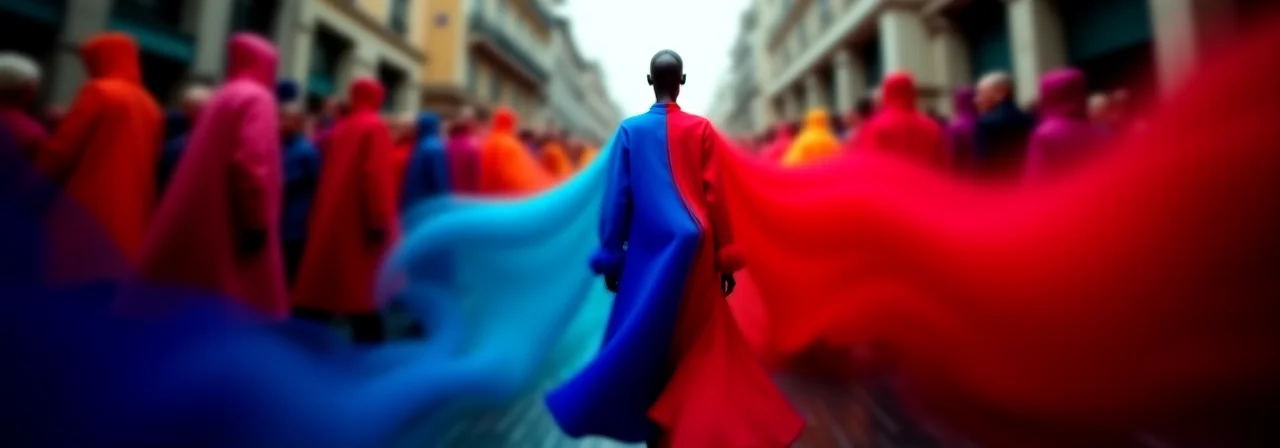
The shirt you're wearing right now is lying on your behalf. It says nothing about whether you're furious, bored, anxious, or quietly smug about the sandwich you packed for lunch. It just sits there, being blue or grey or whatever you grabbed at 7am, and it keeps your secrets.
Now take that away.
Imagine every piece of fabric on your body shifts colour in real time according to your emotional state. Red for anger. Deep blue for sadness. Bright yellow for joy. Green for jealousy. And some horrible murky brown when you're feeling a combination of three things at once and couldn't name any of them if asked.
Monday morning, 9am
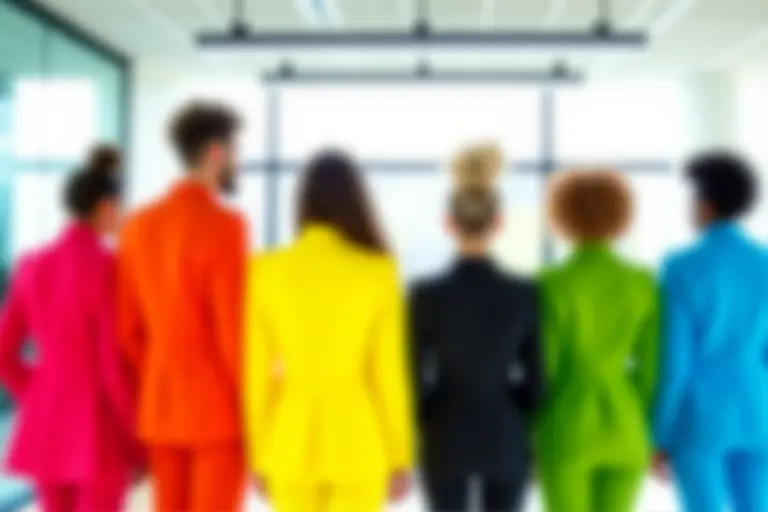
You walk into the office. Your shirt is a dull grey because you didn't sleep well, you hit every red light on the way in, and the coffee machine is broken again. Nobody needs to ask how you are. They can see it. Karen from accounts is sunshine yellow because her kid got into the school play. Dave in IT is a shade of green you've never seen before, and he won't make eye contact with you after the promotion announcement.
The small talk economy collapses overnight. "How are you?" becomes a redundant question when the answer is literally draped across someone's torso. All those polite workplace fictions we maintain to keep things civil? Gone.
Within the first week, someone in HR writes a policy about "colour-based harassment." You cannot, the memo states, comment on a colleague's emotional display without their consent. Nobody follows it.
The dating problem
First dates become impossible to bluff through. You sit down across from someone at a restaurant, and your shirt immediately shifts to a nervous orange. Theirs does too, which is actually reassuring, until halfway through the main course when theirs fades to a bored grey and yours is still solidly orange because you actually quite like them.
There's no recovering from that. You both saw it happen. You both know the other person saw it happen. The waiter definitely saw it happen.
Pickup artists go extinct within a month. You cannot project false confidence when your collar is broadcasting anxiety in real time. The entire industry of "fake it till you make it" crumbles, because faking it is now chromatically impossible.
On the other hand, genuine mutual attraction becomes obvious immediately. Two people at a bar both turning the same shade of warm pink at the same moment. No games, no guessing, no three-day texting rules. Just synchronised colour and the quiet terror of having nowhere to hide.
Job interviews
You walk in. Your blazer is a swirl of grey anxiety and forced yellow confidence. The interviewer's outfit is cool professional blue, because they've done this four hundred times and they're mostly thinking about lunch.
They ask the classic: "What's your biggest weakness?"
You give the classic rehearsed answer about being "too much of a perfectionist." Your shirt immediately turns the specific colour of someone who knows they're lying. The interviewer glances at it. You both pretend they didn't.
"We'll be in touch," they say. Their sleeve flickers with the colour of someone who has already decided no. You shake hands, and both of you perform the ritual of pretending the last thirty minutes weren't made entirely redundant by fabric.
The funeral question
This is where it gets properly uncomfortable. Funerals operate on a social contract: you wear black, you look solemn, you say "they lived a wonderful life" even if the deceased was a miserable sod who owed you forty quid.
With mood-responsive clothing, the front row becomes a psychological audit. The widow is deep blue, obviously. The brother-in-law is... hang on, is that relief? The business partner is displaying something that looks suspiciously like the colour of someone doing mental arithmetic about inheritance.
And you, standing at the back, trying desperately to feel sad but mostly feeling hungry because the service started late and you skipped breakfast? Your jacket is broadcasting that in high definition to everyone behind you.
Funerals would need to go back to mandatory black. Opaque, non-reactive, emotionally silent black. It would be the one socially acceptable colour override, and shops would sell "funeral fabric" the way they sell sympathy cards now.
A new fashion industry
The fashion world splits in two. One half races to create "mood-blocking" fabric. Premium material that stays whatever colour you chose that morning, no matter what you're feeling. Armani sells a suit that costs twelve thousand pounds and its entire value proposition is that it keeps your emotions private. "Emotional opacity" becomes the ultimate luxury.
The other half goes the opposite direction. Designers create garments that amplify your mood colours, making them more vivid, more saturated, harder to miss. Festival wear. Party clothes. Look-at-me outfits for people who want the world to know they're having the time of their lives.
The class implications are immediate. Rich people walk around in emotionally silent clothing, faces composed, giving nothing away. Everyone else is on display. Privacy becomes something you buy, literally, by the metre.
Schools
Teachers can now see, instantly, which students are confused, which are bored, which are anxious about the test next period, and which one is sitting at the back absolutely furious about something that happened at break time.
This sounds useful. It isn't.
A classroom of thirty teenagers is already an emotional warzone. Making it visible doesn't help. It just means the quiet kid whose jumper keeps flickering between anxiety grey and isolation blue is now having their mental health status broadcast to every other student in the room. Bullies don't need mood clothing to find targets, but it certainly speeds up the process.
School uniform policies become the subject of parliamentary debate. Should uniforms be mood-blocking? Is it a safeguarding issue if a child's emotional state is visible to everyone? The Department for Education releases guidance that runs to 140 pages. The Daily Mail runs a headline about "snowflake uniforms." Nobody is happy.
Therapy gets interesting
Therapists have spent decades learning to read micro-expressions, body language, vocal tone. Now their clients walk in wearing a complete emotional readout. The session hasn't started and the therapist already knows you're anxious, slightly resentful about being here, and carrying something that's been making you sad for weeks because your coat has been that shade of blue since the waiting room.
"How are you feeling today?"
"Fine."
Your entire outfit is screaming otherwise. The therapist just gestures at your sleeve. You sigh. You skip the fifteen minutes of deflection and get straight to the point. Therapy becomes more efficient but considerably less comfortable.
The politics of colour
Within six months, a universal colour chart is published. Some academic at Cambridge maps 127 distinct emotional states to specific hex values. People memorise them the way they memorise star signs. "Oh, you're showing a lot of #7B3F00 today, that's suppressed frustration with a hint of resignation."
Colour literacy becomes a skill. Reading someone's outfit in a meeting is the new reading the room. Except there's no ambiguity any more, no benefit of the doubt, no plausible deniability. If your shirt says you're bored in the all-hands meeting, you're bored in the all-hands meeting, and your manager can see it from three rows back.
Politicians would need mood-blocking suits immediately. Prime Minister's Questions with visible emotions would end careers in a single session. The first time a PM's tie shows fear during a tough question, that clip plays on every news channel for a week.
Some countries would ban mood-reactive clothing entirely. Others would mandate it for public officials, arguing transparency. The debate would be loud, angry, and very colourful.