You still age. Your body still deteriorates, gets sick, gets injured. But you don't die. Not from any of it. Not unless you choose to. Death becomes a voluntary act, like emigration, requiring nothing more than a conscious decision: I'm done.
The first question everyone asks is "who would choose to die?" The better question is what happens to a world where nobody has to.
The population maths
Earth's current population is about 8.2 billion. The crude death rate is approximately 7.7 per 1,000 people per year. That's roughly 63 million deaths annually. If those deaths stop happening (because almost nobody would choose death voluntarily, at least not immediately), population growth accelerates from its current rate of about 0.9% per year to something much higher.
Within a decade, Earth's population would pass 9 billion. Within twenty years, 10 billion. Within fifty years, without any change in birth rates, somewhere north of 15 billion. And this assumes birth rates stay constant. They might increase, because people who previously chose not to have children due to the shortness of life might reconsider when they have unlimited time.
The planet can't feed 15 billion people with current agricultural systems. We struggle with 8 billion. Water scarcity, arable land depletion, and energy production all hit hard limits well before that number. Voluntary death doesn't prevent suffering. It prevents the exit from suffering.
Prisons become something else entirely
A life sentence currently means roughly 15-25 years in most jurisdictions, or the remainder of a natural lifespan for whole-life orders. When natural lifespans are infinite, a "life sentence" is infinite.
This is not an abstract problem. There are currently about 10.7 million people in prison worldwide, according to the World Prison Population List. Under the old system, most of them would eventually die (in prison or after release). Under the new system, they don't. The prison population only grows. Every conviction adds a body that never leaves.
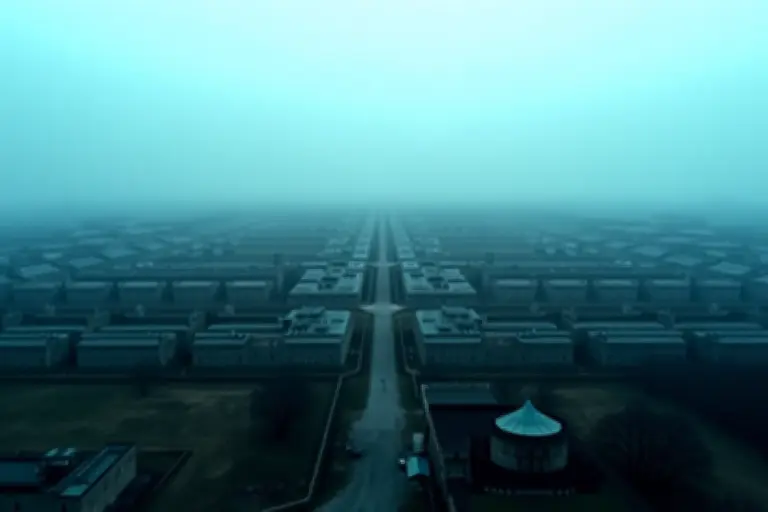
Countries would face a choice: redesign the justice system entirely, or build prisons that scale without limit. Neither option is simple. Abolishing long sentences means releasing people convicted of serious crimes. Building infinite prisons means spending an ever-increasing proportion of GDP on incarceration. Some prisoners, facing genuine eternity behind walls, might choose death. And that introduces the most disturbing ethical question of the scenario: is it still a free choice if the alternative is unbearable?
If a prisoner chooses death because their sentence has no end, the state has created the conditions that led to that choice. The death is voluntary in name. In practice, it's coercion dressed up as autonomy.
What aging looks like without death
You don't die, but I said you still age. Imagine being 200 years old. Your joints are gone. Your vision is gone. Your hearing has deteriorated to the point where you catch maybe one word in ten. Organ function has declined to levels that, in the old world, would have killed you decades ago. But you don't die. Your body persists in a state of extreme decrepitude. Indefinitely.
Medical science would focus entirely on quality of life rather than extension of it. The concept of "life-saving" treatment becomes meaningless when life can't be lost. Instead, every medical resource goes toward managing chronic deterioration in a population that gets older but never smaller.
Healthcare systems, already strained, would face demand that grows without limit. Every condition that would previously have been terminal becomes chronic. Cancer doesn't kill you. It just keeps growing, keeps spreading, keeps destroying tissue that your body can't repair. Dementia doesn't end. It just continues, year after year after year, erasing a person's mind while their body refuses to follow.
The kindest reading of this scenario is that it forces humanity to cure aging itself. If death won't take the old, medicine must make them young. The unkind reading is that it creates a world of billions of people trapped in failing bodies with no way out except a choice that every instinct tells them not to make.
Grief changes shape
When someone dies in our world, grief is involuntary. The person didn't choose to leave (usually). Death arrived and took them. Your anger, if you feel it, is directed at circumstance, at disease, at a universe that allows this.
When death is a choice, grief becomes personal. Someone you love chose to leave. They decided that being alive, that being with you, was no longer worth continuing. Every death is, functionally, a suicide. And every bereaved person is left with the knowledge that the person they lost could have stayed.
This would reshape human relationships at a level I don't think we're equipped to process. Marriage vows that say "till death do us part" become meaningless when death is optional. If your partner chooses death, they chose to part. If they don't, you're married for potentially thousands of years. Both options are terrifying in different ways.
Friendships would carry a different weight. Every relationship is implicitly permanent. The natural turnover of social circles, old friends drifting away and new ones arriving, slows to a crawl when nobody leaves the stage. You'd have friends you've known for centuries. You'd also have grudges you've held for centuries. Human beings are not designed for permanent relationships with everyone they've ever met.
Power concentrates forever
Currently, wealth and power have a built-in redistribution mechanism: the people who hold them die. Not quickly enough, and not equitably enough, but eventually. Estates are divided, companies change leadership, political dynasties end. Death is the great leveller in the most literal sense.
Remove death and the people who hold power today hold it forever. A billionaire who lives for a thousand years accumulates wealth on a scale that makes current inequality look like a rounding error. Compound interest alone would concentrate all global wealth into a handful of immortal individuals within a few centuries. Political leaders who refuse to step down can't be outlived. Dictators don't die of old age. Revolutionary movements lose their most reliable ally: time.
The young would face a world where every position, every resource, every opportunity is occupied by someone who got there first and has no reason to leave. Generational turnover, the mechanism by which societies change their minds about things (civil rights, gender equality, environmental protection), grinds to a halt. The people who opposed progress in 1950 are still alive, still voting, still holding the same opinions they held seventy-five years ago, and now they always will be.
Religion reckons with itself
Every major religion has a framework for death. An afterlife, reincarnation, spiritual transcendence, final judgement. These frameworks provide meaning to the fact that life ends. If life doesn't end (unless you want it to), these frameworks need revision.
Is choosing death a sin? Most religions condemn suicide. But if death is the only way to reach the afterlife that your religion promises, refusing to die means refusing God's kingdom (or nirvana, or whatever your tradition offers). Theology would split. Some denominations would argue that choosing death is the ultimate act of faith. Others would argue that God gave you immortality and you should accept it.
Secular meaning-making faces its own crisis. Much of what gives human life urgency is its finitude. You pursue goals because time is limited. You value experiences because they won't last. You love people fiercely because you'll lose them. Remove the deadline and the urgency drains out. What does ambition mean when you have forever? What does love mean when "always" is literal?
Who chooses to go
Eventually, people would choose death. Not immediately, and not many at first. But over decades, over centuries, the accumulation of experience, of loss, of sheer repetition would wear people down. You'd see clusters. People who lived through the same era choosing to leave together, having decided collectively that they'd seen enough.
The very old would develop a culture around the choice. Rituals. Conversations. A way of saying goodbye that acknowledges the permanence of it without the shock, because everyone has had centuries to prepare.
And somewhere, someone would be the last. The final person alive from the original generation, everyone they knew having made their choice one by one over the centuries. Still here. Still choosing to stay. Not because life is good, necessarily, but because the alternative requires a certainty they haven't found yet.
That person might be the loneliest human being who ever lived. Or the bravest. It's hard to know which from the outside.