
Not invulnerable. You can still be hurt, still feel pain, still lose a limb in a car accident. You just don't age and you can't die of natural causes. Your cells repair themselves indefinitely. Cancer can't kill you. Heart disease can't kill you. Time itself can't kill you.
You're going to wish it could.
The population arithmetic
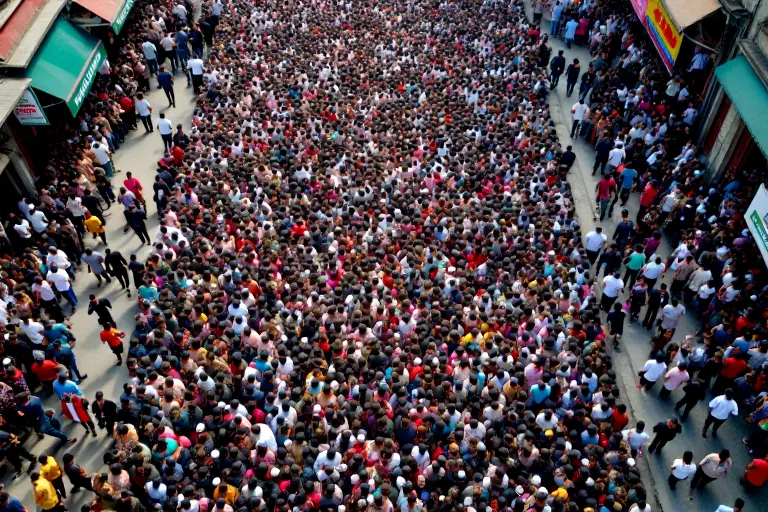
About 385,000 babies are born worldwide every day. Currently, about 170,000 people die. That net increase of 215,000 per day is already straining resources. Now remove all natural deaths. The daily increase jumps to 385,000 and stays there, compounding. No old age, no disease, no organ failure. Only accidents, violence, and the rare suicide.
The global population, currently around 8.2 billion, doubles in roughly 50 years under these conditions. By 2126, we'd be at 16 billion. By 2176, 32 billion. There is no ceiling. Every person ever born after the change is still alive and still consuming resources.
Within two centuries, we'd need to feed 50 billion people using a planet that struggles to feed 8 billion sustainably. The maths is bleak and it doesn't get better.
Governments would ban reproduction
This would happen quickly. Not out of philosophical debate but out of sheer panic. Governments that moved slowly would face famine within a generation. The ones that survived long-term would be the ones that imposed strict reproductive controls early.
China's one-child policy, enforced from 1980 to 2015, is the closest historical precedent. It was brutal, deeply unpopular, and riddled with human rights abuses. An immortality-driven version would need to be far more restrictive. One child per couple wouldn't be enough. You'd need something closer to one child per ten couples, enforced indefinitely, or reproductive licensing where only a fraction of the population is permitted to have children in any given decade.
The politics of this would be vicious. Who decides? How are licences allocated? Wealth, lottery, genetic screening, merit? Every answer creates a different kind of dystopia. Religious groups that consider reproduction a divine right would resist violently. Governments that tried democratic approaches would be outpaced by the ones that simply mandated compliance.
Some countries would refuse entirely, citing sovereignty or religious law. They'd grow fastest. Their neighbours would watch their borders with increasing alarm.
What prison becomes
A twenty-year sentence is bearable when you expect to live to eighty. It takes a quarter of your life, which is severe, but you emerge with decades ahead of you. Now imagine you're immortal. Twenty years is nothing. It's a rounding error in an infinite lifespan.
So sentences scale up. Murder gets two hundred years. Serious fraud gets five hundred. And for the truly heinous crimes, what do you do? You can't execute anyone, they're immortal. Life imprisonment literally means forever. Not a metaphorical forever where the prisoner eventually dies. Actual forever.
Prisons become permanent storage facilities for people society has given up on. The ethical questions are stomach-churning. Is it humane to lock someone in a cell for a thousand years? Is a mind that's been imprisoned for three centuries still recognisably the same person who committed the crime? At what point does the punishment become worse than anything the prisoner could have done?
Some countries would probably adopt exile instead. Drop someone on an uninhabited island and leave them there. They can't die. They'll survive. Whether that's mercy or cruelty depends on your perspective.
The economy stops working
Retirement, as a concept, is dead. Pension systems assume you work for 40 years and draw benefits for 15 to 20. An immortal population draws benefits forever. Every pension fund on Earth goes bankrupt within a decade of the change.
But here's the less obvious problem: career progression jams up completely. Your boss doesn't retire. Their boss doesn't retire. Nobody at the top of any hierarchy ever leaves unless they're fired or choose to go. Promotion becomes almost impossible. A 25-year-old entering the workforce in 2026 might still be in the same entry-level role in 2126 because every position above them is occupied by someone who has been there for a century and has no reason to leave.
Innovation stagnates for the same reason. The people who control institutions, universities, companies, governments, these are the people whose ideas were current when they took power. In a mortal world, they eventually die and new thinkers replace them. Max Planck's observation that "science advances one funeral at a time" wasn't entirely cynical. Immortality means no funerals. The old guard holds power forever.

Memory and identity
The human brain can store an estimated 2.5 petabytes of information, which sounds like a lot until you consider an infinite lifespan. After a few centuries, you'd have lived through more experiences than your brain can retain with any fidelity. Early memories would fade to nothing. The person you were at twenty would be as remote as a stranger.
Your sense of self depends on continuity of memory. You are the person who went to that school, had that first kiss, made that terrible decision at twenty-three. Strip those memories away through sheer volume of subsequent experience and what remains? You'd be a different person every few centuries, wearing the same face.
Relationships would become temporary by default. Not because people stop loving each other but because two immortals who've spent four hundred years together are not the same two people who fell in love. Every friendship, every marriage, every family bond would have a natural expiration date driven by memory loss and personality drift.
The boredom problem
This sounds trivial compared to the population crisis and the economic collapse, but philosophers have argued it's the real horror of immortality. Bernard Williams wrote in 1973 that an immortal life would eventually become unbearable because you'd exhaust every possible experience. Every career tried, every country visited, every book read, every conversation had. Repetition becomes inevitable and then inescapable.
At five hundred years old, what gets you out of bed?
At a thousand, what could anyone say to you that you haven't already heard?
Some would adapt. Others wouldn't. Without the ability to die naturally, the psychological toll would produce a population increasingly disconnected from the present, people physically here but mentally checked out, going through motions they stopped caring about centuries ago.
The one thing it might fix
Climate change. If you're going to be alive in 2326, you care about what the planet looks like in 2326. The fundamental problem with long-term policy is that the people making decisions today won't live to face the consequences. Immortality eliminates that disconnect entirely.
An immortal politician who approves a coal plant will personally breathe the air it pollutes for the next ten thousand years. An immortal CEO who dumps waste in a river will drink downstream from it forever. Self-interest and environmental interest finally align.
Whether that single benefit outweighs everything else, well. The maths suggests probably not. But it's the one area where immortality solves something that mortality can't.