The ocean is, on average, about 3.5% salt by weight. That doesn't sound like much. It's roughly a tablespoon per cup of water. But that small percentage is the difference between an ecosystem that supports life and one that kills almost everything currently living in it.
Imagine it vanishes overnight. Every sodium, chloride, magnesium, and sulphate ion in every ocean on Earth simply stops existing. The water remains. The salt doesn't.
The dying starts within hours.
The salt that keeps things alive
Marine organisms regulate their internal salt concentration through osmoregulation. Their cells are calibrated to match the salinity of their environment. Drop a saltwater fish into fresh water and water floods through its cell membranes by osmosis, trying to equalise the concentration. The cells swell. Organs fail. Most marine fish die within a day.
This applies to nearly everything in the ocean. Coral, crustaceans, molluscs, plankton, sharks, whales. The entire marine food web is built on organisms that need salt water to maintain basic cellular function. Remove the salt and you don't just inconvenience them. You subject every cell in their bodies to a pressure differential they can't survive.
The few exceptions are euryhaline species: salmon, bull sharks, certain eels. These animals can tolerate a range of salinities because they migrate between fresh and salt water naturally. But they represent a tiny fraction of marine biodiversity. Something like 2% of ocean species have any tolerance for fresh water at all.
Within a week, the oceans are graveyards. Trillions of dead organisms floating on the surface. The smell alone would be detectable from inland.
The reefs
Coral reefs cover less than 1% of the ocean floor but support roughly 25% of all marine species. The coral animals themselves die almost immediately in fresh water. Their calcium carbonate skeletons, though, don't dissolve overnight. Fresh water is slightly more acidite than salt water and it lacks the mineral saturation that helps maintain calcium carbonate structures, but the dissolution is slow. Months, not days.
So you'd have these ghostly white structures standing in clear fresh water, gradually softening and eroding. The Great Barrier Reef would persist as a physical formation for years, even decades, but without living coral it's just limestone slowly turning to sand.
Every organism that depended on the reef ecosystem follows the coral into extinction. Reef fish, sea turtles, moray eels, sea anemones. The cascading loss is staggering.
What happens to the water cycle
Salt water evaporates more slowly than fresh water. The dissolved salts lower the vapour pressure at the surface, which is why the ocean isn't constantly shrouded in fog. Remove the salt and evaporation rates jump. Estimates vary, but you'd expect a 2 to 3% increase in global evaporation.
That sounds modest. It isn't.
The oceans cover 361 million square kilometres. A 2% increase in evaporation across that surface area means vastly more moisture in the atmosphere. Rainfall increases worldwide. Coastal regions that were already wet get wetter. Weather systems intensify. Hurricanes, which draw their energy from warm ocean water evaporating at the surface, become more powerful because fresh water gives up its moisture more readily.
The irony is grim. The thing that kills the oceans also makes the weather worse.
Freshwater oceans are less dense
Salt water is about 2.5% denser than fresh water. This matters enormously for ocean circulation. The thermohaline circulation, the "global conveyor belt" that moves warm water from the tropics toward the poles and cold water back again, is driven partly by differences in salinity. Cold, salty water is dense. It sinks. That sinking drives the entire system.
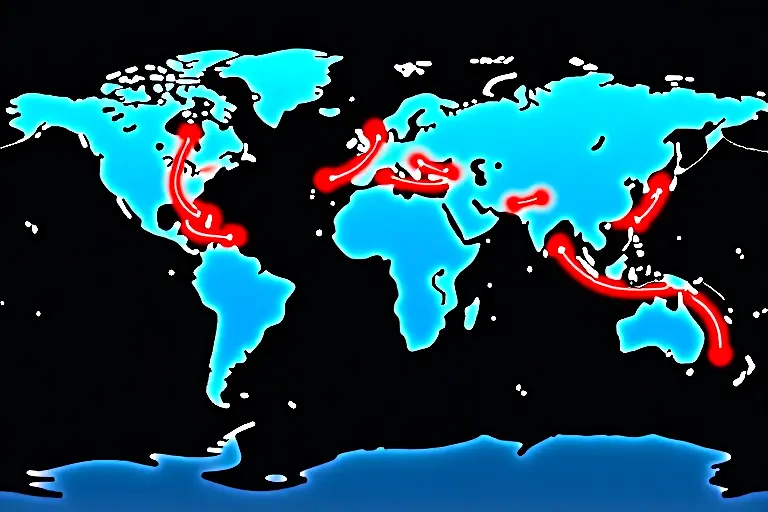
Remove the salt and you lose a major driver of this circulation. The Gulf Stream, which keeps Western Europe about 5°C warmer than it would otherwise be, weakens or stops entirely. Britain's climate shifts toward something resembling Labrador, Canada, which sits at the same latitude. Average January temperatures in London drop from 5°C to around -10°C.
The tropics, meanwhile, overheat. Without cold deep water being pulled up from the abyss (a process called upwelling), tropical surface waters get warmer. Warm water holds less dissolved oxygen. Marine dead zones expand, though by this point there's not much left to kill.
The drinking water question
You might think freshwater oceans would solve the global water crisis. About 2.2 billion people worldwide lack reliably safe drinking water. If the oceans turned fresh, wouldn't that fix everything?
Not really. Ocean water, even without salt, would still contain bacteria, microplastics, industrial runoff, and dissolved minerals. It would need treatment before drinking, same as river water. The infrastructure to pump, treat, and distribute ocean water to inland populations doesn't exist and wouldn't spontaneously appear just because the salt vanished.
Coastal communities could potentially drink it after basic filtration. That's a genuine improvement for some parts of the world. But the catastrophic ecological collapse and climate disruption happening simultaneously would make the drinking water benefit somewhat academic.
Agriculture after the change
Coastal aquifers worldwide are threatened by saltwater intrusion, where rising sea levels push salt water into underground freshwater supplies. Freshwater oceans would eliminate this problem permanently. Farmland currently being ruined by salinisation would recover over years as rainwater flushed the residual salt from soil.
But the weather disruption would offset this. Changed rainfall patterns would flood some agricultural regions and dry out others. The collapse of thermohaline circulation would shift climate zones, making currently productive farmland too cold and currently frozen land potentially arable. It would take decades for agriculture to adapt, and billions of people would face food shortages in the interim.
The fishing industry simply ceases to exist. Roughly 3.3 billion people rely on fish as a primary protein source. Almost all commercial marine species would be dead within the first month. Freshwater fish species might eventually colonise the former oceans, but "eventually" means centuries, and the ocean's ecology would look nothing like what came before.
A quieter loss
There's something people don't mention about this scenario. The sea wouldn't smell the same. That sharp, mineral tang you get standing on a beach in winter, the one that makes you breathe deeper without thinking about it, comes from dimethyl sulphide released by marine algae and from the salt spray itself. Freshwater coasts would smell like lakes. Clean and flat and oddly bland.
The ocean would lose its taste, its bite, its character. Swimming in it would feel wrong in a way that's hard to articulate. You'd float lower in the water because of the reduced density. The waves would behave slightly differently, breaking faster and with less weight behind them.
World Oceans Day, celebrated on the 8th of June, would become something closer to a memorial. Here is the largest habitat on Earth, and we are marking the anniversary of its death.