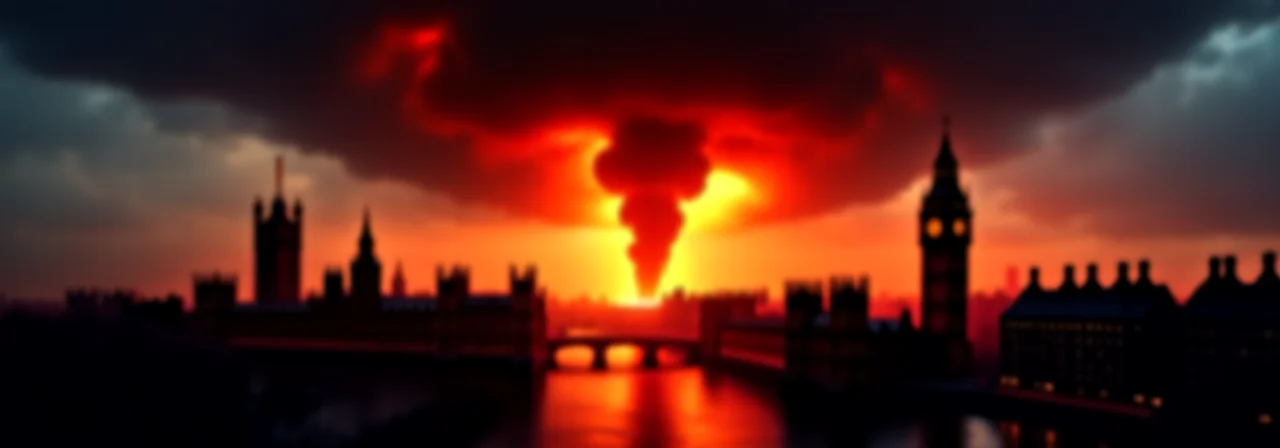
There is no volcano under London. The geology of southeast England is about as volcanically active as a librarian's desk drawer. The bedrock is chalk, clay, and sandstone, laid down in warm shallow seas over millions of years. The nearest volcanic rock in Britain is in Edinburgh, and that's been extinct for 340 million years.
But we're not here for geological accuracy. We're here to put a supervolcano under the Houses of Parliament and see what happens.
What "super" means
A supervolcano is classified as any eruption measuring 8 on the Volcanic Explosivity Index, meaning it ejects more than 1,000 cubic kilometres of material. For reference, the 1980 Mount St. Helens eruption ejected about 1 cubic kilometre. Krakatoa in 1883 ejected about 25. A supervolcano is in a different category entirely.
The most recent supervolcanic eruption on Earth was Toba, in Sumatra, about 74,000 years ago. It ejected roughly 2,800 cubic kilometres of rock and ash. Some researchers believe it reduced the global human population to as few as 10,000 individuals. Others dispute that figure, but nobody disputes that it was very, very bad.
Put that under London.
The warning signs (ignored)
Supervolcanoes don't erupt without precursors. Yellowstone, the most monitored potential supervolcano, shows ground uplift, increased seismic activity, and changes in gas emissions years or decades before any hypothetical eruption. If a magma chamber were forming under London, the British Geological Survey would detect it.
They'd detect it, report it, and then everyone would argue about what to do for so long that it wouldn't matter. Planning permission for the evacuation route would take six years and face opposition from three residents' associations and a listed building trust.
I'm joking. Mostly.
In reality, the warning period for a supervolcanic eruption might be months to years. Long enough to evacuate if you started immediately. But evacuating London means moving 9.7 million people, plus the 1.3 million who commute in daily. Greater London covers 1,572 square kilometres. The road network, even at full capacity, can move about 500,000 vehicles per hour out of the city. At average occupancy of 1.5 people per car, that's 750,000 people per hour. Full evacuation would take a minimum of 13 hours assuming perfect traffic flow.
Traffic flow in London is never perfect. It would take days.
The eruption
The ground beneath Westminster buckles upward. The Thames, already a tidal river that rises and falls by 7 metres twice daily, is pushed out of its banks as the riverbed lifts. Then the surface breaks.
A supervolcanic eruption doesn't look like a Hollywood volcano. There's no neat cone with lava flowing picturescently down the sides. The ground collapses inward as the magma chamber empties, forming a caldera, a vast depression kilometres across. Everything above the chamber drops into the void.
The initial blast column reaches the stratosphere within minutes. Temperatures at the eruption site exceed 1,000°C. The Thames doesn't boil. It vaporises. Parliament, Buckingham Palace, the London Eye, Westminster Abbey: not destroyed in the conventional sense. The ground they sit on simply no longer exists. It's been replaced by a hole full of magma.
The pyroclastic flows come next. These are superheated clouds of gas, ash, and rock fragments travelling at 300-700 km/h with temperatures of 200-700°C. They hug the ground. You cannot outrun them. You cannot shelter from them in a building. They will go through windows, under doors, and around obstacles. Everything organic in their path burns or suffocates.
The radius of total destruction depends on the eruption's energy, but for a VEI-8 event, pyroclastic flows could extend 100 kilometres from the caldera. That circle includes most of southeast England. Reading, Brighton, Canterbury, Cambridge: all within the kill zone.
The ash
This is what gets the rest of the country.
A supervolcanic eruption puts 1,000+ cubic kilometres of ash into the atmosphere. Prevailing winds in England blow roughly west to east, which means the ash plume drifts toward the North Sea and continental Europe. But ash doesn't just travel horizontally. It goes up into the stratosphere and spreads globally.
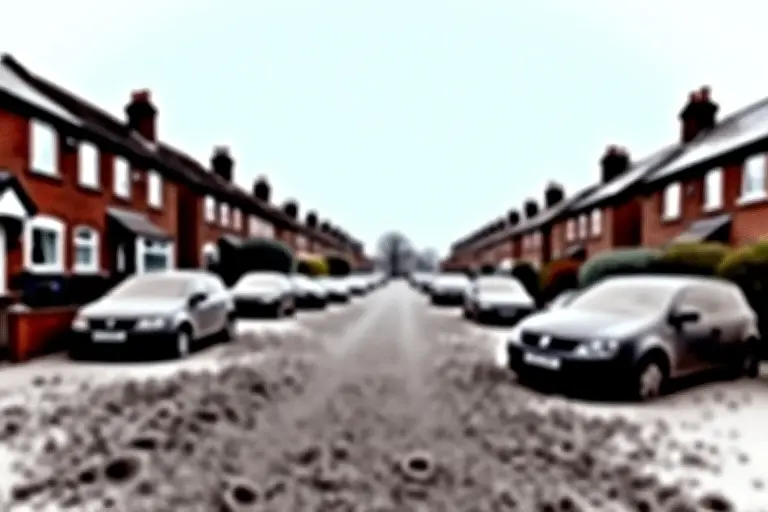
Within the first day, a thick blanket of ash falls on everything east of the eruption site. Several centimetres of volcanic ash will collapse roofs. It clogs engines, poisons water supplies, shorts out electrical systems, and suffocates anyone breathing it without a mask. Norfolk, Suffolk, Essex, and Kent get buried.
Birmingham, Manchester, and the Midlands get a thinner coating, but enough to ground all aircraft, clog motorways, and make outdoor activity dangerous. Scotland and Wales, further from the plume's main path, get less but still enough to disrupt everything.
Continental Europe gets hit within 24-48 hours. The Netherlands, Belgium, northern France, and western Germany receive significant ash fall. Charles de Gaulle Airport closes. Schiphol closes. Every airport in northern Europe closes. Air travel across the entire Northern Hemisphere is disrupted for weeks, as the 2010 Eyjafjallajokull eruption (a comparatively tiny VEI-4) demonstrated when it grounded European flights for six days.
The climate aftermath
Volcanic ash and sulphur dioxide in the stratosphere reflect sunlight back into space. The Toba eruption is estimated to have caused a global temperature drop of 3-5°C lasting several years. A London supervolcano would do something similar.
Global average temperatures fall by 3-5°C within months. That doesn't sound like much until you consider that the difference between now and the last Ice Age was about 6°C. A 5°C drop means failed harvests across the Northern Hemisphere. Growing seasons shorten by weeks. Frost arrives in July. The wheat crop fails across Europe. Rice yields crash across Asia.
Famine follows. Not localised food shortages that can be addressed with aid. Global, systemic failure of agriculture lasting two to five years. The volcanic winter would be the single worst food crisis in recorded history, affecting every country on Earth regardless of how far they are from London.
What's left of Britain
Southeast England is gone. Not damaged, not ruined. Gone. A caldera roughly 30-50 kilometres across occupies what was once the most densely populated part of the country. The Thames Valley is a volcanic wasteland. Heathrow, Gatwick, the M25 corridor, the City of London, Canary Wharf: all destroyed or buried.
The death toll is difficult to estimate because it depends entirely on evacuation success. If the eruption happens without warning, 10-15 million people die in the first hour. With a successful evacuation over several months, the direct death toll might be in the tens of thousands (those who refused to leave, those who couldn't, those caught in the pyroclastic zone during the final phase).
But the indirect deaths from ash fall, infrastructure collapse, and global famine would dwarf the direct toll. We're talking about a global event that reshapes weather patterns, destroys agricultural capacity, and disrupts supply chains for years. The total global death toll, over the following decade, could reach hundreds of millions.
Britain's capital would need to relocate. Manchester is the obvious candidate: large enough, far enough north, already has significant infrastructure. Or Edinburgh, if Scotland remains part of the United Kingdom after the English capital literally exploded. (The independence referendum would write itself.)
The geography of southern England would be permanently altered. Maps redrawn. The caldera would eventually fill with water, creating a vast lake where London used to be. Give it a few thousand years, some forest regrowth, and it would be rather beautiful. Cold comfort for anyone alive to see the transition.