There are roughly 26.5 million cubic kilometres of ice on Earth right now. Most of it is in Antarctica (26.5 million km³), with Greenland holding about 2.85 million km³ and the rest scattered across mountain glaciers and ice caps from the Himalayas to Patagonia. This ice represents about 69% of the world's fresh water, locked up in solid form, doing nothing except keeping sea levels where they are.
Melt it all. Not over centuries, which is the trajectory we're currently on. Instantly. Every glacier, ice sheet, ice cap, and frozen everything, liquid in an afternoon.
Sixty-five metres
That's the number. If all land ice melts, global sea levels rise approximately 65 metres. Not 65 centimetres, which would already be catastrophic. Sixty-five metres. A 21-storey building, submerged to the roof.
The "instantly" part makes this scenario different from the gradual melt projections that climate scientists model. Gradual melting over centuries gives populations time to migrate, build sea defences, abandon coastlines in a somewhat orderly fashion. Instant melting gives you an afternoon.
The water doesn't arrive as a tsunami. It's not being propelled by anything. It's just suddenly there: 26.5 million cubic kilometres of new liquid water added to the oceans, which then redistribute according to gravity. Low-lying areas flood first. The water finds its level, and that level is 65 metres higher than it was this morning.
What drowns
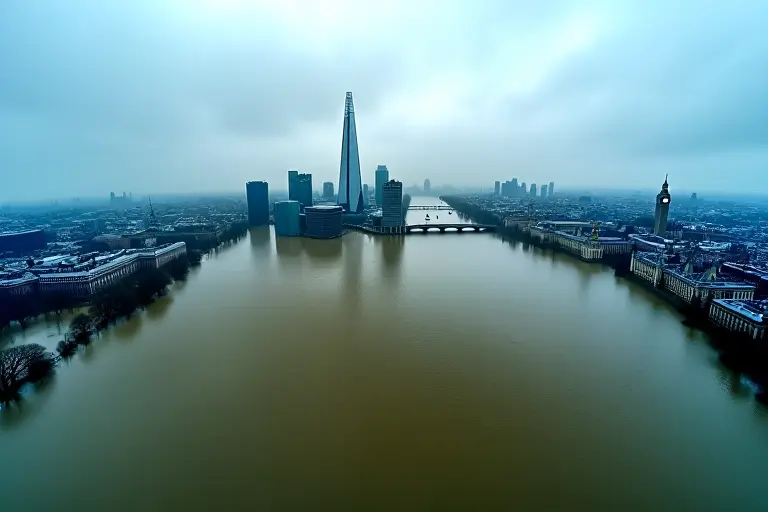
London. The Thames Barrier was designed to handle a storm surge of a few metres. Sixty-five metres puts central London under roughly 50 metres of water. The top of Nelson's Column, which stands 51.6 metres tall in Trafalgar Square, would be just visible above the surface. Everything else, the Houses of Parliament, Buckingham Palace, the entire Tube network, is submerged.
New York. Manhattan's average elevation is about 10 metres. The Statue of Liberty stands on a pedestal 47 metres above sea level. She'd be chest-deep. Wall Street, Times Square, Central Park: all underwater. The only parts of New York visible would be the upper floors of skyscrapers, sticking out of the ocean like steel reeds.
Shanghai, population 24 million, average elevation 4 metres. Gone entirely.
Dhaka, population 22 million, average elevation 8 metres. Gone.
Amsterdam, Mumbai, Miami, Bangkok, Ho Chi Minh City, Lagos, Tokyo's eastern wards, Venice (obviously), Copenhagen, Buenos Aires, Kolkata, Osaka. All either completely submerged or reduced to scattered hilltops.
About 40% of the world's population lives within 100 kilometres of a coastline. A significant fraction of those people live below 65 metres elevation. We're talking about displacing somewhere between one and two billion people in a single day.
The new coastlines
The map of the world becomes unrecognisable. Florida ceases to exist. Not partially. Entirely. The highest point in Florida is Britton Hill at 105 metres, which survives as a small island. The rest of the state, all 170,000 square kilometres of it, is seafloor.
The Netherlands vanishes. Denmark loses most of its landmass. Bangladesh, already flood-prone, becomes a shallow sea with occasional hills. The Amazon basin fills partially with seawater, creating an enormous inland sea across northern Brazil. The UK loses East Anglia, the Somerset Levels, most of Lincolnshire, and the entire Thames estuary. Scotland's Highlands survive comfortably. The Central Belt becomes coastal property.
Australia loses its coastal cities but, being largely elevated desert, keeps most of its landmass. Russia gains an enormous amount of new coastline as the Arctic regions, no longer frozen, meet the rising seas. Canada's Hudson Bay expands dramatically inland.
The fresh water problem
Here's something people miss. All that ice was fresh water. When it melts into the ocean, it dilutes the salinity. The ocean's average salinity is about 35 parts per thousand. Adding 26.5 million cubic kilometres of fresh water reduces that significantly.
Ocean currents are driven partly by temperature differences and partly by salinity differences. The thermohaline circulation (the global conveyor belt that moves warm water from the tropics to the poles and cold water back) depends on dense, salty water sinking in the North Atlantic. Dilute the salt and the whole system stalls.
If the thermohaline circulation collapses, Europe loses its heating system. The Gulf Stream, which keeps Britain roughly 5°C warmer than its latitude would suggest, weakens or stops. Britain's climate becomes more like Labrador's, which sits at the same latitude: harsh winters, cool summers, none of the mild dampness that makes British agriculture viable.
The irony of all the world's ice melting is that parts of the world get colder.
Antarctica without ice
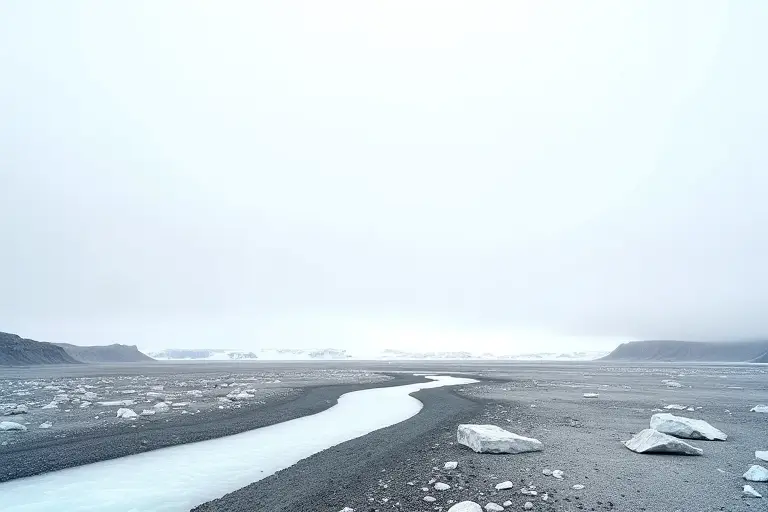
Strip Antarctica's ice sheet away and you reveal a continent nobody has seen. Beneath the ice, Antarctica has mountain ranges, valleys, and basins that have been buried for 34 million years. Some of those basins sit below sea level (pressed down by the weight of the ice above them), so the revealed continent would actually be smaller than the ice sheet suggested, with seawater filling the low points.
Over thousands of years, the land would rebound. It's called post-glacial rebound: remove the ice and the Earth's crust slowly rises, like a mattress after you get out of bed. Scandinavia is still rising from the last Ice Age at about 1 centimetre per year. Antarctica would do the same, but the full rebound would take 10,000 years or more.
In the meantime, you'd have a rocky, barren continent with no soil, no vegetation, and no ecosystem, surrounded by a suddenly warmer Southern Ocean. Colonisable in theory. Useful for mining, probably, given the mineral deposits geologists suspect are down there. Habitable in any pleasant sense? Not for a very long time.
Could we actually survive this
As a species, yes. Humans are tenacious and most of the planet's landmass is above 65 metres elevation. The interior of continents, mountain regions, and elevated plateaux would be fine. Switzerland, Bolivia, Ethiopia, Mongolia: all more or less unaffected by direct flooding.
But the indirect effects would be devastating. Most of the world's food production happens on coastal plains and river deltas. The infrastructure of civilisation (ports, power plants, refineries, data centres, roads, railways) is overwhelmingly coastal. You'd lose it all in a day, and rebuilding it inland would take decades.
Roughly a billion people would need to move somewhere, immediately, with nothing. The refugee crisis would dwarf anything in recorded history by several orders of magnitude. Entire nations would cease to exist as geographic entities. The political consequences of that are beyond prediction.
The ice melting slowly, over centuries, is already one of the defining challenges of this century. The ice melting all at once is the kind of catastrophe that makes you grateful for the boring, incremental version of the problem.