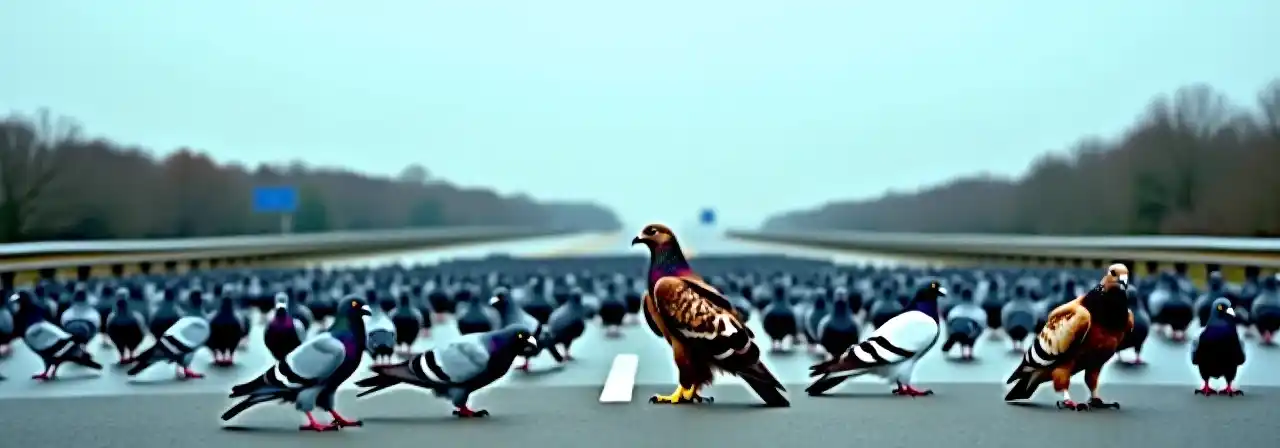
There are roughly 50 billion wild birds on Earth. About 40 billion of them can fly. Tomorrow morning, none of them can.
Not injured. Not grounded by weather. Their wings simply stop generating lift. Feathers intact, muscles working, bones as hollow as ever. They flap and nothing happens. A pigeon launches off a rooftop ledge and drops like a phone off a balcony.
The first morning
Dawn is when you'd notice. Birdsong doesn't stop (their throats still work), but the sky is wrong. Empty. No starlings wheeling over the pier. No crows riding thermals above the motorway. The swifts that haven't landed in three years crash into whatever is below them at the moment their wings fail.
Common swifts spend virtually their entire lives airborne. They eat, sleep and mate on the wing. A swift that can't fly isn't a grounded bird. It's a dead one. Their legs are so short they can't take off from flat ground even in normal circumstances.

Raptors fare badly too. A golden eagle weighs about 5 kilograms and hunts by diving at speeds over 240 kilometres per hour. On the ground, it's an awkward, slow, angry thing with talons designed to grip prey from above, not chase it across a field. Eagles become the world's most overqualified pedestrians.
Who's suddenly fine with this?
Penguins. Ostriches. Emus. Kiwis. Cassowaries.
The flightless birds don't lose a thing. Penguins have been wadding along for 60 million years without air travel and they've done perfectly well. In fact, their competitive position just improved enormously. An emperor penguin can outswim any fish in Antarctica and out-endure most predators. Nothing about this scenario changes their day.
Ostriches, meanwhile, become the apex bird. They already run at 70 km/h. They already kick hard enough to kill a lion. The only birds that outcompeted them before were the ones overhead, and those are now walking.
I think penguins would feel vindicated if they could feel anything beyond cold and hunger.
The insect explosion
This is the part that actually matters, and it gets bad quickly.
A single barn swallow eats about 850 insects per day. There are an estimated 190 million barn swallows. That's over 160 billion insects eaten daily by one species alone. Scale that up to every insectivorous bird on the planet and you're looking at something like 400 to 500 million tonnes of insects consumed per year. That number comes from a 2018 study in The Science of Nature, and it's conservative.
Take away aerial hunting and most of that predation vanishes overnight. Birds that eat insects on the ground (robins pecking at worms, thrushes cracking snails) still manage. But the species that catch flies mid-air, snatch mosquitoes at dusk, and hoover up aphids from crop canopies? They're now standing in fields looking confused.
Within weeks, flying insect populations would balloon. Mosquitoes, midges, crop-eating moths, locusts. The species kept in check by billions of airborne predators would breed unchecked.

Agriculture collapses second
Not immediately. But faster than you'd expect.
Birds are one of the main natural pest controls for farming. Without them catching caterpillars, beetles and aphids, insecticide use would have to increase enormously. In regions where farmers can't afford chemicals (which is most of the developing world's smallholders), crop losses would spike within a single growing season.
Pollination takes a hit too. Hummingbirds pollinate roughly 7,000 plant species across the Americas. Without them hovering at flowers, those plants rely entirely on insect pollinators, which are simultaneously exploding in number but not necessarily the right species. You get more mosquitoes, not more bees.
And seed dispersal. Fruit-eating birds spread seeds across vast distances. A mistle thrush eats berries in one woodland and deposits the seeds five miles away. Without flight, that network of seed movement compresses to however far a bird can walk. For most species, that's not far at all.
The predators adjust
Cats would have the time of their lives. Domestic cats already kill an estimated 1.3 to 4 billion birds annually in the United States alone. Ground-bound birds are simply easier prey. Your neighbour's tabby goes from occasional bird-murderer to full-time one.
Foxes, rats, stoats and snakes would likewise feast. Ground-nesting birds already lose eggs and chicks to these predators. Now tree-nesting birds have the same problem, because their chicks can't fledge. A baby robin that leaves the nest is just falling.
The predator population spikes. Then, once the easy bird prey is mostly gone, it crashes. Classic boom-and-bust.
Cities get strange
Pigeons walking everywhere. That's the image. Not flying in startled bursts when you walk through Trafalgar Square, but milling about on foot like confused tourists. They'd survive, probably. Pigeons are already ground feeders, scrounging chips and bread. They'd just become slower, fatter and more vulnerable.
Seagulls, though. A herring gull is aggressive, large and territorial. On the ground, in groups, fighting over bins? Coastal towns would feel like a low-budget horror film. They already steal sandwiches; now they'd have to mug you at ankle height.
Window strikes cease entirely, which is something. An estimated 600 million birds die annually from hitting glass in the US. That number drops to zero. Small consolation when the entire aerial ecosystem has collapsed, but still.
Migration ends
The Arctic tern migrates 71,000 kilometres per year, pole to pole. It simply can't do that on foot. Neither can any long-distance migrant. The bar-tailed godwit, which flies 11,000 kilometres non-stop from Alaska to New Zealand, would never leave Alaska.
Seasonal migration disappears. Birds that depend on wintering in warmer climates die when winter comes and they haven't left. Birds that depend on summer breeding grounds in the Arctic never arrive. Entire species vanish within a year, not from the grounding itself, but from being trapped in the wrong place at the wrong time.
Long-term
Within a decade, most small flying bird species are extinct or nearly so. Ground predation, habitat loss from inability to disperse and the collapse of migration patterns would wipe out thousands of species. The larger ground-adapted birds survive. Corvids might adapt (crows and ravens are smart enough to find new strategies). But the warblers, flycatchers, swifts, hummingbirds and raptors are gone.
The world gets louder with insects and quieter with birdsong. Forests change as seed dispersal patterns shift. Fruit trees that relied on birds for reproduction decline. Insect-borne disease rates climb as mosquito populations grow unchecked.
And somewhere in Antarctica, a penguin stands on a rock, looking exactly the same as it did before any of this happened, completely unaware that it is now the most successful bird body plan on the planet.