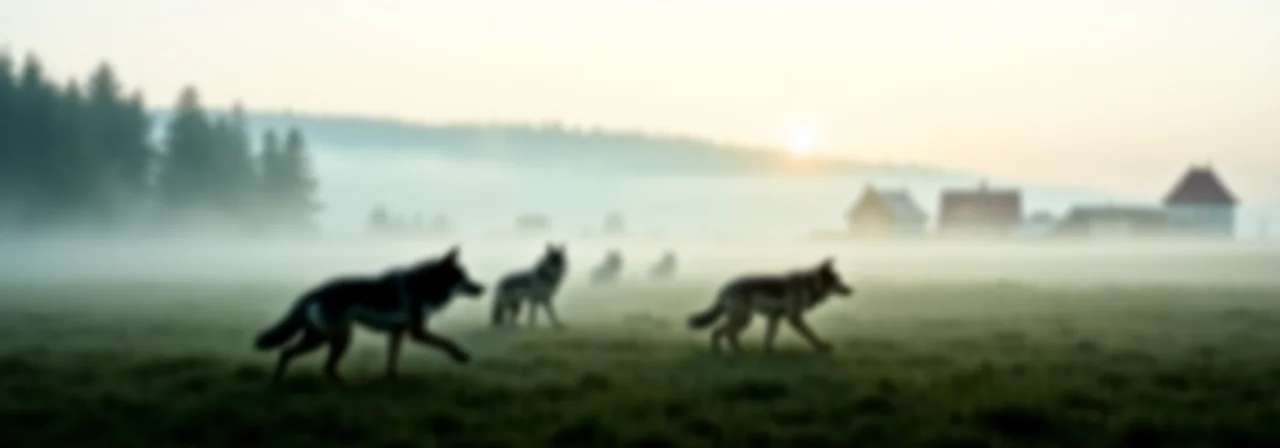
In 1995, fourteen grey wolves were released into Yellowstone National Park after a seventy-year absence. Within two decades, the entire ecosystem had visibly changed. Elk herds, no longer free to graze riverbanks without fear, moved to higher ground. Vegetation recovered along waterways. Root systems stabilised the soil. Rivers that had been widening and meandering for decades began to narrow and deepen. Songbird populations increased. Beaver colonies returned. The wolves changed the rivers.
This process is called a trophic cascade, and it is one of the most striking demonstrations in ecology that everything is connected to everything else. The question is: what happens if you repeat it across an entire continent?
Europe's missing predator
Wolves once roamed from Portugal to the Urals. By the mid-twentieth century, systematic extermination had wiped them from most of Western Europe. Britain killed its last wolf sometime in the 1680s. Ireland lost its wolves by 1786. France, Germany, the Netherlands, Denmark, Austria, Switzerland: all wolf-free by the early 1900s.
The reasons were practical. Wolves killed livestock. Farmers, understandably, killed wolves. Governments paid bounties. The programme was efficient and thorough and it worked exactly as intended. Europe got what it wanted: a continent without apex predators.
The consequences took longer to notice.
What happened to the deer
Without wolves, deer populations across Europe exploded. Red deer in Scotland, roe deer in England, fallow deer across the continent. Germany alone has an estimated deer population of around 3.5 million. These animals eat young trees. Relentlessly. A single red deer can strip the bark from a sapling in minutes. Multiply that by millions of deer across millions of hectares and you get forests that can't regenerate.
This is visible across the Scottish Highlands. Vast treeless expanses that look natural and ancient are actually the result of overgrazing. The Caledonian Forest, which once covered much of Scotland, has been reduced to scattered fragments. New trees sprout, get eaten, die. The forest hasn't been able to replace itself for centuries. Not because the climate changed, or the soil failed, but because nothing is eating the things that eat the trees.
Reforestation projects in Scotland spend enormous sums on deer fencing. Literally building walls around saplings to stop deer from destroying them. This works, but it's expensive, labour-intensive, and fundamentally absurd. We're paying to do what wolves used to do for free.
The cascade
Introduce wolves to Europe's forests and the Yellowstone effect begins. Deer change their behaviour before the wolves even reduce their numbers significantly. The ecology of fear matters as much as actual predation. Deer avoid lingering in open riverbanks and valley floors where they're exposed. They move more, graze less intensively, and abandon areas where wolf packs are active.
Vegetation recovers in the vacated zones. Willows, aspens, and birches grow past the browse line. Their roots hold soil in place. Erosion slows. Streams become narrower and more defined. Wetlands reform where water is held by vegetation instead of running freely over bare ground.
Insects return to the new growth. Birds follow the insects. Small mammals find cover in the undergrowth. Raptors find the small mammals. Each link in the chain strengthens the next. A continent that has been ecologically simplified for three hundred years starts to regain some of its original complexity.
The farming problem
None of this happens without conflict, and the conflict is straightforward. Wolves eat sheep. They eat cattle. They eat goats. A single wolf can kill dozens of sheep in a year if flocks are unprotected, and European sheep are profoundly unprotected. They've had three centuries without predators. They stand in open fields at night with no guardian animals, no shepherds, and no fear whatsoever.
France offers a preview. Wolves naturally recolonised the French Alps from Italy starting in the 1990s, and the response from sheep farmers has been furious. Roughly 12,000 livestock kills per year are attributed to wolves in France, though the actual number is contested in both directions. The government pays compensation. Farmers say it's not enough. Conservation groups say farmers exaggerate losses. Everyone is angry.
Scaling this to the entire continent means millions of livestock owners adapting simultaneously. Guard dogs, night shelters, electric fencing, shepherd employment. These measures work. They've been proven effective in Spain, Romania, and Turkey, where wolves and farming coexist because they never stopped coexisting. But they cost money, and they require farmers to change practices that have been standard for generations.
In Britain, where sheep farming is already economically marginal (many hill farms survive on government subsidies rather than wool or meat revenue), the additional cost of wolf-proofing could push farms into unviability. Whether that's an argument against wolves or against subsidising unviable farms depends on who you ask.
The public reaction
Wolves occupy a peculiar position in the European imagination. In reality, wolf attacks on humans are vanishingly rare. Between 2002 and 2020, across all of Europe, there were precisely zero fatal wolf attacks on humans. You are orders of magnitude more likely to be killed by a cow, a horse, a dog, or a vending machine.
But folklore doesn't care about statistics. Wolves are the villain in fairy tales that every European child grows up hearing. They eat grandmothers. They blow houses down. They lurk in dark forests waiting for the naive and the lost. Centuries of extermination were driven partly by genuine agricultural damage and partly by a cultural fear that long outlived any rational basis.
Public opinion polls across Europe show a rough split. Urban populations tend to support wolf reintroduction. Rural populations tend to oppose it. The people who want wolves are largely the people who won't live near them.
This is not a trivial observation. Conservation imposed by cities on countryside breeds resentment that can poison the entire project. Sweden and Norway have both experienced illegal wolf kills by farmers who view the animals as a threat imposed on them by distant bureaucrats. Any European-wide reintroduction would need rural communities on board, not merely overruled.
What the land would look like
Give it fifty years. Wolves establish territories across the continent's forests and uplands. Deer numbers fall by perhaps 30 to 40 percent. The surviving deer are warier, more mobile, less destructive. Forests that haven't successfully regenerated in living memory start filling in.
The Scottish Highlands grow trees again. The bare hillsides that tourists photograph as "wild Scotland" become woodlands. This changes the scenery aesthetically, which will annoy people who liked the view, and ecologically, which will benefit essentially everything that lives there.
Flooding reduces. Upland forests slow rainwater runoff, reducing peak flows in rivers downstream. A 2020 study in the journal Ecological Engineering estimated that woodland restoration on just 5% of British uplands could reduce peak river flows by up to 29%. Wolves don't prevent floods. But the forests that grow because of wolves do.
Carbon storage increases. Mature woodland stores significantly more carbon per hectare than overgrazed grassland. Europe's climate targets become marginally easier to meet, not because of any technological fix, but because someone let the wolves back in and the forests did the rest.
The ecological argument is strong. The political argument is a mess. And the gap between those two things is where the wolves will wait, as they've waited for three hundred years, for humans to make up their minds.