The Amazon River discharges roughly 209,000 cubic metres of freshwater into the Atlantic Ocean every second. That's about 20% of all the river water entering the world's oceans. It pushes so much freshwater so far offshore that you can drink from the surface of the sea up to 160 kilometres from the coast. Ships in the Age of Exploration reportedly filled their water barrels from the "sweet sea" before realising they'd found the mouth of a river.
Now reverse it.
Which way is backwards?
The Amazon flows from west to east, from the Andes to the Atlantic, for a good reason. The Andes are high and the Atlantic is low. Water goes downhill. To reverse the Amazon, you need to reverse the gradient of the entire northern half of South America. The Andes become a low basin. The Brazilian coast rises into a mountain range. Or, if you prefer something more dramatic, a geological event tilts the continent like a dinner tray.
Either way, 6.9 million square kilometres of drainage basin now feed the river in the wrong direction. Water from the Andes that used to flow east toward the Atlantic now flows west toward the Pacific. Except the Pacific coast of South America is very close to the Andes, with almost no coastal plain. So the reversed Amazon would have to punch through or around the mountain range to reach the ocean.
This is already geologically absurd. Good. Let's continue.
The Atlantic starves
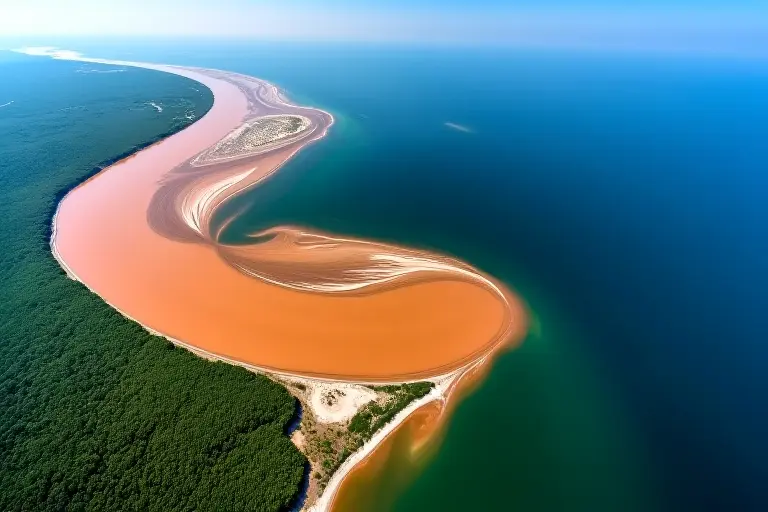
The immediate casualty is the Atlantic Ocean's freshwater balance. The Amazon is the largest single freshwater input to the Atlantic. Remove it and you alter the salinity of the tropical Atlantic measurably. The plume of fresh water that currently extends hundreds of kilometres offshore disappears. Surface salinity increases. The ecosystem that thrived in that brackish zone, including coral reefs, fish nurseries and plankton blooms fed by Andean nutrients, collapses.
The Amazon River carries about 1.3 billion tonnes of sediment into the Atlantic annually. That sediment builds coastlines, feeds mangroves, and extends into submarine fans on the ocean floor. Cut the supply and the coastline of northeastern Brazil begins to erode. Mangrove forests that depend on river sediment starve and recede. The Marajó island at the river's current mouth, roughly the size of Switzerland, gradually dissolves as the ocean takes back what the river built.
Further afield, the Amazon's freshwater discharge affects the Atlantic Meridional Overturning Circulation, the vast conveyor belt of ocean currents that carries warm water northward and moderates European climate. The relationship is complex, but models suggest that Amazon outflow helps maintain the density gradients that drive the circulation. Reduce it and the AMOC weakens. European winters get colder. Not ice-age cold, but noticeably, persistently colder. London gains a climate closer to Labrador's than Paris's.
The rainforest dries out
The Amazon rainforest generates about half of its own rainfall through transpiration. Trees pull water from the soil, release it through their leaves, it forms clouds, it rains again further west. This cycle, called "flying rivers" by Brazilian climatologist Antonio Nobre, moves moisture across the continent like an atmospheric conveyor belt.
Reverse the river and you reverse the drainage. The water table drops in the eastern Amazon as groundwater that used to flow eastward now flows west. The eastern forest, deprived of its usual water supply, enters drought stress. Trees shed leaves. Canopy thins. Fires, already a growing problem in the real Amazon, become devastating. The flying rivers weaken because there are fewer trees to pump moisture into the atmosphere.
The western Amazon, receiving all the new water flow, floods catastrophically. The Peruvian and Ecuadorian lowlands become a permanent swamp. Species adapted to seasonal flooding now face permanent inundation. Terrestrial mammals drown or flee to higher ground. The forest canopy, which evolved for a specific flooding regime, can't adapt fast enough. Trees that can tolerate two months of flooding per year die when it becomes twelve.
Within a decade, the Amazon rainforest is unrecognisable. The eastern half is dying. The western half is drowning. The biodiversity crisis is orders of magnitude worse than current deforestation, because at least deforestation leaves pockets. A reversed water table kills everything simultaneously.
The Pacific gets a new giant
If the reversed Amazon reaches the Pacific (and it's hard to see how, given the Andes, but we're committed), the Pacific coast of South America transforms. Peru and Ecuador currently have arid coastlines. The Atacama Desert in Chile is the driest place on Earth. A massive freshwater river system emptying onto this coast would turn desert to wetland over decades.
The Humboldt Current, the cold, nutrient-rich upwelling that supports one of the world's most productive fisheries off the coast of Peru, would be disrupted by a massive freshwater influx. The anchovy fishery, which at its peak in the 1960s produced 10 million tonnes per year and was the largest single-species fishery in history, would collapse. Peru's economy, heavily dependent on fishing and fish meal exports, would be devastated.
But new ecosystems would emerge. Where the river meets the Pacific, a vast delta would form, building outward with Andean sediment that used to go to the Atlantic. Mangroves would colonise. Fish species from the Amazon basin would reach salt water for the first time and either adapt or die. The Pacific coast of South America would become, over centuries, as biologically rich as the current Amazon basin mouth. Just with completely different species.
The human cost
Roughly 30 million people live in the Amazon basin. Most settlements sit on or near the river and its tributaries. A reversal doesn't just change which way the water flows. It changes where the water is. Towns built on riverbanks that have been stable for centuries suddenly find themselves on the wrong side of the current, or above a river that's draining away, or below one that's rising.
Manaus, the largest city in the Amazon interior, has 2.2 million people. It sits at the confluence of the Rio Negro and the Solimões. Reverse the flow and Manaus is either flooded by water that can't drain eastward any more, or stranded above a dropping river depending on the local topography. Either way, the city is uninhabitable within months.
Belém, at the current river mouth, population 1.5 million, loses its river entirely. The economic foundation of the city, port trade, fishing, river transport, vanishes. Belém becomes a coastal city with no river, watching its harbour silt up with the last of the sediment before the current stops bringing more.
Could it actually happen?
It did, once, sort of. About 10 million years ago, the Amazon flowed westward into a vast inland lake in what is now western Amazonia. The rise of the Andes eventually blocked this route and the river reversed to its current eastward path. It took millions of years. The geological forces involved are slow, patient and enormously powerful.
A sudden reversal, the kind that makes for a good thought experiment, would require the sort of tectonic event that hasn't happened on Earth in recordable time. It would probably also involve earthquakes that would make the river's direction the least of anyone's concerns.
But the exercise is useful because it shows how much a single river does. The Amazon isn't just a body of water. It's a climate system, an ecosystem engine, a sediment delivery network, and a freshwater regulator for an entire ocean. Take it away from the Atlantic and you don't just lose a river. You lose the weather patterns it generates, the coastlines it builds, the ocean currents it influences, and the rainforest it sustains. One river, and half a continent's ecology hangs on which direction it flows.