
Somewhere in the North Atlantic right now, an enormous river of warm water is flowing northeast from the Gulf of Mexico toward Europe. It carries roughly 1.4 petawatts of thermal energy, which is about 100 times the entire world's electricity consumption. This is the Gulf Stream, and it is the reason London has mild winters while Labrador, at the same latitude, is buried under ice from November to April.
Now switch it off.
What ocean currents actually do
The global ocean circulation system works like a conveyor belt. Warm surface water flows from the tropics toward the poles, where it cools, becomes denser, sinks to the deep ocean, and creeps back toward the equator along the seafloor. This process is called thermohaline circulation, driven by temperature and salinity differences. One complete loop takes roughly a thousand years.
It redistributes heat. Without it, equatorial regions would be significantly hotter and polar regions significantly colder. The temperature difference between the equator and the poles would widen by an estimated 10 to 15 degrees Celsius.
But heat transport is only part of the job. Ocean currents also carry nutrients. Cold, deep water is rich in nitrogen, phosphorus, and iron. When currents bring this water to the surface (a process called upwelling), it feeds phytoplankton blooms that form the base of the marine food chain. About half the oxygen you're breathing right now was produced by ocean phytoplankton. They need those nutrients.
Europe gets cold
The most immediate and dramatic effect would hit Western Europe. The Gulf Stream and its extension, the North Atlantic Drift, are responsible for keeping the British Isles, Scandinavia, and coastal Western Europe 5 to 10 degrees warmer than their latitude suggests. Without it, average temperatures in the UK would drop to match those of central Canada.

Edinburgh is at the same latitude as Moscow. The only reason Edinburgh doesn't feel like Moscow is warm Atlantic water. Remove that water and Scottish winters would regularly hit minus 20. London would see sustained sub-zero temperatures for months. The Thames would freeze solid, which it used to do when the Little Ice Age weakened Atlantic circulation in the 17th century. They held frost fairs on it back then. This time, there would be nothing to celebrate.
Agriculture across Northern Europe would fail within two or three growing seasons. Crops bred for mild, wet British conditions cannot survive a continental climate. Wheat, barley, rapeseed: gone. The UK imports about 46% of its food already. That percentage would climb toward 80 or 90, assuming anyone was willing to sell.
The tropics overheat
While Europe shivers, the equatorial belt has the opposite problem. Ocean currents currently carry enormous amounts of heat away from the tropics. Stop that flow and the heat stays put. Sea surface temperatures in the Caribbean, the Gulf of Guinea, and the western Pacific would climb by several degrees.
Warmer water means more powerful hurricanes. Hurricane intensity is directly linked to sea surface temperature. A rise of even two degrees significantly increases the proportion of storms reaching Category 4 and 5. The Caribbean and Gulf Coast would face a permanent escalation in storm severity. Florida, already barely insurable for hurricane risk, would become genuinely uninhabitable for anyone without concrete walls and steel shutters.
Coral reefs, already bleaching at current temperatures, would die. Not slowly. Quickly. Mass bleaching events that currently happen every few years would become continuous. The Great Barrier Reef, already in critical condition, would be gone within a decade. With it goes the estimated 25% of marine species that depend on reef ecosystems for some part of their life cycle.
The fish disappear
The most productive fishing grounds on Earth sit where cold, nutrient-rich water wells up from the deep. The coast of Peru, the Grand Banks off Newfoundland, the Benguela Current off southwestern Africa. These upwelling zones support fisheries that feed hundreds of millions of people.
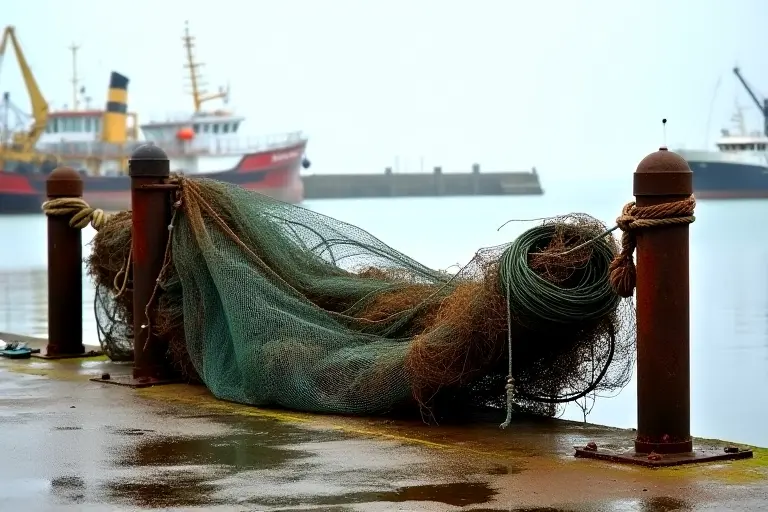
Without ocean circulation, upwelling stops. The nutrients stay locked in the deep ocean. Surface waters become a biological desert: warm, clear, and empty. Phytoplankton populations crash. The zooplankton that eat them crash. The fish that eat the zooplankton crash. The collapse cascades up the food chain in a matter of years.
Global fish catch currently sits at about 80 million tonnes per year. It wouldn't drop to zero, because some coastal and freshwater fisheries would survive. But the open-ocean fisheries that provide the bulk of the world's seafood would effectively cease to exist. For the roughly 3 billion people who depend on fish as their primary protein source, this is a food security catastrophe.
Oxygen production drops
Marine phytoplankton produce between 50 and 80 percent of atmospheric oxygen, depending on which study you read. They need nutrients delivered from the deep ocean by currents. Cut the supply and phytoplankton productivity drops, possibly by half or more.
The atmosphere wouldn't suddenly become unbreathable. There's roughly 1.2 billion billion tonnes of oxygen up there, and even a halving of production would take centuries to meaningfully deplete it. But CO2 absorption would fall in lockstep. Phytoplankton are also the ocean's primary carbon sink, drawing down about 10 billion tonnes of CO2 per year. Less phytoplankton means more CO2 in the atmosphere, which means faster warming, which makes the ocean surface even more stratified and less hospitable to the plankton. A feedback loop with no obvious off-switch.
The dead zones spread
Ocean circulation also ventilates the deep sea. The sinking of cold, oxygen-rich water at the poles delivers dissolved oxygen to the ocean floor, keeping deep-sea ecosystems alive. Without this circulation, the deep ocean gradually becomes anoxic: no oxygen.
This has happened before. During several periods in Earth's history, ocean circulation weakened dramatically. The result was ocean anoxic events, where vast stretches of the deep sea went dead. The sedimentary record shows black shale layers from these periods, rich in organic matter that couldn't decompose because there wasn't enough oxygen. Some of these events are associated with mass extinctions.
The Permian-Triassic extinction, 252 million years ago, killed 96% of marine species. Ocean stagnation and anoxia are considered significant contributing factors. We wouldn't reach that severity quickly. But the trajectory points in that direction.
Could the currents actually stop?
Climate scientists have been worrying about this for decades. The Atlantic Meridional Overturning Circulation (AMOC), the system that includes the Gulf Stream's deep-water component, has measurably weakened by about 15% since the mid-20th century. Greenland ice melt dumps fresh water into the North Atlantic, which is less dense than salt water and doesn't sink as readily. This disrupts the engine that drives the conveyor belt.
A full shutdown is considered unlikely but not impossible. Some models suggest it could happen within this century under high-emission scenarios. A 2024 study in Nature Communications estimated a potential AMOC collapse between 2025 and 2095, though with considerable uncertainty.
The uncomfortable truth is that we don't need a total shutdown for serious consequences. Even a further weakening of 30 to 40 percent would meaningfully shift European climate, disrupt fisheries, and accelerate tropical warming. We might not get the Hollywood version. We might just get the slow, grinding version where each decade is slightly worse than the last and nobody can agree on exactly why.