The Amazon rainforest covers 5.5 million square kilometres. That's larger than the entirety of the European Union. It contains an estimated 390 billion individual trees, roughly 16,000 different species, and generates so much of its own rainfall that it functions as a self-sustaining weather engine.
Now imagine it's gone. Not logged. Not burned. Just absent. The land is bare soil where forest stood yesterday.
The oxygen myth (sort of)
The first thing everyone says is that we'd lose twenty percent of the world's oxygen. This figure gets repeated constantly, and it's technically misleading. The Amazon does produce about 16-20% of the oxygen generated by photosynthesis on land. But it also consumes nearly all of that oxygen through its own respiration and decomposition. The net contribution to atmospheric oxygen is close to zero in a stable year.
So we wouldn't suffocate. Not from this.
But that doesn't mean the oxygen story is irrelevant. The photosynthesis-respiration cycle drives carbon exchange. The Amazon stores an estimated 150-200 billion tonnes of carbon in its biomass and soil. If the trees vanished and that carbon was somehow released (through decomposition of root systems, soil carbon exposure, microbial activity in the suddenly bare ground), the atmospheric CO₂ spike would be measurable within weeks and catastrophic within years.
The rainfall collapses
This is where things get genuinely frightening.
The Amazon creates roughly 50-75% of its own rainfall through a process called evapotranspiration. Trees pull water from the soil through their roots and release it as vapour through their leaves. This moisture rises, forms clouds, falls as rain further west, gets absorbed by more trees, and the cycle repeats. Atmospheric scientists call these "flying rivers." The volume of water cycling through this aerial system rivals the flow of the Amazon River itself.
Remove the trees and the flying rivers stop. Rainfall across the western Amazon basin drops by 50-80%. But the effects don't stop at the forest's edge. Moisture from the Amazon feeds weather systems across South America. Agriculture in southern Brazil, Paraguay, and northern Argentina depends on rainfall patterns that originate in the Amazon basin. Without the forest, the breadbasket of South America dries out.
Brazil is the world's largest exporter of soybeans, the second-largest exporter of beef, and a major producer of coffee, sugar, and orange juice. All of those industries take a direct hit.
Species loss on a scale we can't count
The Amazon holds roughly 10% of all species on Earth. That's the estimate for what we've identified. The actual number is higher, because new species are still being discovered in the Amazon at a rate of about one every two days.
Many of these organisms exist nowhere else. The Amazon's sheer size and the isolation of its sub-ecosystems (separated by rivers too wide to cross, canopy layers too dense to penetrate) mean that species evolve in pockets. Remove the whole forest and you don't just lose common animals. You lose thousands of species that science never catalogued. Insects, fungi, bacteria, plants with potential pharmaceutical applications. Gone before anyone knew they existed.
The golden lion tamarin, the harpy eagle, the poison dart frog, the pink river dolphin. All extinct overnight.
What happens to the indigenous people
Between 400 and 500 indigenous groups live in the Amazon basin. Some have had limited or no contact with the outside world. Their entire cultural existence, language, knowledge systems, medicinal traditions built over thousands of years, is tied to the forest. The forest isn't their environment. It's their civilisation.
Removing the Amazon doesn't just displace these communities. It erases them entirely. There is no "relocate and adapt" when your entire way of life is the forest itself.
The global thermostat breaks
Forests absorb sunlight and use it for photosynthesis. Bare soil absorbs sunlight and converts it to heat. The albedo change alone (the shift in how much solar energy the surface reflects versus absorbs) would alter regional temperatures by 2-3°C. Combined with the loss of evapotranspiration cooling, ground temperatures in the former Amazon basin could rise by 4-5°C.
This heat feeds back into weather patterns globally. The Amazon influences the Hadley cell circulation, the jet streams, monsoon timing in Africa and Asia. Climate models show that full Amazon removal pushes several other ecosystems past their own tipping points. The African savanna dries further. The Indian monsoon weakens. Australian drought cycles intensify.
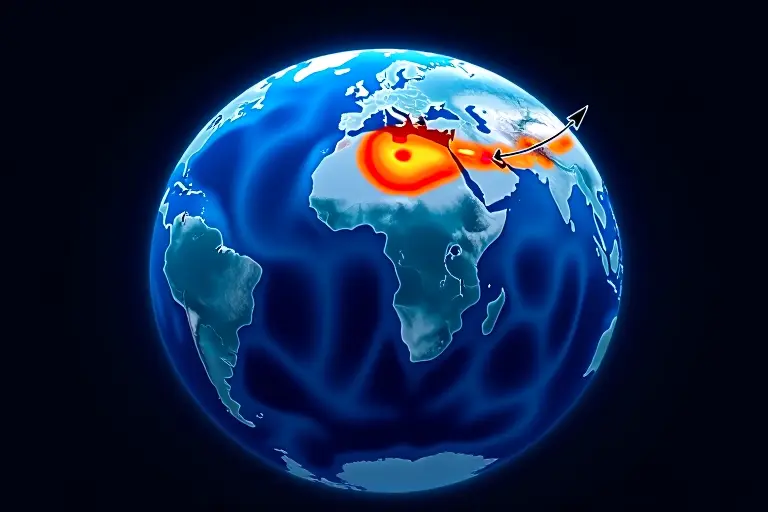
None of these systems exist in isolation. The Amazon is wired into planetary weather like a load-bearing wall is wired into a building. You can't remove it and expect the rest of the structure to hold.
The soil
Here's something most people don't realise about the Amazon: its soil is terrible.
Tropical rainforest soil is thin, acidic, and nutrient-poor. The fertility of the Amazon isn't in the ground. It's in the trees themselves, in the constant cycle of falling leaves, decomposition, and nutrient uptake that keeps everything locked in the biomass. The topsoil layer in most of the Amazon is only a few centimetres deep.
Without trees to hold it together, that topsoil washes away in the first heavy rains. What's left is laterite, a hard iron-rich clay that bakes into something resembling brick when exposed to sunlight. You can't farm it. You can barely dig it. This is why cattle ranching on cleared Amazon land fails within five to eight years. The soil gives up.
So the idea that you could remove the forest and use the land for agriculture is a fantasy. You'd have a few years of declining yields followed by permanent wasteland.
The river changes
The Amazon River discharges about 209,000 cubic metres of water per second into the Atlantic Ocean. That's roughly 20% of all river water entering the world's oceans. Without the forest cycling moisture back into the atmosphere, river volume eventually drops. The massive sediment load that the river carries, which fertilises floodplains and feeds aquatic ecosystems, changes in composition and timing.
Downstream communities that depend on seasonal flooding for agriculture lose their livelihoods. Fish populations that depend on submerged forest during flood season lose their habitat. The river doesn't vanish, but it becomes a different thing entirely. Narrower, more erratic, less alive.
Could it grow back?
Not as it was. The Amazon as it exists today is the product of roughly 55 million years of continuous evolution since the forests first formed in the Palaeocene. The species relationships, the soil fungi networks, the pollination partnerships, the seed dispersal systems. All of that co-evolved over geological time. You can't replant it any more than you can rebuild a coral reef by dropping rocks in the sea.
Secondary forest would eventually grow on parts of the land where soil hadn't been destroyed. But it would be a simplified version: fewer species, less structural complexity, less carbon storage, less resilience. A photocopy of a photocopy.
The Amazon isn't just a collection of trees. It's a machine built by evolution over tens of millions of years, and we have no idea how to build another one.