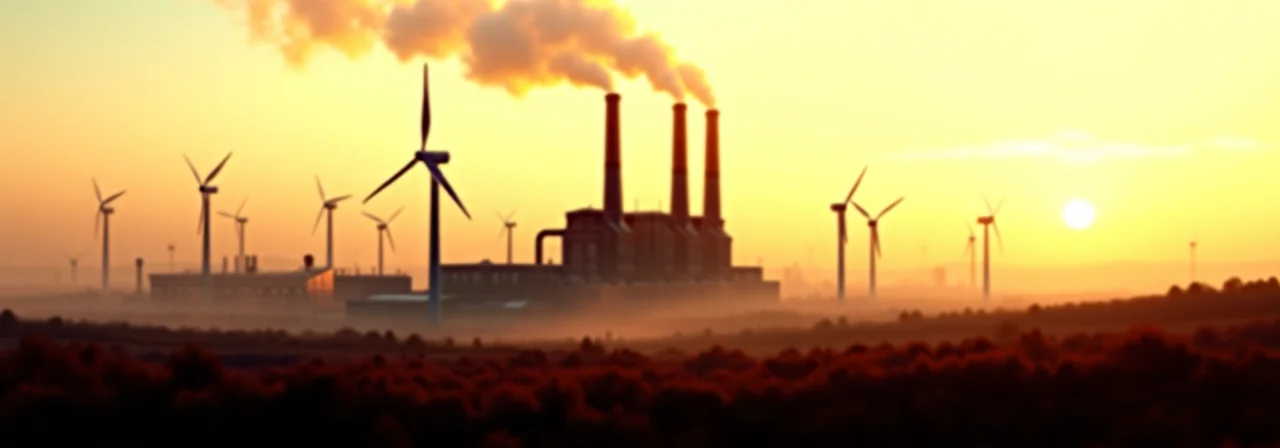
The year is 1800. George III is on the British throne, Napoleon is about to crown himself in France, and somewhere in a workshop, an inventor builds a working solar panel.
Not a primitive one. A proper photovoltaic cell, converting sunlight to electricity with the same 20-22% efficiency we get from modern monocrystalline silicon panels today. They don't understand the quantum mechanics behind it. Nobody will for another century. But it works, it's reproducible, and the materials (silicon, glass, copper wiring) are all available with 1800s metallurgy and glassmaking.
What happens to the next two centuries?
Coal still matters (for a while)
The thing about solar panels in 1800 is that they produce electricity, and in 1800, nobody has any use for electricity. The electric motor won't be invented until 1821. The lightbulb won't arrive until the 1870s. The electrical grid is decades away. A solar panel in 1800 is a solution waiting for a problem.
So coal doesn't vanish overnight. The early Industrial Revolution is driven by steam, and steam doesn't need electricity. It needs heat. Coal provides heat directly, which is why it won over wood: more energy per kilogram, easier to transport, and Britain was sitting on enormous deposits of it.
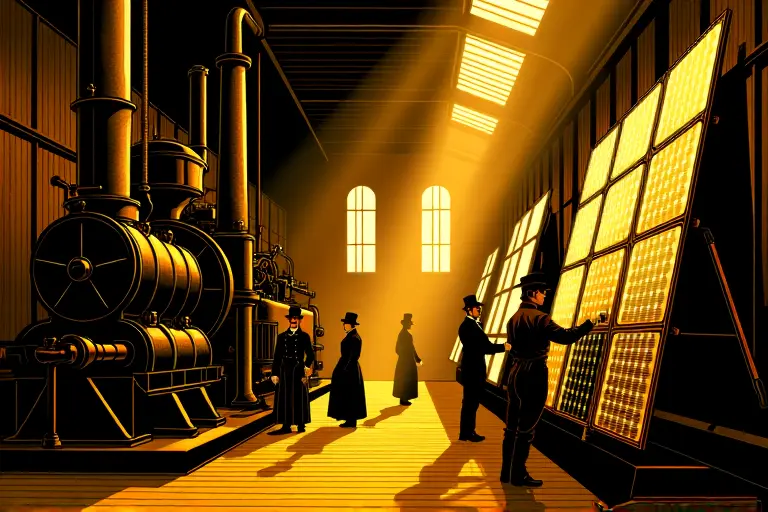
But here's the difference. In our timeline, once electrical technology matured in the late 1800s, the infrastructure was already locked into fossil fuels. Power stations burned coal because that's what industry already used. The path dependence was set. In this alternate timeline, electricity arrives into a world that already has a free, clean source of it. The lock-in never happens.
The electrification race
The existence of solar panels would accelerate electrical research enormously. In our timeline, early electrical experiments relied on chemical batteries (Volta's pile, invented in 1800) and hand-cranked generators. Both were expensive, limited, and impractical for anything beyond laboratory curiosity. Solar panels change that equation completely. Suddenly you have abundant, free electrical energy. Every experimenter in Europe wants one.
I'd estimate the electric motor arrives by 1810 instead of 1821. Faraday's work on electromagnetic induction, which he published in 1831, might happen in the 1810s or 1820s because the demand for understanding electricity is now driven by a practical, working technology rather than academic curiosity.
The telegraph, which in our timeline arrived in the 1830s, might be operational by the early 1820s. Railways, which in our timeline used steam locomotives, might electrify their first lines by the 1840s rather than the 1890s. The entire pace of technological development shifts forward by twenty to forty years.
The coal barons lose their grip
In our timeline, coal mine owners wielded extraordinary political power throughout the 19th century. They sat in Parliament. They shaped labour law. They resisted regulation for decades because their product was the lifeblood of the economy. In Britain, coal mining employed over a million people at its peak in 1920, and the political leverage that came with controlling the energy supply shaped everything from foreign policy to domestic welfare.
In this timeline, coal is still useful for steel smelting and heating, but it never becomes the dominant energy source. The political class of coal barons either never forms or forms as a smaller, less influential group. The labour movement still happens (exploitation didn't require coal specifically) but the specific grievances change. No mining disasters killing hundreds at a time. No black lung disease epidemic. No coal towns that boom for fifty years and then collapse into poverty when the seams run out.
The human cost of coal mining in our timeline is staggering. In Britain alone, over 100,000 miners died in pit accidents between 1850 and 1950. That's a century of preventable death, and in this timeline, most of it simply doesn't happen.
The oil age never really begins
Oil's dominance in our timeline came from three things: the internal combustion engine, the petrochemical industry, and geopolitics. In a world where electrical infrastructure has a 60-year head start, the internal combustion engine faces much stiffer competition from electric motors from the moment it's invented.
Karl Benz builds his first petrol-powered car in 1886 in our timeline. In this one, electric vehicles already exist and have a decades-long infrastructure advantage. Charging stations (solar-powered) are widespread. The battery technology might be less developed than our modern lithium-ion cells, but the lead-acid battery, invented in 1859, works well enough for short-range urban transport.
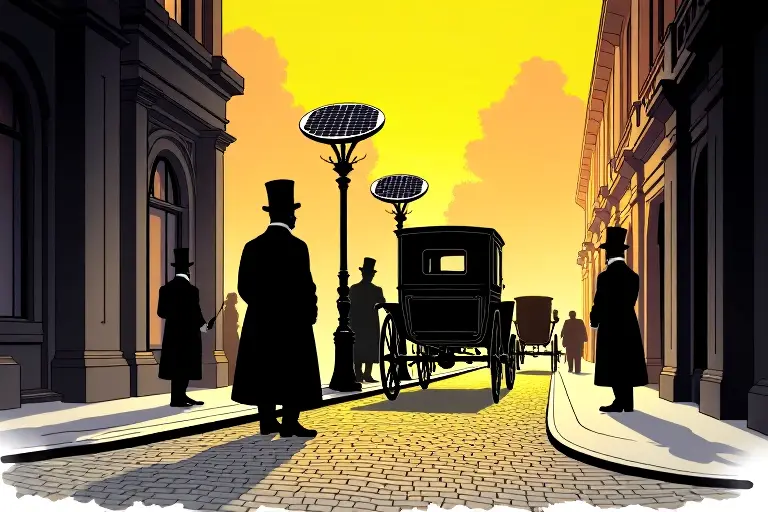
Oil still gets extracted. It's too useful as a chemical feedstock for plastics, pharmaceuticals, and lubricants. But it never becomes the primary energy source. The geopolitical consequences of this are enormous.
The wars that don't happen
A significant portion of 20th-century conflict was driven by energy resources. Japan's invasion of Southeast Asia in 1941 was motivated partly by access to oil in the Dutch East Indies after the US oil embargo. The Gulf Wars had oil as a central strategic interest. The entire geopolitical structure of the Middle East was shaped by Western powers securing petroleum supplies.
Without oil dependence, these specific conflicts either don't happen or happen for different reasons at different times. The Middle East still has its own internal politics and tensions, but it's no longer the centre of global strategic interest. Western powers have less reason to meddle. The Ottoman Empire's collapse in 1918 still occurs (it had internal structural problems that had nothing to do with oil), but the carve-up of its territories by Britain and France might look very different without petroleum as a motivating factor.
I'm not suggesting world peace. Humans are extremely good at finding reasons to fight. But the specific pattern of 20th-century resource wars changes dramatically.
Climate change
This is the big one. In our timeline, atmospheric CO₂ was about 280 parts per million in 1800. By 2024, it reached 421 ppm. Most of that increase came from burning fossil fuels for energy: coal from the 1800s, oil from the 1900s, gas from the mid-1900s onward.
In this timeline, fossil fuel consumption for energy is a fraction of our historical reality. Coal is used for steel and heating but not electricity generation. Oil is a chemical feedstock, not a primary fuel. The massive, century-long carbon pulse that is currently warming our planet by 1.2°C above pre-industrial levels simply doesn't happen at the same scale.
There's still some warming. Deforestation for agriculture still releases carbon. Industrial processes still emit greenhouse gases. But atmospheric CO₂ in this timeline's 2024 might be 310-320 ppm instead of 421 ppm. The difference is the difference between "mild regional climate shifts" and "existential threat to civilisation."
No melting ice sheets. No coral reef die-offs. No climate refugees. No annual COP summits arguing about emissions targets. The entire political and environmental crisis that dominates our early 21st century is, in this timeline, a footnote in an atmospheric science textbook.
The catch
It wouldn't be paradise. Solar panels in 1800 don't solve poverty, disease, imperialism, or human cruelty. The British Empire still expands. Slavery still happens (though the economic arguments shift when sugar plantations can run electric processing equipment). The World Wars might still occur over territory and ideology. The Cold War might still happen.
And solar has its own problems even in our modern world. Intermittency. Storage. Manufacturing pollution. In the 1800s, without modern battery technology, solar energy is only available during daylight hours. Northern countries like Britain, with their famously grey skies, are at a disadvantage compared to equatorial nations. This might accelerate colonialism as European powers seize sunny territories specifically for energy production.
Clean energy, dirty politics. Some things don't change regardless of the technology.