
Picture this: your skin is a soft green. Not sickly, but rich and alive, like a leaf catching June sunlight. You step outside in the morning, not for your commute, but because you're hungry. Fifteen minutes of direct sun and you feel full. Your skin is feeding you.
Humans who photosynthesise. No food industry, no famine, no grocery bills. Sounds utopian. But would it actually work?
The energy problem
Here's the uncomfortable maths. A human body needs roughly 2,000 kilocalories per day to function. Photosynthesis in plants converts about 1-2% of incoming solar energy into chemical energy (glucose). The sun delivers approximately 1,000 watts per square metre at ground level on a clear day.
The average human body has about 1.7 square metres of skin surface area. If all of it were photosynthetic (you're green everywhere), and you stood naked in direct midday sun with 2% efficiency:
1,000 W/m² × 1.7 m² × 0.02 = 34 watts
That's 34 joules per second. Over an hour of direct sunlight: 122,400 joules, or about 29 kilocalories.
To get your full 2,000 kcal? You'd need to stand in direct sun for approximately 69 hours straight. Nearly three days of non-stop sunbathing for one day's energy.
So it's useless?
Not entirely. 29 kcal per hour in the sun won't replace meals, but it supplements them. Think of it as a biological snack. Perhaps 200-400 kcal per day if you spent significant time outdoors. That's roughly one meal covered by sunlight alone.
Historically, that would have been enormous. In famine conditions, a species that could scrape even 15% of its calories from sunlight would have a real survival advantage. You still need to eat, but you're far harder to starve.
How society changes
Architecture
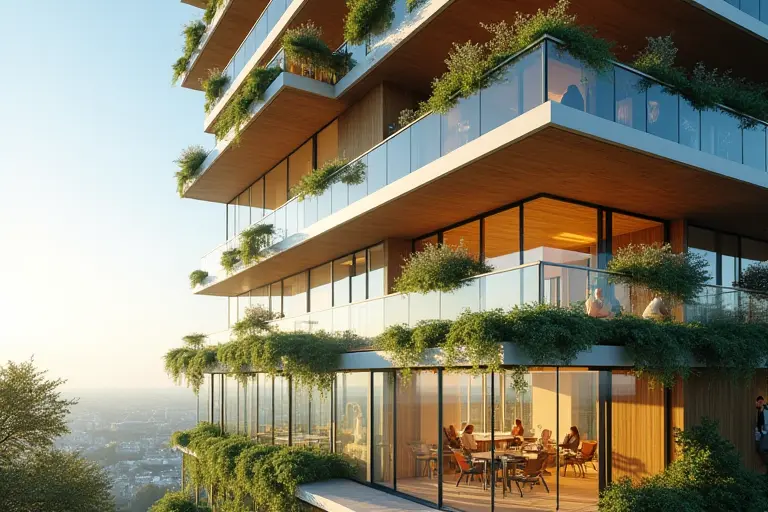
Buildings would be designed with vast glass walls and sun rooms. Open-air terraces where office workers recharge during lunch. Housing prices would correlate even more strongly with sun exposure. North-facing flats in London? Practically worthless. South-facing roof terraces? Worth more than the building beneath them.
Clothing
Clothing becomes a trade-off between social modesty and caloric intake. Summer fashion trends toward transparent or minimal coverage. Winter in northern latitudes becomes a genuine nutritional crisis. Seasonal affective disorder meets seasonal starvation.
Geography
Equatorial nations become the wealthiest on Earth. Year-round intense sunlight means their populations need less food infrastructure. Scandinavia and northern Canada face permanent nutritional disadvantage. Global migration patterns reverse entirely. The economic map of the world flips upside down within a generation.
Class and inequality
Can the rich afford to be paler? If you can buy all your food, you don't need to stand in the sun for hours. Paleness becomes a status symbol, not because you work indoors, but because you're wealthy enough to eat without the sun's help.
The poor spend their days in the sun because they have no choice. We'd reinvent agricultural class dynamics but with human bodies as the crop. Medieval peasants worked the land. Photosynthetic peasants are the land.
Could this actually evolve?
Chloroplasts in human cells face serious biological barriers. Our cells are structured completely differently from plant cells. We lack the cell walls, vacuoles, and internal architecture that makes photosynthesis work in the first place.
But nature has done something close. The sea slug Elysia chlorotica steals chloroplasts from algae and runs photosynthesis in its own body for months. So it's not impossible. Just improbable for a large, warm-blooded mammal that burns through 2,000 kcal a day keeping a 37°C body running.
The brain tax
The reason this doesn't quite work comes down to one organ. The human brain weighs 1.4 kg and uses 20% of our daily energy. Roughly 400 kcal just to keep the lights on upstairs. Plants can photosynthesise because they don't think. They don't move, fight, plan, or argue about politics online.
We burn energy at a rate that leaves photosynthesis looking like trying to fill a swimming pool with a pipette. The numbers just don't add up. But as a supplement, as a buffer against starvation, as a reason to redesign every city on earth around sun exposure? It changes everything.