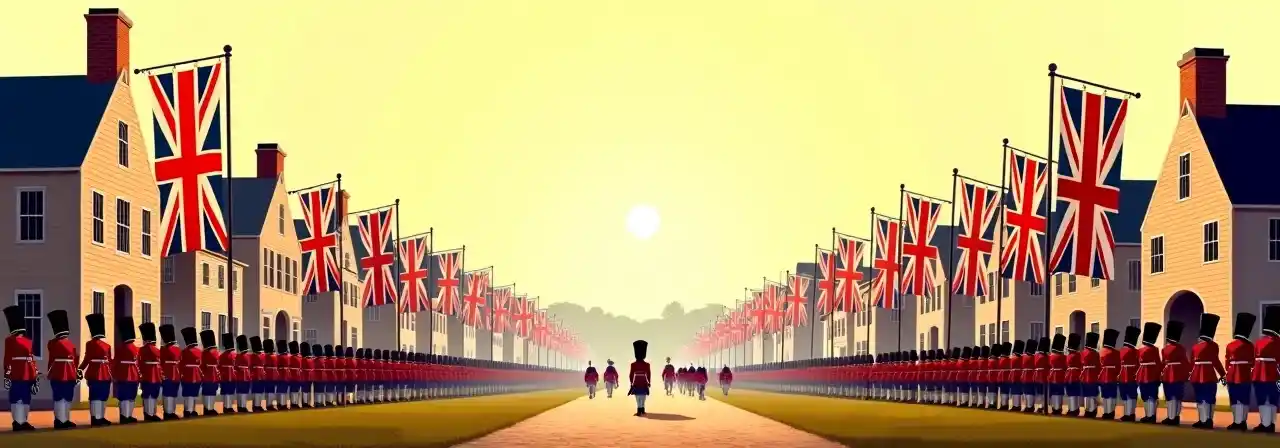
The Fourth of July, 1776. The Continental Congress signs the Declaration of Independence and the colonies commit to their break from Britain. In our timeline, this eventually works. The colonists win, partly through grit, partly through French help, and partly because fighting a war 5,000 kilometres from home across the Atlantic in the 18th century was a logistical headache even for the world's largest navy.
But it very nearly didn't work. The American Revolution was not the inevitable triumph that school textbooks present. It was a messy, close-run thing that could have gone the other way at several points.
What if it had?
How Britain wins
The most likely scenario isn't a single decisive battle. It's a war of attrition that the colonies simply can't sustain. Washington's Continental Army spent much of the war underfed, underpaid, and underequipped. At Valley Forge in the winter of 1777-78, roughly 2,000 of 12,000 soldiers died from disease, cold, and starvation. Morale was held together by Washington's personal authority and not much else.
If France doesn't enter the war in 1778, the balance shifts heavily. French money, ships, and soldiers were decisive at Yorktown in 1781, where the combined Franco-American force trapped Cornwallis. Without the French fleet blocking the Chesapeake Bay, Cornwallis evacuates by sea and the war grinds on.
Grind on long enough and colonial support fractures. About a third of colonists were loyalists anyway. Another third were indifferent. The active revolutionaries were a minority who needed momentum to keep recruiting. Stall that momentum and the rebellion collapses from within.
The aftermath
Britain wouldn't burn the colonies to the ground. That's not how empires worked. Crushing a rebellion and then destroying the territory you just fought to keep makes no strategic sense. The colonies were valuable: timber, tobacco, cotton, furs, and a growing consumer market for British manufactured goods.
The rebel leadership would face consequences. Washington, Jefferson, Adams, Franklin, Hancock. Some would hang. Treason against the Crown carried the death penalty. Others, particularly those with wealth and social standing, might negotiate exile or reduced punishments. Britain was pragmatic about these things when it suited them.
The rank and file? Pardoned, mostly. Britain couldn't imprison or execute thousands of farmers who'd picked up muskets. The smarter approach, and the one the British used after other colonial rebellions, was amnesty with conditions. Swear loyalty, hand over your weapons, go back to your farm.
North America stays British
This is where it gets interesting. Without an independent United States, westward expansion still happens, but under British direction. The Louisiana Territory, which Napoleon sold to the US in 1803 partly because he needed cash and partly because he'd lost Haiti, might instead remain French or be acquired by Britain through negotiation or war.
The western frontier develops differently. Britain had a track record of trying to limit colonial expansion to avoid conflicts with Indigenous nations. The Royal Proclamation of 1763 drew a line along the Appalachian Mountains and told colonists to stay east of it. That line was one of the grievances that fuelled the revolution in the first place. Without independence, it might hold longer.
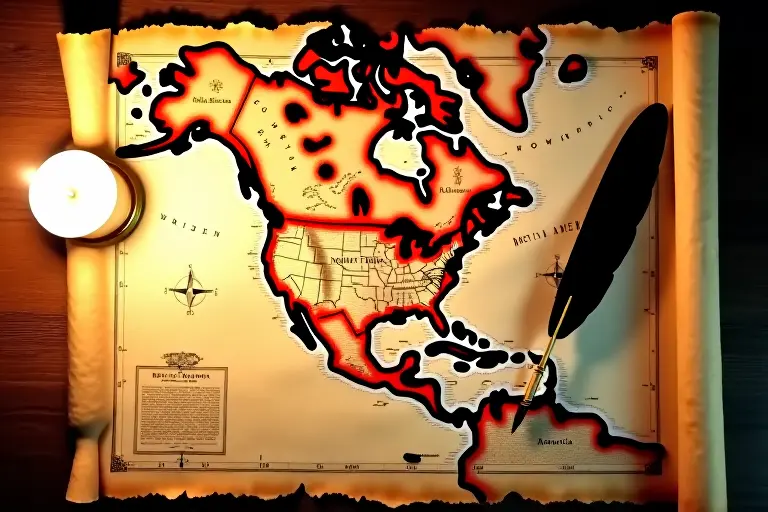
Longer, but not forever. Settler pressure was relentless. British-controlled North America would expand westward eventually, but perhaps more slowly and with more formal treaties with Indigenous peoples. The displacement and violence would still occur. British colonialism was not gentler than American expansion. It was just more bureaucratic about it.
Slavery
Britain abolished the slave trade in 1807 and slavery itself throughout most of the empire in 1833 via the Slavery Abolition Act. If the American colonies were still British territories in 1833, abolition would apply to them.
This is the single biggest divergence. No American Civil War. No 620,000 dead. No century of Jim Crow laws following a war supposedly fought to end the institution. Southern plantation owners would resist, certainly. But they'd be resisting the British Parliament, not a federal government they shared power in. And the British Army, fresh from the Napoleonic Wars and at the height of imperial power, would enforce abolition with considerably less hand-wringing than Abraham Lincoln faced.
The economic disruption to the cotton-growing South would be severe. Compensation was paid to slaveholders under the British abolition (the equivalent of about 17 billion pounds in today's money, paid as government bonds). The formerly enslaved people received nothing, which is a whole other conversation. But the legal end of slavery in North America comes 30 years earlier than it did in our timeline, without a civil war.
No superpower
The United States became the world's dominant power in the 20th century for a collection of reasons: continental scale, natural resources, immigration, industrial capacity, geographic isolation from Europe's wars, and the specific economic and political system that developed after independence.
British North America would have some of those advantages, but not all. The resources and geography don't change. But the political structure does. A colonial territory governed from London doesn't develop the same entrepreneurial culture, the same immigration pull, or the same military independence.
Canada is the comparison point. Canada remained British, gained gradual self-governance through the 19th century, and became an independent dominion in 1867. It's a prosperous, stable, well-run country. It is not a superpower. A British-controlled America follows a similar trajectory: wealthy, functional, and taking orders from London on foreign policy until sometime in the early 1900s.
The 20th century looks very different without an independent America. No American entry into World War I in 1917. No Marshall Plan. No NATO as we know it. No American military bases spanning the globe. Britain remains the dominant English-speaking power, but Britain was already in relative decline by the late 1800s. Without America stepping up, the vacuum gets filled differently. Possibly by a more confident German Empire. Possibly by the British Empire lasting longer through sheer lack of competition.
The culture
No Hollywood. Or rather, not the Hollywood we know. The American film industry grew out of a specific set of conditions in early 20th-century Los Angeles. A British colonial film industry might still emerge (it has the audiences, the capital, the English language) but it would have a different character. More restrained, probably. Less obsessed with individual heroism and manifest destiny.
No American Constitution. No Bill of Rights. No Second Amendment. The gun culture that defines modern America doesn't develop in the same way under British common law, which never treated firearm ownership as a constitutional right.
English stays English. No "color" without the U. No "aluminum" with the missing I. Noah Webster, who standardised American spellings as a deliberate act of linguistic independence in the 1820s, would have had no reason to do so. The whole continent spells it "colour."
Baseball probably still happens. Cricket definitely has a stronger foothold. Tea consumption remains high. The entire cultural identity of America as a scrappy underdog nation born from revolution doesn't exist, replaced by something more like Australian or Canadian identity: defined by geography and character rather than a founding mythology.
Whether that's better or worse depends entirely on what you value. But it would certainly be quieter on the Fourth of July.