
The Ottoman Empire lasted 623 years. From 1299 to 1922, it controlled territory spanning three continents, governed dozens of ethnic and religious groups, and administered a legal and bureaucratic system that, at its peak, was more sophisticated than most of its European contemporaries. Then it picked the wrong side in a world war and that was that.
But suppose it didn't. Suppose the Ottomans stayed neutral in 1914, or joined the Entente, or simply muddled through the way empires sometimes do. No Treaty of Sevres. No Mustafa Kemal. No Turkish Republic. The sultanate continues, reforms or stagnates, and the twentieth century unfolds around an empire that still controls the eastern Mediterranean, the Arabian Peninsula, and the crossroads between Europe, Asia, and Africa.
The map looks completely different. And not just the map.
No Sykes-Picot
In 1916, a British diplomat named Mark Sykes and a French diplomat named Francois Georges-Picot drew lines on a map of the Middle East. Those lines, drawn with little regard for the ethnic, tribal, or religious composition of the region, created the borders of Iraq, Syria, Lebanon, Jordan, and Palestine. The agreement was secret, self-serving, and catastrophic in its long-term consequences.
If the Ottoman Empire survives, Sykes-Picot never happens. There's nothing to carve up. The provinces of the empire remain provinces of the empire, administered from Constantinople under a system that, whatever its faults, had managed multi-ethnic governance for centuries.
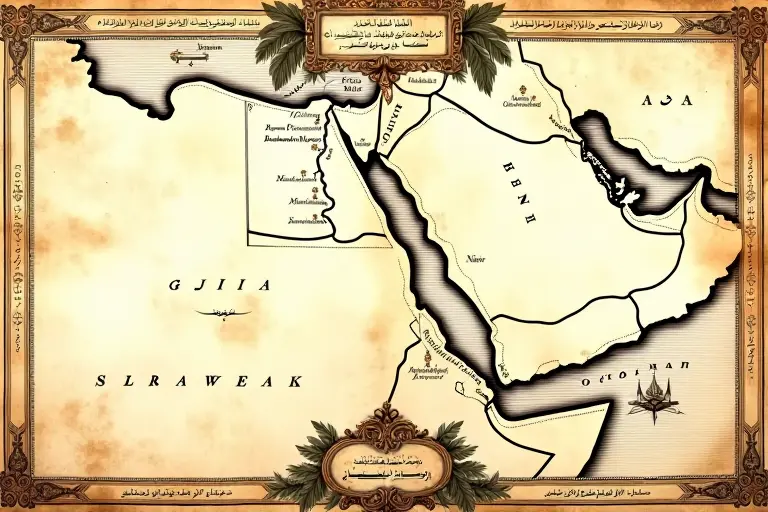
This single change ripples forward through the entire century. No British Mandate in Palestine. No Balfour Declaration implemented on the ground (the letter itself might still exist, but without British control of the territory, it's just a letter). No partition, no 1948 war, no decades of conflict over borders that didn't exist until two diplomats drew them in a room in London.
I'm not suggesting the Ottoman solution was peaceful or just. It wasn't. But the specific pattern of conflict that defined the twentieth-century Middle East was largely a product of those imposed borders, and without them, the conflicts that arose would have been different in character if not in intensity.
Oil changes hands
The first major oil discovery in the Middle East came in 1908 in Persia (modern Iran), outside Ottoman territory. But the massive reserves in Mesopotamia (modern Iraq), the Arabian Peninsula (modern Saudi Arabia), and the Gulf states were all under Ottoman jurisdiction.
In our timeline, the collapse of the empire allowed British and later American oil companies to negotiate concessions with newly created states that lacked the diplomatic experience or military power to resist. The Anglo-Persian Oil Company, which became BP, was essentially a British government operation extracting Iranian oil under terms that gave Iran a pittance.
A surviving Ottoman Empire would have negotiated very differently. The Ottomans understood European diplomacy. They'd been playing the Great Powers against each other for four centuries. Ottoman control of Mesopotamian and Arabian oil would have meant the empire set the terms of extraction, not Western oil companies.
The global energy economy of the twentieth century would have run through Constantinople. That's a level of geopolitical leverage that makes OPEC look like a discussion group.
Turkey as we know it doesn't exist
Mustafa Kemal Ataturk's republic was built on the rubble of the empire. Without that rubble, there's no republic. The Ottoman state continues as a constitutional monarchy or an absolutist sultanate, depending on how reform plays out.
Ataturk's reforms were radical. He abolished the caliphate, replaced Arabic script with Latin, banned the fez, gave women the vote in 1934, and secularised the legal system. These changes happened because a revolutionary with enough military prestige to force them through had the opportunity created by total state collapse.
Without collapse, reform is slower. The Ottoman tanzimat reforms of the nineteenth century showed the empire was capable of modernisation, but it happened at the pace of institutional negotiation, not revolutionary decree. Women's suffrage might come decades later. The script stays Arabic. The caliphate continues, and the sultan remains both head of state and nominal leader of the global Sunni Muslim community.
That last point matters more than anything else on this list.
A surviving caliphate changes Islam's political trajectory
The abolition of the Ottoman caliphate in 1924 left a vacuum in Sunni Islamic political authority. No single institution replaced it. Various movements, from the Muslim Brotherhood (founded in Egypt in 1928) to Wahhabism's expansion in Saudi Arabia, rushed to fill the gap.
A surviving Ottoman caliphate doesn't prevent these movements from forming, but it limits their reach. There's an existing, recognised, institutional authority in Sunni Islam. Reformers and radicals alike have something to argue against, petition, or work within. The caliphate functions as a lightning rod, absorbing political energy that in our timeline dispersed into dozens of competing factions.
Whether this produces a more moderate or more conservative Islamic world depends on the sultans. Good ones could have channelled reform productively. Bad ones could have provoked exactly the kind of revolutionary movements they were supposed to contain. Empires are only as stable as their leadership, and the Ottoman dynasty's later track record was mixed at best.
Europe without the treaty of Versailles's Middle Eastern clauses
The post-war settlement in 1919 didn't just redraw the Middle East. It redrew Europe. But the Middle Eastern clauses of the Versailles settlement and the subsequent Treaty of Sevres occupied enormous diplomatic energy. Without them, British and French attention remains focused on Europe.
Does this change the rise of fascism? Probably not directly. The economic conditions that produced Mussolini and Hitler were primarily European in origin. But the British Empire's overextension in the Middle East drained military and administrative resources that might have been available for European commitments in the 1930s. A Britain not managing Palestine, Iraq, and Transjordan might have been more willing to confront German rearmament earlier.
This is speculative to the point of being unfalsifiable. But the resources were real. The distraction was real. And the consequences of delayed European intervention were real.
The twentieth century without the oil wars
No Gulf War in 1991. No Iraq War in 2003. These conflicts were products of a specific sequence: Ottoman collapse, arbitrary borders creating Iraq, British-backed monarchy, revolution, Ba'athist dictatorship, invasion of Kuwait. Remove the first domino and the rest don't fall. Different dominoes fall instead, but not those ones.
The 1991 Gulf War cost approximately $61 billion in direct military spending. The 2003 Iraq War cost the United States between $1.7 and $2.4 trillion, depending on how you count long-term veterans' care and interest on war debt. These numbers don't include the cost to Iraq itself, which is difficult to quantify and painful to contemplate.
None of this means the Middle East would be peaceful under continued Ottoman rule. Empires suppress conflict by force, which is not the same as resolving it. But the specific conflicts of our timeline, shaped by specific borders drawn by specific diplomats for specific imperial interests, would not exist in the form we know them.
Six hundred and twenty-three years is a long time for anything to last. Empires don't survive because they're good. They survive because the alternatives, at any given moment, seem worse. The Ottoman Empire might have continued for another century on sheer institutional momentum alone. Whether the world would be better for it is a question that doesn't have a clean answer, only a different set of problems wearing different names on a very different map.