On 6 August 1945, a B-29 bomber called Enola Gay dropped a uranium bomb on Hiroshima. Three days later, a plutonium bomb fell on Nagasaki. Between 129,000 and 226,000 people died, most of them civilians. Japan surrendered on 15 August.
These are among the most scrutinised decisions in military history. And the uncomfortable question that follows every discussion is: what if it hadn't happened?
The answer is not what most people expect.
Operation Downfall
The planned Allied invasion of mainland Japan had a name. Operation Downfall. It had two phases: Operation Olympic, the invasion of Kyushu scheduled for November 1945, and Operation Coronet, the invasion of the Kanto Plain and Tokyo, planned for March 1946.
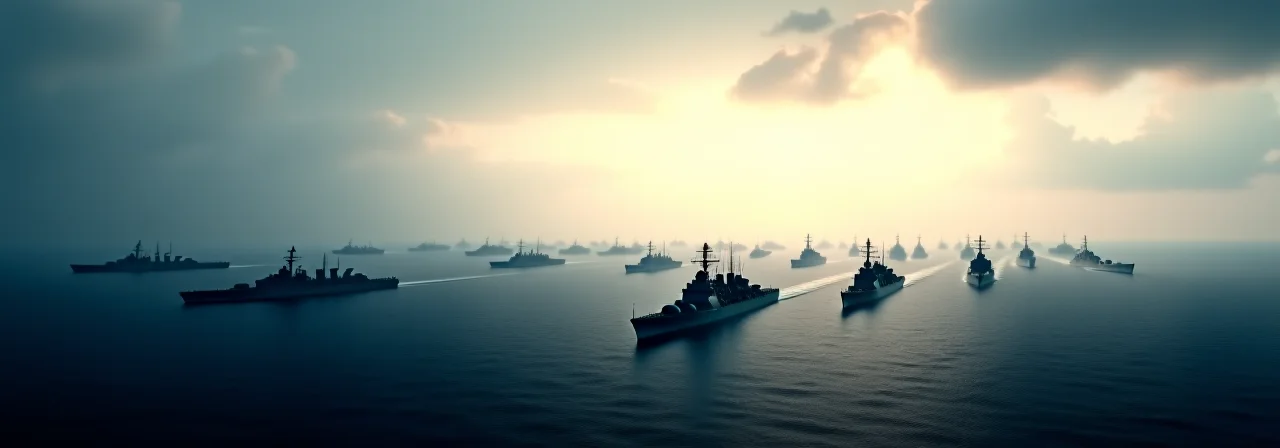
The scale of Downfall was staggering. Olympic alone would have involved 14 combat divisions and roughly 767,000 troops in the initial assault, making it larger than D-Day. The naval component would have been the largest in history. Every available aircraft carrier, battleship, and transport vessel in the Pacific was allocated.
The Joint Chiefs of Staff commissioned casualty estimates in June 1945. They varied widely, because nobody had ever attempted anything like this. The most conservative estimate, from the Joint War Plans Committee, projected 46,000 American dead and 170,000 wounded in the first 90 days of Olympic alone. The more pessimistic assessments, including those by the office of the Secretary of War, put total American casualties for both operations at between 500,000 and one million.
Japanese casualties were projected to be far higher. The civilian population had been mobilised for homeland defence under the Ketsu-Go strategy. Women, children, and elderly men were trained to fight with sharpened bamboo spears, farming tools, and improvised explosives. This was not propaganda. Training manuals survive. The Japanese military government expected and planned for mass civilian participation in the defence.
Japan's preparation
By August 1945, the Japanese military had accurately predicted where the invasion would land. Intercepted communications and geographical logic pointed to the beaches of southern Kyushu, and Japan had reinforced accordingly. The original American intelligence estimate counted around 350,000 defenders on Kyushu. Post-war analysis revealed the actual number was closer to 900,000.
The Japanese had also stockpiled roughly 10,000 aircraft for kamikaze operations. Not all were operational. Many were trainers, biplanes, even gliders fitted with explosives. But the volume was the point. During the Battle of Okinawa, 1,900 kamikaze attacks sank 34 ships and damaged 368 others, killing nearly 5,000 US Navy personnel. Multiply the aircraft available by five and apply it to a larger, slower invasion fleet.
The US Navy's own planning documents estimated it would lose more ships during Downfall than in the entire Pacific War up to that point.
What the fighting would have looked like
Okinawa is the closest reference point. The battle lasted 82 days. Between 77,000 and 110,000 Japanese soldiers were killed, along with between 40,000 and 150,000 Okinawan civilians. American casualties were 82,000, including over 12,500 dead. The civilian toll was particularly horrific. Many were caught in crossfire. Others were killed by Japanese soldiers who viewed them as security risks. Thousands committed suicide, some coerced by soldiers who told them the Americans would torture and murder them.
Mainland Japan would have been Okinawa at a hundred times the scale. The geography is worse for the invader. The defender knows the ground. The civilian population is larger, more tightly packed, and has been told for months that death is preferable to surrender.
American planners were so concerned about casualties that the War Department ordered 500,000 Purple Heart medals manufactured in anticipation of Downfall. Those medals were never used for their intended purpose. The stock was so large that every American service member wounded in Korea, Vietnam, the Gulf War, Iraq, and Afghanistan received a Purple Heart from that 1945 batch. As of the early 2000s, there were still over 100,000 left.
Let that number sit for a moment. They made half a million medals for wounds they expected from a single campaign.
The Soviet factor
The Soviet Union declared war on Japan on 8 August 1945, two days after Hiroshima and one day before Nagasaki. Soviet forces invaded Manchuria with 1.5 million troops and advanced rapidly against weakened Japanese forces. Within eleven days they had overrun most of Manchuria and northern Korea.
Without the atomic bombs and Japan's rapid surrender, the Soviet invasion continues. Stalin had ambitions in the Pacific. He wanted a share of the occupation, specifically the northern half of Japan itself. At the Yalta Conference in February 1945, the Soviets were promised territory in exchange for entering the Pacific War, but the scope of their involvement was left vague.
In the absence of a quick Japanese surrender, Soviet forces likely push into Hokkaido. The Soviets had the naval capability to cross the relatively narrow La Perouse Strait, and with Japan's navy destroyed and its air force allocated to kamikaze operations in the south, northern Japan was effectively undefended against a Soviet amphibious landing.
The result: a divided Japan. North and South, like Korea. An iron curtain running through the Japanese archipelago. Hokkaido becomes a Soviet satellite state. Tokyo sits in the American zone, Sapporo in the Soviet one. Two Japans, with all the Cold War tension that implies.
The humanitarian calculus
This is the part that makes people uncomfortable, because the maths doesn't produce the answer anyone wants.
Hiroshima and Nagasaki killed roughly 200,000 people, with tens of thousands more suffering radiation-related illness in the decades that followed. This is a horror almost beyond comprehension. No argument about military necessity should diminish the scale of that suffering.
Operation Downfall's projected death toll, combining American, Japanese military, and Japanese civilian casualties, ranges from conservative estimates of around one million to higher estimates of several million. The historian Richard Frank, drawing on Japanese and American sources, estimated total Japanese deaths (military and civilian) at approximately two million. Some Japanese historians put the figure higher.
The conventional bombing campaign, which would have continued and intensified during the invasion, was already killing at catastrophic rates. The firebombing of Tokyo on 9-10 March 1945 killed approximately 100,000 people in a single night. More than either atomic bomb. This was one raid among many. LeMay's bombers were systematically incinerating Japanese cities, and the target list was growing.
The atomic bombs were horrific. The alternative was also horrific. There is no version of the end of the Pacific War that isn't horrific. The choice was never between destruction and peace. It was between different kinds of destruction at different scales.
What it means for the nuclear age
If the bombs are never used in war, they remain theoretical. A test in the desert is an abstraction. Hiroshima and Nagasaki made nuclear weapons real in a way that no test could. The photographs, the survivor testimony, the keloid scars, the shadow of a person burned into stone steps, these images shaped seventy years of nuclear policy.
The fear of nuclear war that drove the Cold War's strategy of deterrence was grounded in the knowledge of what the weapons actually do to cities and to people. Without Hiroshima, that knowledge is academic. The threshold for use might be lower. The arms race might proceed with less public horror and less political pressure for restraint.
It is entirely possible that, in a world where the bomb was never used in 1945, it gets used later, in Korea or in a direct US-Soviet confrontation, on targets much larger than Hiroshima, with warheads much more powerful than Little Boy's 15 kilotons. The first use might have been the thing that prevented a worse second one.
There is no clean lesson here. Only the grim recognition that the twentieth century offered a series of terrible options and the people making decisions chose among them with incomplete information under unbearable pressure. History is not a morality play. Sometimes every door leads somewhere awful, and the only honest thing to say about it is that it happened, and it was worse than it needed to be, and it might have been worse still.