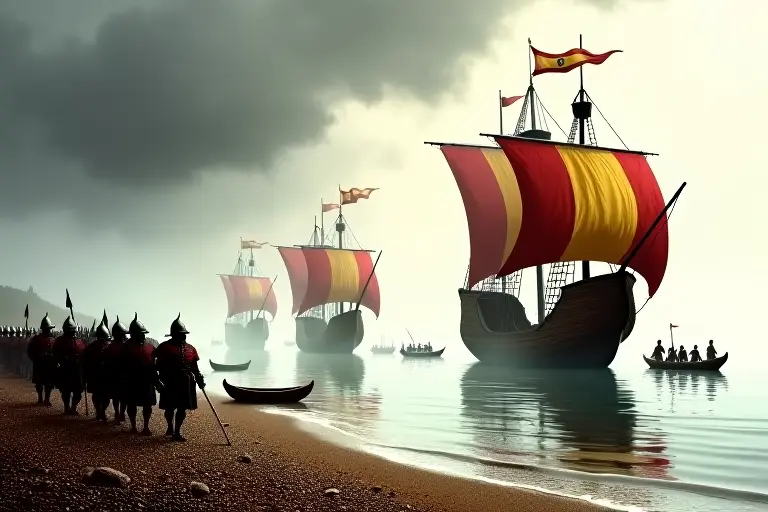
In the summer of 1588, Philip II of Spain sent 130 ships and roughly 30,000 men to invade England. The plan was to sail up the English Channel, rendezvous with the Duke of Parma's army in the Spanish Netherlands, ferry those troops across the Channel, and depose Elizabeth I. Replace the Protestant queen with a Catholic monarch. Bring England back into the fold.
It failed. English fireships scattered the fleet at Calais. North Atlantic storms did the rest. About a third of the Armada's ships never made it home. Philip spent the rest of his reign in debt and frustration, and England went on to build the largest empire in human history.
But the margin was thin. The weather nearly broke the other way. The fireships nearly missed. The rendezvous with Parma nearly worked.
What success looks like
Assume the Armada links up with Parma's 27,000 seasoned veterans in the Low Countries. The combined fleet crosses the Channel and lands on the Kent coast, probably near Margate or Deal. England's standing army in 1588 is a militia. Brave, patriotic, poorly trained, and armed mostly with billhooks and longbows against Spanish tercio infantry who are, at that point, the most feared professional soldiers in Europe.
Elizabeth rallied her troops at Tilbury with one of the great speeches in English history. "I know I have the body of a weak and feeble woman; but I have the heart and stomach of a king, and of a king of England too." In the invasion timeline, that speech either never happens or happens before a battle that England loses.
London falls within weeks. Elizabeth is captured or flees to Scotland. Philip installs a Catholic regent, most likely the Infanta Isabella. England becomes a Habsburg client state.
Catholic England
The first thing that changes is religion. The English Reformation is reversed. Protestant churches are reconsecrated as Catholic. Monasteries dissolved under Henry VIII are restored, though the land they sat on has been sold and resold several times by now, creating property disputes that would tie up courts for decades.
The Protestant clergy face a choice: convert, flee, or die. Many would flee to the Dutch Republic, to the German Protestant states, to Scandinavia. England exports its intellectual class the way France later exported Huguenots after the revocation of the Edict of Nantes in 1685. Except this is a century earlier and the Protestant exiles include some of the most original minds of the Elizabethan age.
Including, possibly, one particular playwright from Stratford-upon-Avon.
Shakespeare in exile
William Shakespeare was 24 in 1588. His career hadn't properly begun. He may have been in London, or still in Warwickshire, or somewhere in between. What we know is that the theatrical world he entered depended on royal patronage, on a Protestant court that tolerated secular entertainment, and on London's particular mix of commercial energy and relative intellectual freedom.
Under Catholic Spanish rule, theatre is censored. The Spanish Inquisition, already active in Spain and its territories, extends to England. Public performances are monitored for heresy. Plays about English kings become politically dangerous. A play in which a monarch is deposed on stage, which Shakespeare wrote several times, is unthinkable under a regime that just deposed a monarch by force.
Does Shakespeare still write? Perhaps. But he writes differently. He might produce religious drama for Catholic patrons. He might flee to Amsterdam and write in exile, for a diminished English-speaking audience scattered across Protestant Europe. He almost certainly doesn't produce Hamlet, Macbeth, or King Lear as we know them. Those plays require a specific cultural moment: an England confident in its own identity, grappling with questions of legitimacy and power from a position of strength.
An occupied England doesn't have that confidence. Its literature would reflect subjugation, not ambition.
No British Empire
This is the big one. England's defeat of the Armada was the moment that established English naval confidence. Not naval supremacy, not yet, but the belief that England could challenge Spain on the sea and win. Without that confidence, the entire trajectory of English colonisation changes.
The Virginia Company doesn't receive its charter in 1606. Jamestown doesn't get founded in 1607. The Pilgrim Fathers don't sail on the Mayflower in 1620, because they're Puritan separatists who in the invasion timeline are either dead, imprisoned, or hiding in the Dutch Republic with no means to fund a transatlantic voyage.
North America is colonised by Spain and France. Spain pushes north from Florida and Mexico. France expands south and west from Quebec. The east coast of what we call the United States becomes a Spanish colonial territory, administered from Madrid, populated by Spanish settlers, and speaking Castilian Spanish.
There is no United States of America. At least, not one that speaks English.
The language
English in 1588 was spoken by roughly four million people on a small island. It was not yet a global language. That happened because of the British Empire, which happened because of English naval power, which crystallised after the Armada's defeat.
Without the empire, English remains a minor European language. It doesn't spread to North America, India, Australia, or Africa. The global lingua franca of trade, science, and diplomacy is either Spanish or French. The internet, when it eventually arrives, runs on Spanish. This article would be written in Spanish. Or it wouldn't be written at all, because the cultural tradition that produced it, the English essay, the English popular science article, doesn't develop in the same way.
You're reading this in a language that nearly died. Not through extinction, but through irrelevance. Four million speakers on a conquered island, slowly absorbed into a Spanish-speaking Catholic Europe. English might survive the way Catalan or Basque survived under Castilian dominance: as a regional language, spoken at home, discouraged in schools, preserved by stubborn locals who refused to let it go.
The counter-reformation wins
By 1588, the Protestant Reformation had split Europe roughly in half. Northern Europe was largely Protestant. Southern Europe was Catholic. England's survival as a Protestant power kept that balance. It funded Dutch resistance against Spain. It sheltered French Huguenots. It served as proof that a Protestant nation could defy the greatest Catholic power on earth and survive.
Remove that proof and the Reformation loses momentum. The Dutch revolt, deprived of English support and English money, may well fail. Protestantism retreats to Scandinavia and a few German principalities. The Catholic Church reasserts control over most of Western Europe. The Enlightenment, which grew partly from Protestant emphasis on individual conscience and scriptural interpretation, develops differently. Later. More cautiously.
The scientific revolution still happens. Catholic Europe produced Galileo and Copernicus. But it happens under the watchful eye of the Inquisition rather than in the relatively freewheeling intellectual environment of Protestant Northern Europe. Newton, born in Lincolnshire in 1642, might still be a genius. But a genius working under Catholic censorship produces different work than one working in a Protestant university with a royal charter to think freely.
One storm
The entire Anglophone world, 1.5 billion English speakers across six continents, exists because of weather patterns in the North Atlantic in the autumn of 1588. If the wind had shifted. If the storms had come a week later. If one commander had made one different decision at Calais.
History is full of moments like this, where the margin between what happened and what nearly happened is so thin it barely exists. The Armada is one of the thinnest. And unlike most counterfactuals, the consequences aren't confined to one country or one century. They reshape the entire world for the next five hundred years.