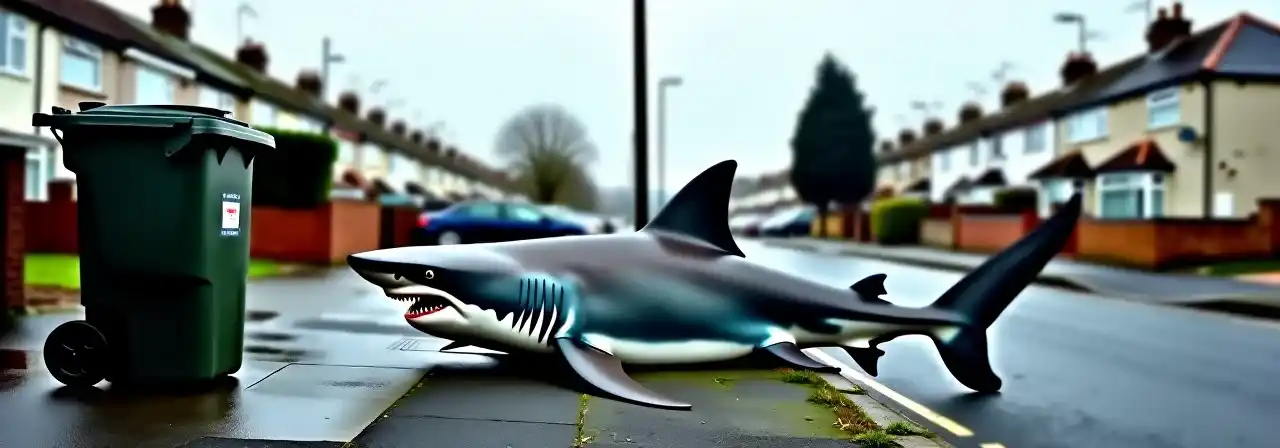
There are roughly 500 species of shark in the world's oceans. Most of them are small, harmless, and about as interested in eating you as you are in eating a shoe. But the ones people think about when they hear the word "shark" are the large coastal predators: great whites, bull sharks, tiger sharks. Fish built like torpedoes with serrated teeth and an electroreceptive sixth sense that can detect your heartbeat from several metres away.
Now give them legs.
What kind of legs are we talking about
This matters more than you'd think. If we're giving sharks stubby amphibian legs, little gecko arms splayed out to the side, then the threat is real but manageable. A great white shark weighs up to 2,268 kilograms. On stubby legs, it's moving at maybe walking pace. Terrifying, but you could outrun it. Probably.
If we're giving them proportional legs, muscular quadruped limbs like a large cat, scaled to their body weight, then the calculation changes entirely. A tiger weighs about 300 kilograms and can sprint at 65 kilometres per hour. A great white on tiger-proportioned legs, at seven times the mass, probably can't match that speed. But it doesn't need to. Even at 30 kph, it's faster than most humans.
And it's armoured in dermal denticles, has a bite force of approximately 18,216 newtons, and can detect the electrical impulses of your nervous system through the ground.
For the purposes of this thought experiment, let's go with functional quadruped legs. Because if we're imagining nightmares, we might as well be honest about them.
Coastal living ends
Roughly 40% of the world's population lives within 100 kilometres of a coastline. That's about 3.2 billion people sharing habitat with an apex predator that can now stroll up the beach and into town.
How far inland would land-sharks travel? Sharks need to keep their gills wet. Even with functional legs, they're still fish. Their respiratory system extracts oxygen from water passed over gill membranes. On land, those gills dry out. So your land-shark's range is limited by humidity and access to water.
In tropical climates with high humidity, they might manage several hours ashore. Near rivers, streams, and lakes, they'd have essentially unlimited range inland. Think about that for a moment. Every river in every country that has sharks in its coastal waters becomes a shark highway. The Thames. The Mississippi. The Ganges. The Amazon, which already has bull sharks swimming 4,000 kilometres upriver to Iquitos, Peru.
Bull sharks, by the way, are the species you should actually worry about. They already tolerate fresh water. They're aggressive. They hunt in murky, shallow water where visibility is poor. Give them legs and they're the thing that crawls out of the river behind your garden while you're hanging out washing.
The infrastructure response
Coastal cities would need walls. Not metaphorical barriers or planning restrictions. Physical walls. Shark-proof fencing along every beach, river mouth, and waterfront. Australia already has shark nets along many of its popular beaches, though these are controversial because they kill other marine life. In the land-shark timeline, those nets are replaced by solid barriers with foundations deep enough that a 2,000-kilogram predator can't push through.
Beach holidays become extreme sports. "Going to the seaside" requires the same risk assessment as "going on safari." You check the shark forecast. You book a fenced resort. You don't wander off on your own after dark.
Property values along coastlines collapse. The premium for a sea view becomes a discount for proximity to predators. Everyone moves inland. House prices in Stoke-on-Trent, about as far from the sea as you can get in England at 70 miles, increase fivefold. Stoke becomes a desirable address. This is perhaps the most destabilising consequence of the entire scenario.
Ecosystems rearrange
Land-sharks wouldn't just terrorise humans. They'd devastate coastal wildlife. Seals, which currently escape sharks by hauling out onto beaches and rocks, lose their safe havens. Seal populations crash. Seabirds nesting on coastal cliffs are now accessible to a climbing predator. Penguin colonies in the southern hemisphere are wiped out within a generation.
But there are winners. Scavengers thrive. Any animal that can eat the remains of a shark's land-based kills benefits. Crows, foxes, rats. The rat population near coastlines explodes, which brings its own public health problems. You've traded one large, visible predator for millions of small, disease-carrying ones.
Deer populations near rivers drop sharply, which means less overgrazing, which means forests recover. Ecologists have a concept called a "trophic cascade" where the reintroduction of an apex predator reshapes an entire ecosystem from the top down. Wolves did this in Yellowstone. Land-sharks would do it to every coastal and riparian ecosystem on the planet, on a scale that makes the wolf reintroduction look like a school science project.
Culture shifts
Jaws wasn't just a film. It reshaped how an entire generation thought about the ocean. In 1975, beach attendance in the United States dropped measurably after the film's release, even though the statistical risk of shark attack hadn't changed. The fear was irrational but real.
Now make the fear rational. Shark attacks on land are documented, frequent, and occasionally happen in car parks. The cultural response would be intense. Shark hunts become politically popular. Conservation efforts for sharks, already difficult to fund in our timeline, become impossible. "Save the sharks" is a harder sell when one ate someone's dog in Bristol last Tuesday.
Religions develop shark mythology. Coastal cultures that already revere or fear sharks develop elaborate rituals around land-shark avoidance. Children grow up with shark drills the way they currently grow up with fire drills.
And somewhere, inevitably, someone keeps one as a pet. It goes exactly as well as you'd expect.
Would we survive
Of course we would. Humans coexisted with cave lions, sabre-toothed cats, and giant short-faced bears for hundreds of thousands of years. We're very good at killing things that threaten us. Too good, usually. Land-sharks would be hunted, fenced out, and gradually driven to extinction in any area with a significant human population. The only land-sharks left would be in protected reserves, behind very tall fences, visited by tourists in reinforced vehicles.
The phrase "jump the shark" would, at least, finally make sense to everyone.