On 25 December 1991, Mikhail Gorbachev resigned as President of the Soviet Union. The red flag came down over the Kremlin. Fifteen new countries appeared on the map overnight. The Cold War was over and the West had won.
But what if Gorbachev had succeeded? What if the reforms held, the hardliners failed to coup, the economy stabilised just enough, and the Union survived? Not thrived. Just survived. A reformed, battered, diminished Soviet Union limping into the 21st century.
What survival would have required
The Soviet economy in 1991 was in freefall. GDP had contracted by roughly 17% in two years. Consumer goods were scarce. The rouble was nearly worthless against the dollar. Oil prices, the Soviet Union's primary hard currency earner, had collapsed in the mid-1980s from about 30 dollars per barrel to around 10.
For the Union to survive, something needed to break differently. The most plausible scenario: Gorbachev's New Union Treaty, which would have restructured the USSR as a looser federation of sovereign republics with shared defence and foreign policy, actually gets signed. In our timeline, the August 1991 coup attempt by communist hardliners derailed it. Without that coup, the treaty was days from signing. Nine of the fifteen republics had agreed to it.
So the Union reforms. The Baltic states leave anyway, because they were never willing partners. Georgia leaves. Maybe Armenia. But Russia, Ukraine, Belarus, Kazakhstan, and the Central Asian republics stay in a reconfigured union. Call it the Union of Sovereign States, which was the actual proposed name.
No NATO expansion
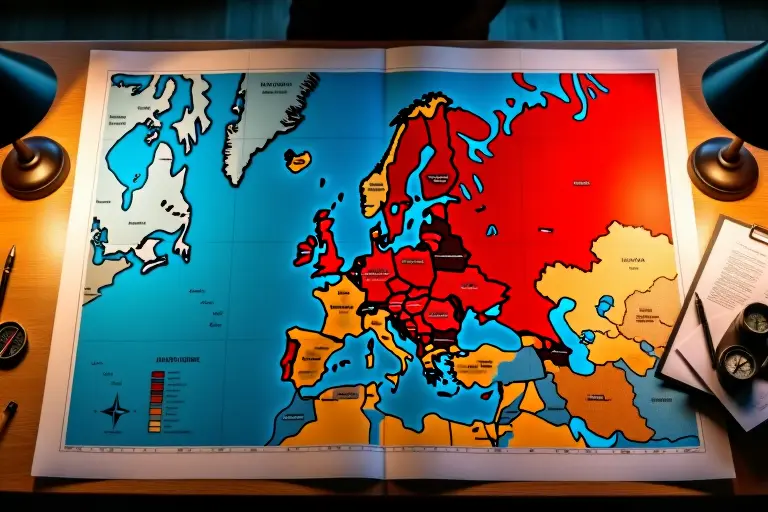
This is the single biggest geopolitical consequence. In our timeline, NATO expanded eastward three times after 1991: in 1999 (Poland, Czech Republic, Hungary), 2004 (the Baltic states plus four others), and 2009 (Albania and Croatia). This was possible because the Soviet Union no longer existed to object.
With a surviving USSR, none of this happens. Poland, Hungary, and the Czech Republic remain in a grey zone between two blocs. The Baltic states, if they managed to leave the Union, would be independent but unallied, like Finland during the Cold War. The buffer zone between NATO and Soviet territory would persist. Eastern Europe stays in limbo.
The European Union's eastern expansion would also stall. The EU admitted ten new members in 2004, most of them former Soviet bloc states. A surviving Soviet Union would view EU membership for its former satellites as hostile encirclement, which it essentially was from a strategic perspective, regardless of how Brussels framed it. Economic integration of Eastern Europe into Western markets would be slower, more cautious, and continuously negotiated against Soviet objections.
No unipolar moment
The 1990s, as Americans experienced them, were a decade of uncontested global dominance. One superpower. One economic model. One military that could project force anywhere on Earth without a peer competitor. Francis Fukuyama famously declared the end of history. The Washington Consensus spread free-market economics to every corner of the world. American culture, American brands, American foreign policy operated without meaningful opposition.
None of this happens with the USSR still standing. The United States would remain the stronger of the two powers, but its freedom of action would be constrained by the same Cold War logic that governed the previous four decades. Every American military intervention would be weighed against Soviet reaction. The Gulf War in 1991 might still happen, since Iraq had no Soviet treaty, but the Kosovo intervention in 1999 almost certainly wouldn't. The Soviets would have vetoed it at the Security Council and backed Serbia as a traditional Slavic ally.
The 2003 invasion of Iraq? Impossible. The Soviet Union would have supplied Iraq with weapons, intelligence, and diplomatic cover, exactly as it did throughout the 1980s. Saddam Hussein would remain in power, contained but not overthrown. The entire chain of consequences that followed, the insurgency, the rise of ISIS, the destabilisation of Syria, either doesn't happen or happens very differently.
The economic trajectory
A reformed Soviet Union with market elements (along the lines of China's eventual path) would have had certain advantages. It possessed vast natural resources: oil, gas, metals, timber. It had a large, educated workforce. It had existing industrial infrastructure, even if much of it was outdated. When oil prices recovered in the 2000s, rising from about 20 dollars per barrel in 1999 to 140 in 2008, the Soviet economy would have boomed alongside Russia's. Perhaps more so, since Ukraine's agricultural output and Kazakhstan's mineral wealth would have been part of the same economic unit.
But the structural problems would persist. Central planning, even reformed central planning, is bad at producing consumer goods. The Soviet Union was always better at making tanks than televisions. A hybrid economy would have improved living standards from the 1991 nadir, but catching Western European levels of prosperity would remain out of reach. The quality of life gap would narrow without closing.
The oligarch phenomenon, where state assets were sold to connected insiders for fractions of their value during the 1990s privatisation, wouldn't happen in the same form. This is one of the clearest positives. The looting of Russian state industry by a handful of men who happened to be in the right meetings in 1993 was a catastrophe for ordinary Russians. A surviving Union with controlled reform would have avoided the worst of it, though corruption would find other channels. It always does.
Ukraine
The question everyone is thinking about. In our timeline, Ukraine declared independence in December 1991 and has spent the subsequent decades building a separate national identity, orienting toward Europe, and fighting a war with Russia since 2014.
In the surviving-USSR scenario, Ukraine remains inside the Union. Not happily, necessarily. Ukrainian nationalism existed throughout the Soviet period and would have grown stronger with glasnost. But the formal structures of union, the shared military, the economic interdependence, the political framework, would have prevented the clean break that occurred in our timeline.
The war that began in 2014 doesn't happen. Not because the underlying tensions don't exist, but because the context that created it (NATO expansion, the EU association agreement, the Maidan revolution, Russian fears of losing Ukraine to the West) doesn't arise in a world where the Union still holds. The tensions would express themselves differently: as internal politics within the Union rather than as an international conflict.
This isn't necessarily better for Ukrainians. It's just a different kind of constraint. Independence and war versus union and subordination. Neither option is what anyone would choose if they could design their own history.
What the world would feel like
The internet would still exist. The Soviets didn't invent it, but they'd have adopted it, probably with heavy state filtering from the start. A Soviet internet would look more like China's: functional, commercially active, but with a firewall and content controls. Russian-language internet culture would have developed differently. The anarchic, freewheeling Russian internet of the 1990s and 2000s was a product of the state's temporary weakness. A surviving Soviet state would never have allowed that degree of digital freedom.
Global culture would be less homogeneous. American cultural dominance in the 1990s and 2000s was partly a consequence of having no ideological competitor. With the USSR still operating, Soviet cinema, music, and media would continue to offer an alternative cultural sphere for a third of the world's population. Whether that's better or worse depends on your taste and your politics.
The psychological effect on the West would be the most subtle and perhaps the most significant change. The triumphalism of the 1990s, the sense that liberal democracy and free markets had permanently won, shaped Western politics for a generation. That certainty led to complacency, to financial deregulation, to the assumption that markets would self-correct and democracy would inevitably spread. Without the Soviet collapse confirming those beliefs, Western policy might have been more cautious, more self-critical, and less convinced of its own inevitability. Or it might have been more paranoid, more militarised, and more willing to sacrifice civil liberties for security. The Cold War had a way of justifying both.