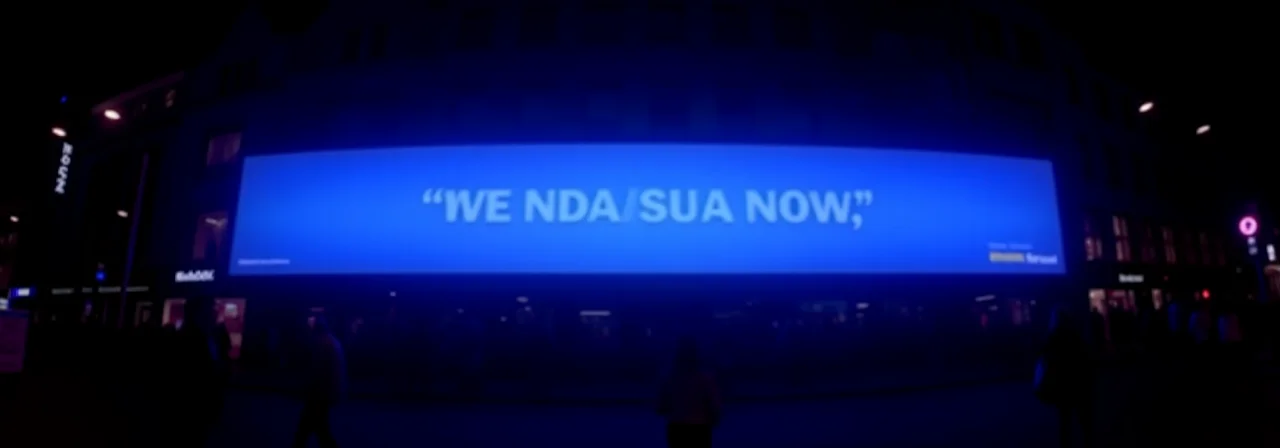
You step into the shower. The water hits the right temperature. Your muscles relax. Your brain, freed from the tyranny of screens and schedules, starts to wander. And somewhere above the nearest motorway, a digital billboard flickers to life with your thought displayed in 20-foot sans-serif letters.
"If you drop soap on the floor, is the floor clean or is the soap dirty?"
Forty thousand commuters read that on the M25 this morning. Three of them rear-ended the car in front because they were thinking about it too hard.
The mechanics
Let's establish the rules. Every time you have a thought while showering, it appears on the nearest public billboard to your location. Real-time. Verbatim. Attributed to you, full name, like a quote in a newspaper. The billboard returns to normal advertising when you stop showering or stop thinking, whichever comes first. (Stopping thinking, incidentally, is much harder than stopping showering.)
There is no opt-out. There is no filter. Whatever crosses your mind goes up in lights.

This changes everything about the morning routine.
The first week
For about 48 hours, it would be funny. People would screenshot the billboards. Social media would be flooded with them. Someone in Croydon thinking "do fish know they're wet?" would go viral. A plumber in Dundee wondering "if you hit yourself and it hurts, are you strong or are you weak?" would get a book deal.
The novelty would be intense. Morning commutes would become entertainment. People would slow down near billboards instead of speeding past them. The billboard advertising industry, which generates roughly £1.4 billion annually in the UK, would collapse overnight because nobody is looking at the Coca-Cola ad when Dave from Peterborough is philosophising about whether identical twins ever get confused about which one they are.
By day three, the fun would start to curdle.
The thoughts you don't want shared
Here's the thing about shower thoughts. The ones that make it onto Reddit are the charming ones. The observations about language, the quirky what-ifs, the gentle philosophical musings. But your brain doesn't only produce those in the shower. Your brain also produces anxiety spirals, petty grudges, intrusive thoughts, and the occasional dark fantasy that you'd never act on but would be mortifying if anyone saw.
"I wonder if Sarah from work knows everyone talks about her behind her back."
That's on a billboard now. In Sarah's postcode.
"I could probably get away with not paying that invoice."
"My mother-in-law's cooking is genuinely terrible."
"What if I just didn't go to work ever again."
All of these are normal, private thoughts that every functioning adult has and that no functioning adult would say out loud. The shower is where your brain processes things without a social filter. Put that processing on a billboard and you haven't created transparency. You've created a surveillance system pointed at the one place people are genuinely unguarded.
The shower economy
People would adapt. Humans always adapt to humiliation by turning it into commerce.

First, shower times would plummet. The average UK shower is 7.5 minutes, according to a 2023 Energy Saving Trust study. That would drop to under two minutes. Get in, wash, get out. Do not think. Focus on the shampoo. Count tiles. Recite the alphabet backwards. Anything to keep your mind blank.
Meditation instructors would pivot entirely to "shower mindfulness" courses. Clear your mind before you clear your body. Monasteries would offer residential retreats focused entirely on thought suppression during bathing.
Some people would go the other direction. Influencers would deliberately use their shower time to broadcast content. Scheduled shower sessions at peak commute hours, crafting their thoughts for maximum engagement. "Shower thought influencer" would be a job title. They'd have agents. Brand deals. Morning routines that include twenty minutes of scripted philosophical musing under hot water. The billboard equivalent of a podcast.
Advertisers would try to hack it. "Think about Pepsi in the shower and we'll pay you £500." There would be apps that train you to think branded thoughts on cue. It sounds absurd. It is absurd. It would also work.
Relationships would suffer
Imagine living with someone whose shower thoughts you can read on the billboard outside your window every morning.
"I miss being single."
That's not a statement of intent. It's not a plan. It's an idle thought, the kind that floats through everyone's head and means nothing. But try explaining that to your partner who just watched it appear in glowing letters above the Tesco Express.
Couples would stop showering at home. Gym memberships would spike. People would drive to industrial estates where the nearest billboard is far away, hoping their thoughts appear on some rural road sign instead of the one outside the school gates. The logistics of avoiding your own broadcast would become a daily calculation.
Divorce lawyers would start citing billboard transcripts as evidence. "Your Honour, on the morning of March 14th, the defendant's billboard displayed, and I quote, 'I should have married Tom instead.'"
The political dimension
Politicians would stop showering entirely. Or they'd shower in Faraday cages, hoping that whatever mechanism links thought to billboard can be blocked by electromagnetic shielding. (It can't. The rules say no opt-out.)
Imagine the Prime Minister's morning shower broadcast on the billboard outside Downing Street. "I have no idea what I'm doing with the economy." "I only appointed her because she'd cause trouble on the backbenches otherwise." "God, I hope nobody asks about that report I haven't read."
Every election would be won or lost in the bathroom. Voters wouldn't need manifestos. They'd just check the billboard outside the candidate's house at 7:15am.
Diplomacy would be impossible. World leaders meeting at summits would know, because everyone read the billboard that morning, that the other leader privately thinks their country is a joke. International relations already run on polite fiction. Remove the fiction and you're left with a room full of people who know exactly what everyone else really thinks of them.
The quiet adaptation
Eventually, after the lawsuits and the breakups and the political crises, society would reach some kind of equilibrium. Not a comfortable one, but a functional one.
People would develop a tolerance for other people's unfiltered thoughts, because everyone's unfiltered thoughts would be public. You can't judge someone for thinking "I wonder what it's like to punch a swan" when your billboard said "I eat cereal with water sometimes" last Tuesday. Mutually assured embarrassment.
The phrase "it was just a shower thought" would become the ultimate social defence. A legal defence, even. Courts would have to grapple with the distinction between thinking something and meaning it. Thought crime, previously a dystopian hypothetical, would be a real legislative question.
And somewhere in all of this, a small, quiet minority of people would discover that they quite enjoy it. The relief of having no secrets. The freedom of a brain that has nothing left to hide because it already showed the worst of itself on a billboard above the A406 on a rainy Wednesday.
They'd be the weird ones, obviously. But they'd also be the only ones still taking long showers.