
My cat, if she could text, would send exactly one message per day. It would arrive at 4:47 PM. It would say "food." No punctuation. No greeting. If I didn't respond within ninety seconds, she'd send it again. And again. And again, until I appeared in the kitchen like a summoned butler.
This is not speculation. This is who she is as a person.
But the thought experiment is too good to leave at cats being rude. What if every pet, across every species, suddenly gained the ability to send text messages? Not talk. Not think in complex sentences. Just text, at whatever cognitive level they actually operate on.
Dogs would be unbearable
A Labrador Retriever's text history would read like the output of a broken slot machine. "ARE YOU COMING HOME." "I HEARD A NOISE." "FALSE ALARM IT WAS THE FRIDGE." "ARE YOU COMING HOME." "THERE IS A SQUIRREL." "I LOVE YOU." "ARE YOU COMING HOME YET." All caps, always. Dogs don't have an indoor voice and they wouldn't have an indoor font.
Separation anxiety, which already affects roughly 14% of dogs according to veterinary research, would become a phone problem. Your device buzzing forty times an hour while you're trying to work. You'd have to explain to your boss why your phone keeps lighting up. "It's my dog." "Turn it off." "He'll think I'm dead."
And they'd believe every departure was permanent. You go to the bins and your phone explodes. You step into the shower and three missed messages appear before you've found the shampoo. The emotional neediness of a golden retriever, expressed through the medium of text, would make the most intense human relationship you've ever had look casual by comparison.
Cats would weaponise read receipts
Cats already communicate contempt through body language. Give them a keyboard and they'd become the most passive-aggressive texters on the planet. Messages like "the dry food again. interesting." Or "I see you bought a new sofa. it would be a shame if something happened to it." Never exclamation marks. Never emoji. Just flat, judgemental observations sent at 3 AM.
They'd also leave you on read constantly. You send a photo of a new cat toy you've bought. Delivered. Read. Nothing. You text "do you want treats?" Read immediately. Response four hours later: "fine."
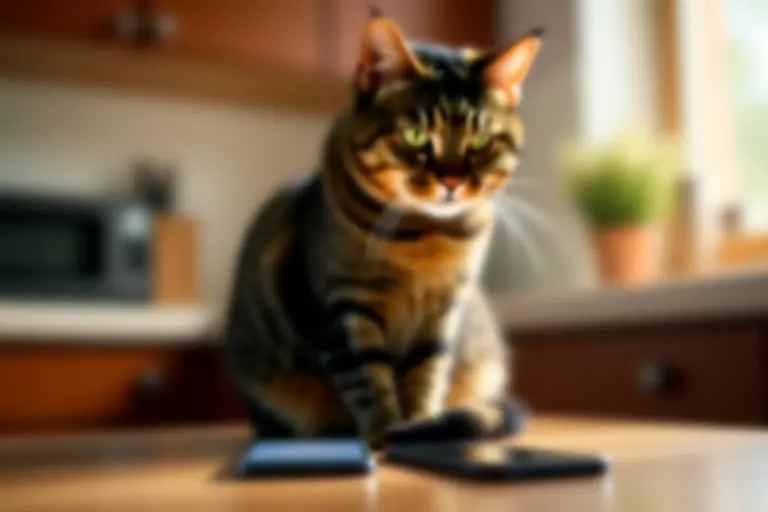
The power dynamic, already tilted in the cat's favour, would become absurd. They'd use texting the way a middle manager uses email: as a tool of control, not communication.
Fish would have nothing to say
Goldfish have a memory span longer than the myth suggests (closer to five months, actually), but their inner life is presumably not rich with conversational material. A goldfish's texts would be sparse. "Bubble." Then silence for six hours. "Bubble." Perhaps, once a week, something ambitious: "the castle moved." It didn't. It's glued to the bottom of the tank.
Tropical fish might be slightly more varied. A betta fish would probably text threats to its own reflection. Clownfish would send passive reports about the anemone. But by and large, fish ownership would remain a one-sided relationship, just with occasional proof that someone is home.
The hamster problem
Hamsters are nocturnal. Every text would arrive between 11 PM and 5 AM. "Running." "Still running." "Running more." "Found a seed." "Running." The content wouldn't be the issue. The timing would be brutal. You'd wake up to thirty-seven messages, all variations on locomotion and snacks.
Hamster owners would develop the same relationship with their phones that new parents have: constant low-grade dread about what happened while they were asleep, followed by relief that the answer is "nothing, just running."
Parrots would be horrifying
Parrots can already talk. Give them texting and they'd be the one pet that could actually hold something resembling a conversation. African greys have vocabularies of up to 1,000 words and can use them in context.
The problem is that parrots live for decades. An African grey can live to 60. That's sixty years of texting. They'd outlive relationships. They'd remember things you said to ex-partners and bring them up unprompted. They'd text your new girlfriend something your old girlfriend used to say. They'd store grudges in group chats.
A parrot with a phone is essentially a housemate who never leaves, never forgets, and has no concept of social boundaries.
What would actually change
Veterinary care, immediately. Instead of guessing what's wrong with a limping dog, you could just ask. "Where does it hurt?" "LEG." "Which leg?" "THE LEG." Not sophisticated diagnostic information, but better than nothing. Pet owners currently spend an average of £1,600 over their pet's lifetime on veterinary bills in the UK, and a meaningful chunk of that is diagnostic. If the animal could say "my stomach hurts and I ate something from the bin on Tuesday," half those appointments get shorter.
Animal welfare would transform overnight. Neglect would become provable. A dog texting "haven't eaten in two days" is evidence. Puppy farms would be exposed by the puppies themselves. The RSPCA would have a very different kind of tip line.
And then there's the uncomfortable bit.
If your pet can text you, it can express preferences. And if it can express preferences, you have to start taking them seriously. The chicken in your fridge becomes a more complicated situation when your dog can identify what it is and your parrot can comment on it. Vegetarianism wouldn't become mandatory, but meal times would get awkward.
The group chat
Multi-pet households would develop the most chaotic group chats in human history. The dog reporting every sound. The cat responding with contempt. The hamster checking in at 2 AM with "seed update." The rabbit, who has been in the chat for three months, has sent exactly one message: "hay." Nobody knows what it means beyond the obvious.
You'd mute the chat within a day. Everyone would. And your pets would know you muted them. The cat would find this confirming. The dog would find it devastating.
The real outcome of pets being able to text isn't that we'd understand them better. It's that we'd finally have proof of what we already suspected: they have opinions about us, and not all of them are flattering.