Your eyes detect electromagnetic radiation between roughly 380 and 700 nanometres in wavelength. That's visible light. It's a tiny sliver of the full electromagnetic spectrum, which stretches from gamma rays at one end (wavelengths smaller than an atom) to radio waves at the other (wavelengths longer than a football pitch).
Radio waves are everywhere. They carry Wi-Fi, mobile phone signals, FM radio, television broadcasts, Bluetooth, GPS, emergency services communications, air traffic control, satellite data. Right now, as you read this, your body is being passed through by radio waves from dozens of sources. You can't feel them. You can't see them.
What if you could?
Your Wi-Fi router is a bonfire
A typical home Wi-Fi router broadcasts at 2.4 or 5 GHz, pumping out radio waves in all directions. If you could see these waves, the router would be one of the brightest objects in your house. Not a gentle glow. A pulsing, flickering sphere of radiation expanding outward through walls, floors, ceilings. It doesn't stop at the edge of your property. Your neighbours can see your router glowing through the wall, and you can see theirs.
The colour of radio waves is an interesting question. Our visual system maps wavelength to colour: short wavelengths look violet, long wavelengths look red. Radio wavelengths are far longer than any visible light, so they'd need new colours. Colours that don't exist in our current perception. The brain would have to invent them. For simplicity, imagine radio waves as a deep, warm red, well beyond infrared, getting darker and deeper as the wavelength increases.
In a shared house, you'd see three or four routers blazing away through the walls of neighbouring flats. Coffee shops with public Wi-Fi would have a visible haze hanging in the air. The signal strength bars on your phone would be redundant because you could literally see how strong the signal was by how bright the glow appeared.
Mobile towers are lighthouses
A single mobile phone tower broadcasts at around 20 to 50 watts per channel across multiple frequency bands. There are roughly 400,000 mobile towers in the UK alone. Each one would be a pillar of light visible for miles, a visible beacon sweeping the landscape with directional beams aimed at coverage areas.
From a hilltop, you'd see them studding the horizon in every direction. Cities would be forests of glowing towers, each one surrounded by a halo of signal. The countryside would be visibly darker, with towers spaced further apart and their beams stretching longer across open terrain to reach the next settlement.
You'd be able to see mobile coverage gaps with your own eyes. That dead zone on the A303 where your phone drops to one bar? You'd watch the signal thin to a faint glow and then disappear entirely, the tower's beam not quite reaching the dip in the road.
Cities become blinding
Add it all up. Every router. Every mobile tower. Every Bluetooth device (earbuds, smartwatches, car stereos, wireless keyboards). Every microwave oven (yes, they leak a small amount of 2.4 GHz radiation). Every car's keyless entry system. Every baby monitor. Every smart meter pinging its readings back to the energy company.
The average home in 2026 contains between fifteen and twenty wirelessly connected devices. Each one is a small radio transmitter. Your pocket contains a phone that communicates simultaneously with mobile towers, Wi-Fi routers, Bluetooth accessories, and GPS satellites. It's a torch in four different frequency bands.
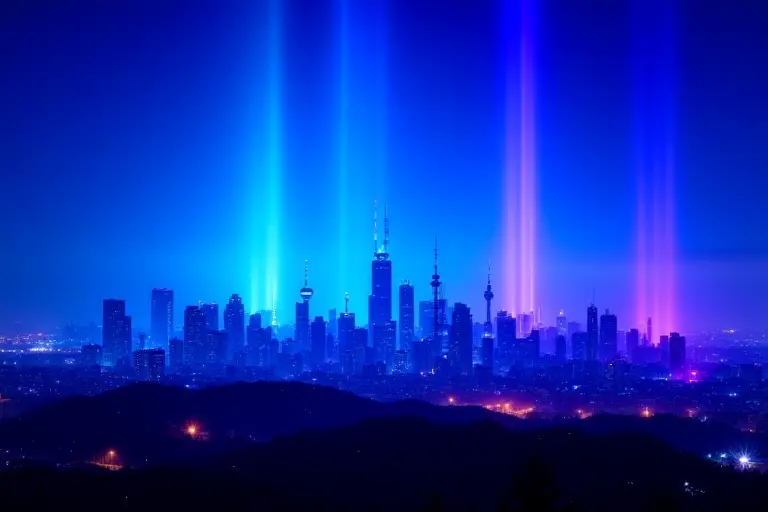
A city seen from a distance at night is already spectacular. Add visible radio emissions and it would be overwhelming. London wouldn't just glow with streetlights. It would blaze with the combined output of millions of radio transmitters, a dome of electromagnetic light visible from the home counties. The glow would be brighter than the visible light, because radio transmitters operate around the clock and collectively pump out far more energy than the city's illumination.
Radio frequency light pollution would become a genuine issue. Just as visible light pollution washes out the stars, radio light pollution would wash out fainter radio signals. Astronomers already struggle with radio frequency interference at observatories. If everyone could see it, the scale of the problem would be viscerally obvious.
The countryside goes dark
Drive an hour out of any city and the radio spectrum thins dramatically. Fewer towers. Fewer devices. Fewer overlapping signals. In truly remote areas, the Highlands of Scotland, rural mid-Wales, parts of Northumberland, the radio landscape would be almost completely dark.
You'd see the occasional flicker of a satellite signal overhead, thin beams of GPS and communication satellites crossing the sky like very slow shooting stars. The faint pulse of a distant tower on the horizon. But mostly, silence. The electromagnetic equivalent of a clear, dark sky.
People would travel for it. Radio-dark tourism. Retreats in the Scottish Highlands marketed not for their scenery but for the absence of electromagnetic noise. A place where you can't see any radio waves at all. Complete spectral silence.
The irony is that these would be the same places you currently go when you want to escape your phone. The appeal would be the same. Just visible.
Radar paints the sky
Heathrow Airport runs several primary surveillance radars, each rotating continuously and sending out pulses of radio energy that bounce off aircraft and return to the antenna. If you could see this, the radar would look like a searchlight sweeping the sky in a circle, its beam hitting aircraft and scattering in all directions.
Weather radar would be visible as a slow, sweeping glow from Met Office installations. Military radar, operating at higher power, would be visible from much further away. The Fylingdales early warning station on the North York Moors, which monitors ballistic missile launches, would be one of the most visible artificial structures in the country, broadcasting enormous pulses of energy into the sky 24 hours a day.
Ships at sea would see each other's navigation radar as rotating beams. Police speed cameras would have visible beams crossing the road. "I could see the speed trap" would be literal.
Your body becomes an antenna
Human bodies are moderately good at absorbing radio waves, particularly at the frequencies used by mobile phones (700 MHz to 2.6 GHz). Your body absorbs roughly 40 to 60 per cent of the mobile phone signal that hits it, converting it to tiny amounts of heat. If you could see this absorption, people standing near transmitters would have a faint glow around them, as radio waves are absorbed into skin and scattered by bone and tissue.
Holding your phone to your ear would look like pressing a small, bright torch against the side of your head. The signal would be visible entering your skull, scattering through tissue, partially absorbed and partially re-radiated. It's the same thing that happens now, just visible.
This would terrify people. The health effects of mobile phone radiation have been studied extensively and the scientific consensus is that the energy levels are far too low to cause tissue damage. But seeing radiation enter your head is viscerally different from knowing it theoretically. Rational assessment of risk tends to evaporate when you can watch the thing happening in real time.
Mobile phone usage would probably drop, at least temporarily, not because the science changed but because the visibility did.
We'd finally understand the spectrum
Right now, radio spectrum allocation is an abstract regulatory exercise managed by Ofcom. Frequency bands are auctioned to telecoms companies, reserved for emergency services, allocated to broadcasters. It's invisible governance of an invisible resource.
Make it visible and spectrum management becomes tangible. You could see when a frequency band is crowded, literally, because the associated colour would be brighter in that area. Spectrum hoarding by companies who bought bandwidth but aren't using it would be visibly obvious: dark bands amid bright ones.
Interference would be visible. When your Wi-Fi slows because the neighbour's microwave is operating on the same frequency, you'd see the two signals clashing, overlapping, garbling each other. Debugging wireless problems would be trivially easy. "Ah, I can see the signal isn't reaching the bedroom because the bathroom wall is absorbing it."
We'd also see, for the first time, just how saturated our environment is. Radio waves are the most pervasive artificial addition to the natural environment, far more ubiquitous than noise pollution or light pollution, and completely invisible. Making them visible would be like turning on the lights in a room you've been sitting in for decades. Everything is exactly where it was before. You just hadn't realised how full the room was.