
The average cumulus cloud, the fluffy white kind that children draw, weighs about 500,000 kilograms. That's roughly the mass of 80 elephants. You don't think about this because the water is dispersed across billions of tiny droplets suspended in a massive volume of air. It floats because it's less dense than the surrounding atmosphere, not because it's light.
Now make it solid.
Same mass, but condensed into a single rigid object. Sitting where the cloud was, ten kilometres above the ground, with nothing holding it up any more. It falls.
The physics of a falling cloud
A solid cumulus cloud would be roughly 1 kilometre across and maybe 500 metres tall. The shape depends on what "solid" means here (ice? rock? compressed water?) but for the purposes of watching it plummet, the shape matters less than the mass.
Five hundred tonnes falling from 10,000 metres. Terminal velocity for an object this size and shape would be complicated to calculate precisely (drag coefficients depend on surface area and density), but we're talking about something hitting the ground at several hundred kilometres per hour.
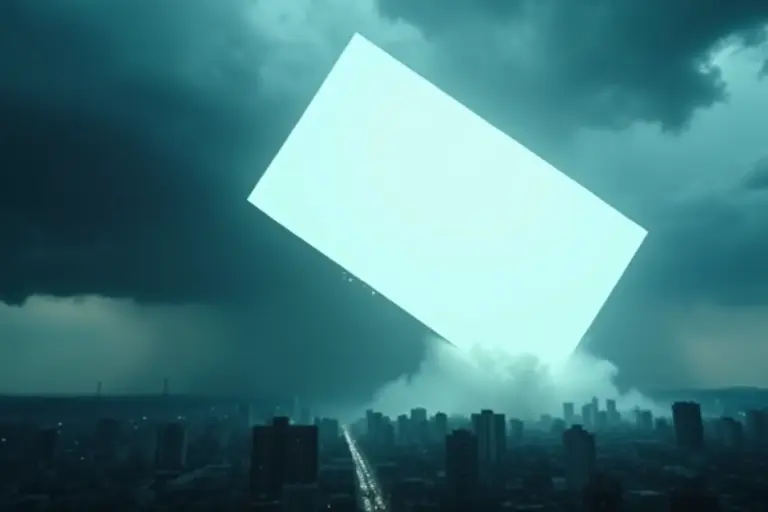
The impact energy is enormous. For comparison, a Boeing 747 weighs about 184,000 kilograms at maximum takeoff weight. This cloud weighs nearly three times that. And it's falling from higher than any commercial aircraft cruises.
If it hit a city, the destruction would look like a meteor strike. Not a dinosaur-killing one, but enough to flatten several blocks, generate a shockwave and leave a crater. From a cloud. The fluffy white thing you were looking at five minutes ago.
It gets worse with bigger clouds
Cumulus clouds are the small ones. A cumulonimbus thunderhead can weigh over a million tonnes. That's a billion kilograms of water, towering up to 20 kilometres high, now suddenly a solid block the mass of a large mountain falling from the edge of the stratosphere.
There is nothing in our engineering or our imagination that handles this. No building survives it. No bunker deep enough matters when the surface above it receives the equivalent of a small asteroid impact. A single solid thundercloud hitting London would be comparable in energy release to a tactical nuclear weapon, minus the radiation but with all the kinetic destruction.
And thunderstorms produce multiple cumulonimbus clouds. A supercell storm system could drop a dozen of these in an afternoon.
Weather forecasting becomes threat assessment
Meteorologists currently predict rain, wind and temperature. In this scenario, they predict falling buildings. The evening forecast would read like a military briefing. "A low-pressure system moving in from the Atlantic will bring 4-6 solid cloud masses, each weighing between 200,000 and 800,000 tonnes, expected to reach ground level between 2pm and 6pm tomorrow. Residents in the projected impact zone are advised to evacuate."
You'd need to predict not just where clouds form, but exactly where they solidify and fall. Cloud formation depends on humidity, temperature, pressure and wind patterns. Predicting the landing zone of a solid cloud would require tracking its formation point, the wind speed at altitude and the aerodynamics of whatever shape it freezes into. This is a harder problem than anything the Met Office currently handles.
Cloudy days become dangerous. Overcast skies are terrifying. A clear blue sky is the only safe sky.
Where could you live?
Deserts. Specifically, the driest ones.

The Atacama Desert in Chile receives an average of 15 millimetres of rain per year in its driest parts. Some weather stations there have never recorded any rainfall at all. Cloud formation is rare. In a solid-cloud world, the Atacama is prime real estate.
Antarctica's interior is also extremely dry (it's technically a desert, receiving less than 50mm of precipitation annually), but it's Antarctica, so the other problems are significant.
Most of the inhabited world becomes unlivable. The UK, famously cloudy, would be annihilated. London averages about 170 days of cloud cover per year. That's 170 potential bombardments. Britain, a country whose entire cultural identity involves complaining about clouds, would be wiped out by them.
Aviation is finished
Commercial aircraft currently fly through clouds routinely. In this world, flying through a cloud means hitting a solid wall at 900 km/h. There's no version of aviation that survives this. You can fly under clouds (suicidal, since they're falling) or above them (only possible if you can confirm the airspace above is clear, and new clouds can form at any altitude at any time).
Every flight becomes a game of dodging falling megastructures. Airlines would cease to exist within a week. Private aviation too. Helicopters, light aircraft, drones: nothing airborne is safe.
The water cycle breaks
Clouds are a stage in the water cycle. Water evaporates, rises, condenses into droplets that form clouds, then falls back as rain. If clouds solidify instead of raining, the water still returns to the surface (violently) but the distribution changes completely.
Rain falls relatively evenly across a wide area. A solid cloud hits a single point. Instead of watering a county, it obliterates a postcode and floods the impact zone. Rivers wouldn't receive steady rainfall. They'd receive occasional catastrophic water dumps from sky-blocks melting after impact.
Agriculture can't function. Crops need distributed water, not 500,000 kilograms of ice dropped onto a field from low orbit. Irrigation from underground aquifers becomes the only option, and those deplete fast without rain to recharge them.
Humanity retreats underground
Surface living becomes too dangerous anywhere that clouds regularly form. The only safe structures are underground or carved into solid rock. You'd need something capable of withstanding the impact of a falling cloud, which means essentially military-grade bunkers as residential housing.
Cities move underground. Or they move to deserts. Or both. The geography of civilisation inverts: historically fertile, well-watered regions become kill zones. Dry, barren regions become the only safe places to build.
The entire history of human settlement has been driven by access to water. In a solid-cloud world, it's driven by the absence of it. You want to live where it never rains because where it rains, the sky falls in 500-tonne chunks.
You'd never look at a white fluffy cloud the same way again. You'd never look at one at all. You'd be underground.