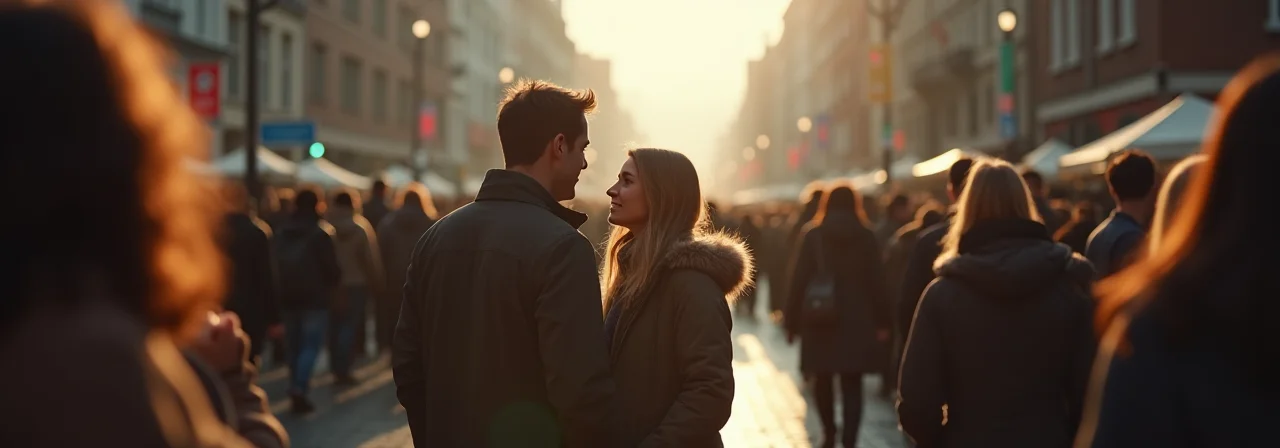
Imagine waking up tomorrow and finding you simply cannot lie. Not that you've decided to be honest, not that you're trying harder. Just that the words won't come out unless they're true. No fabrication, no deliberate misdirection, no "I'm fine thanks" when you're not. Every human on Earth, simultaneously, in exactly the same position.
The first thing most people imagine is politicians. Understandable. But the political fallout, entertaining as it would be, is actually one of the slower effects. The immediate chaos is far more local.
The first hour
Your alarm goes off. You have a meeting at 9am you've been quietly dreading. You open your email and start typing: "Looking forward to it!" You stop. Nothing comes out. You try: "See you there." Fine, that's true enough. You send it.
Your partner asks if you slept well. You say no, the mattress is awful, you've been meaning to say something for months. And now it's out there. Breakfast is already different.
Social lubrication is overwhelmingly false. Not maliciously false, just... false. Psychologists at the University of Massachusetts ran a study in 2002 and found that in a 10-minute conversation between strangers, 60% of people lied at least once — averaging 2.92 lies. Not scheming lies. Things like "I'm doing great," "I love your jacket," "no, I've seen that film." Little smoothings-over. Remove all of them and conversation becomes raw in ways we've genuinely never experienced as a species.
What actually breaks first
Not government. Not finance. Social life.
You'd find out within 24 hours which of your friendships are built on honest appreciation and which are built on comfortable habit. Turns out that's a terrifying thing to discover. Some friendships don't survive the question "do you actually want to come to this thing, or are you just being polite?" when the person has to answer honestly.
Work gets strange in different ways. Performance reviews become unusable in their current form. "You've been a fantastic addition to the team": is that true? Your manager now has to think very carefully before speaking. What actually comes out of their mouth: some version of "you're capable but you don't take enough initiative and I think you know that." Not cruel. Just unfiltered.

Doctors, interestingly, don't suffer much. Medical information is meant to be accurate. Patient histories become more reliable instantly. The classic underreporting of alcohol consumption (patients typically report about half of what they actually drink) disappears. Clinical outcomes probably improve.
The things that collapse
Diplomacy, as we know it, stops functioning. Not because diplomats lie constantly (though they do), but because the entire practice depends on maintaining positions in public that differ from positions held in private. A trade negotiator who must only say what they actually mean is not a negotiator. They're just a person at a table stating their country's actual bottom line, which is not how deals get made.
Fiction becomes complicated. Actors can say scripted lines because they're not asserting those things as true, they're performing. But salespeople who believe their product is mediocre and say so to customers have a real problem. Estate agents describing a small flat with no natural light as "cosy and atmospheric" find the words just don't form.
Advertising mostly dies. Not the kind that shows you a product and says "here it is," but the kind that implies things without stating them: that drinking a particular beer puts you on a beach with attractive people, that a luxury car means something about who you are. None of that is technically stated as fact, so the lying ban might not even catch it. But any advert that requires someone to say "this is the best product of its kind" when they know it isn't becomes impossible to shoot.
The things that might get better
Here's where it gets genuinely interesting, and genuinely complicated.
Confession becomes structurally impossible to delay. If you've done something wrong and someone asks you directly, you cannot construct a plausible denial. Wrongdoing of all kinds, domestic, professional, criminal, gets harder to sustain. Abuse thrives on denial and gaslighting. Both require lying. Remove that tool and victims are believed faster, perpetrators can't maintain their cover stories, and the whole machinery of abuse becomes harder to operate.
Courts simplify massively. Perjury as a crime becomes irrelevant because perjury as an act becomes impossible. Witness testimony, long the most unreliable part of any trial, becomes the most reliable. Cross-examination exists to catch people lying; with nobody lying, you're left with genuine disagreements about memory and interpretation, which is a much more honest problem to work with.
Mental health treatment probably improves. Therapy requires honesty to function, and a significant proportion of therapeutic time is spent getting patients to actually say what's happening rather than the acceptable version. That work disappears. Patients walk in and just say it.
The social adaptation
Humans are creative. We'd adapt.
Within weeks, you'd see the emergence of elaborate truth-compatible communication strategies. "Do I look good in this?" doesn't get a brutal yes or no; it gets "I think the blue one from last week suited you better." True. Diplomatic enough. We'd become very good at redirecting questions rather than answering them, because redirection isn't lying. We'd become expert at technically accurate framings. Lawyers do this already. The rest of us would learn fast.
There's a real question about whether this would produce a kinder world or just a more anxious one. Many people's sense of self depends on a kind of social fiction: that they're liked, that they're competent, that their colleagues respect them. Discovering the actual truth about how you're perceived is not always liberating. Often it's just painful. Growth, sometimes. But not comfortably.
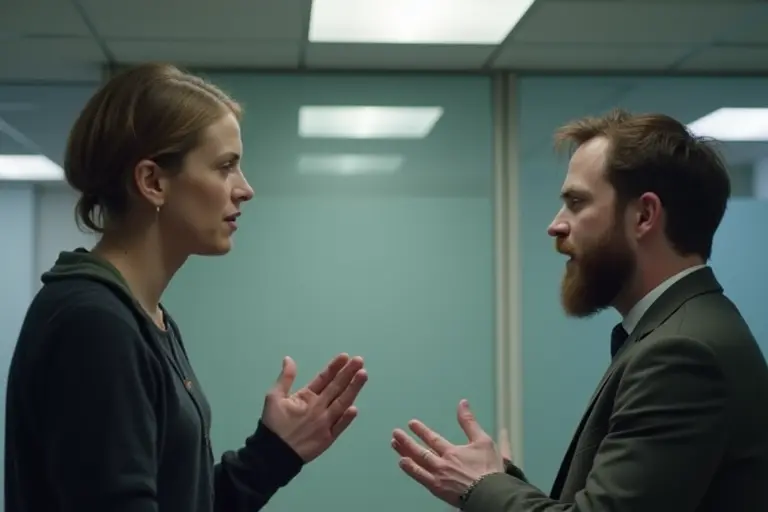
The white-lie economy is enormous and mostly invisible until it's gone. "Your presentation was great." "I didn't even notice." "The traffic was terrible." "I wasn't even slightly annoyed." All of these cost nothing and buy enormous amounts of daily goodwill. Lose them and you have to replace that goodwill with something else, or accept that relationships are slightly more abrasive than they were yesterday.
The one thing nobody talks about
Self-deception is a different problem. We lie to ourselves constantly: about our motivations, our feelings, our reasons for decisions. And we genuinely believe our own self-deceptions. If the constraint is on deliberate dishonesty to others, self-deception continues. You can still tell yourself you're fine, that you're not jealous, that you made the right decision. None of that counts as lying because you believe it.
Which means the ban on lying doesn't produce a world of perfect self-knowledge. It produces a world where we can't perform false comfort for each other, but we're still perfectly capable of performing it for ourselves. That's a strange, specific kind of clarity. You'd know exactly what your friends really think of you. You'd still have no idea what you really think of yourself.
Whether that's progress is a question I genuinely don't know the answer to.
Some days the polished version of things is what gets you through. And maybe that was always the point.