
You've got one. Right now, technically. The human coccyx is a fused set of four vertebrae at the base of your spine, and it's what's left of the tail your ancestors ditched roughly 25 million years ago. Evolution decided we didn't need one. But what if it had gone the other way? What if every human alive today was walking around with a proper, functioning tail?
Not a vestigial nub. A real one. Muscular, flexible, about 45 centimetres long, covered in skin. Something between a cat's tail and a monkey's, capable of broad movement and fine expression. You could swish it, curl it, maybe even grip things loosely if you practised.
Let's talk about the trousers.
The trouser problem
Every pair of trousers ever made would need a hole in the back. That sounds simple until you think about it for more than ten seconds. Where exactly does the hole go? How do you stop it gaping when the tail moves? What happens with belts? The entire garment industry, from Savile Row to Primark, would have evolved around this single anatomical inconvenience.
Jeans would probably have a reinforced tail slot with a button or press-stud closure above and below. Formal trousers would feature a tailored slit, neatly finished, with the tail emerging through a bias-cut opening. Cheap joggers would just have a stretched-out hole that gets worse in the wash.
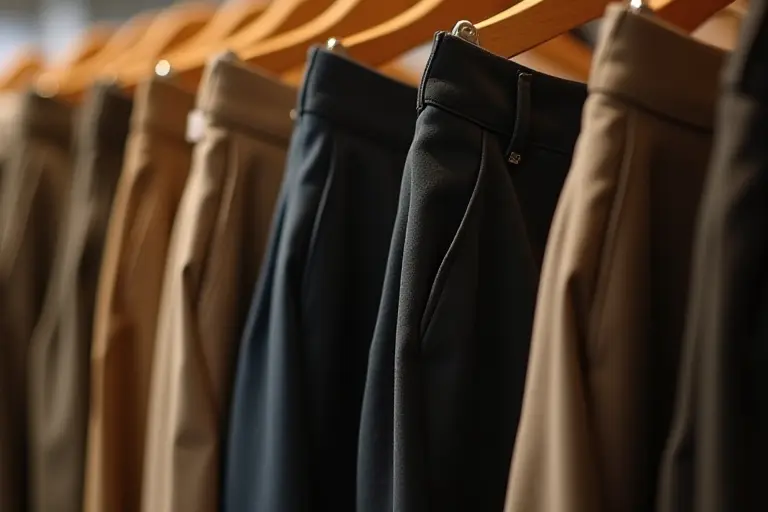
Underwear gets even more complicated. I'll leave the engineering specifics to your imagination, but suffice to say that pants designers would be among the most respected professionals in the fashion world.
Sitting down is a nightmare
Try sitting in a standard office chair right now. Notice how your back presses flat against the backrest. Now imagine there's a 45-centimetre appendage between you and that backrest, and it's sensitive.
Chairs would look completely different. Every seat ever designed would need a tail gap, a channel, or an open back. Dining chairs, car seats, cinema seats, aeroplane seats (already miserable, now with tail crush), park benches, toilet seats. All of them redesigned around the fact that humans have a large, bendy protrusion coming out of their lower back.
Office workers would develop "tail strain" from eight hours of poor tail posture. Ergonomic tail supports would be a genuine product category. Your company's health and safety officer would send round emails about correct tail positioning at your desk, and you'd ignore those too.
Your tail would grass you up constantly
This is where it gets properly interesting. If human tails worked anything like they do in other mammals, they'd be expressive. Dogs wag when happy, cats puff up when angry, monkeys use tail position to signal dominance. Your tail would broadcast your emotional state to everyone in the room whether you liked it or not.
Think about that in a job interview.
You're sitting there, maintaining perfect eye contact, delivering a confident answer about your five-year plan. Meanwhile your tail is curled tight against your leg, the tip twitching. Everyone in the room knows you're terrified. The interviewer's tail is doing slow, relaxed sweeps. Power move.
Poker would be a very different game. Bluffing would require not just a straight face but a straight tail, and that kind of muscular control would take years of deliberate practice. Professional poker players would train their tail discipline the way actors train their voices. Some people would never manage it. Their tail would give away a good hand before they'd even looked at their cards properly.
Dating would be absolute chaos. You're at a bar, trying to play it cool, and your tail is wagging like a golden retriever who's just spotted a tennis ball. There's no recovering from that. "Oh, this? No, it does this sometimes. Draught from the door." Nobody's buying it.
Tail language
We'd have developed an entire vocabulary of tail positions. Low and still for respect. High and loose for confidence. Wrapped around yourself for comfort or anxiety. A sharp flick for irritation.
Children would learn tail etiquette before they learned table manners. "Don't point your tail at people." "Keep your tail to yourself on the bus." "We do NOT wrap our tail around other children without asking." Primary school teachers would have to police an entirely additional limb, which is frankly more than they're paid for.
Different cultures would develop different tail norms. In Britain, you'd keep your tail neatly tucked in public, because visible emotional display is already frowned upon here. Letting your tail wag openly in a meeting would be seen as a bit much. Americans would probably wag freely and wonder why the British were all so repressed about it.
The practical bits
On the anatomy side, a functional tail would require significant changes to the human pelvis and lower spine. The sacrum would need to extend rather than terminate, with additional vertebrae, muscles, and a dedicated blood supply. The gluteal muscles would reshape to accommodate tail movement. Your centre of gravity would shift backward slightly.
Balance would improve. A tail is a counterweight. Gymnasts, climbers, and anyone who works at height would have a genuine advantage. Toddlers learning to walk would fall over less, which is honestly reason enough to want this to have happened.
But there'd be medical consequences. Tail injuries from car doors, from getting it caught in machinery, from someone standing on it in a crowded pub. Broken tails. Dislocated tails. A whole branch of orthopaedics dedicated to tail trauma. The NHS waiting list for tail-related complaints would be staggering.
The weird stuff
Tail grooming would be a thing. Tail hair (if we had it) or tail skin care. Tail jewellery. Tail tattoos. Someone, inevitably, would bedazzle their tail for a festival and immediately regret it.
Lifts would be more stressful than they already are. Six people in a lift is tight enough without six tails. You'd end up with your tail pressed against a stranger's leg, both of you pretending it wasn't happening. The London Underground during rush hour doesn't bear thinking about.
Sports would adapt. Tail-grabbing in rugby would either be a penalty or a legitimate tackle technique, and the argument would never be settled. Swimmers would have to decide whether to let the tail trail naturally (drag) or strap it to one leg (uncomfortable). Cyclists, already dealing with enough discomfort in the saddle region, would have yet another problem to solve.
Babies would be born with tails, obviously, and anyone who's held a newborn knows they already flail unpredictably enough. Add a tail and you've got a small, screaming octopus.
Would we actually want them?
Honestly, probably yes. Once you got past the furniture redesign and the trouser alterations and the excruciating social transparency, a tail would be genuinely useful. Better balance. An additional limb for carrying light objects. A built-in fidget device for meetings. And the emotional honesty might, after a few generations, make us a slightly less duplicitous species.
Or we'd all just get really good at tail control and lie with five limbs instead of four. That's probably more realistic.