
Imagine you wake up and your dog can talk. Or your cat. Or your elderly tortoise who has watched four generations of your family and has thus far kept his opinions entirely to himself.
You have one day. Twenty-four hours of genuine two-way communication, then it's gone. What do you ask? What do you find out? And perhaps more importantly: are you sure you want to know?
What "talking" would actually mean
Before we get into the fantasy of meaningful interspecies conversation, it's worth pausing on what this scenario actually requires. Language isn't just sound production. It involves shared conceptual frameworks, the ability to refer to things that aren't present, an understanding of cause and effect, and a theory of mind: the capacity to know that another being has thoughts different from your own.
Dogs score surprisingly well on some of this. Rico, a border collie studied by researchers at the Max Planck Institute, learned over 200 words and could apply fast-mapping to acquire new ones in a single trial, a feat previously thought exclusive to children. Chaser, another border collie, reached over 1,000 object labels. That's not nothing. But knowing what "ball" refers to is a long way from being able to discuss whether you were actually happy or just performing happiness.
Cats, incidentally, have been studied far less. This is partly because they don't reliably cooperate with researchers. Make of that what you will.
So let's assume the hypothetical works around these problems. Your pet has full linguistic access for a day. They can express whatever they actually think, in whatever terms they actually think it.
That's where it gets uncomfortable.
The food situation
The first ten minutes would probably be about food. I'm fairly certain of this. Not because animals are shallow, but because food is genuinely central to their existence in a way it isn't for most of us. A dog's daily schedule is largely structured around meals, the approach of meals, the hope of meals, and the retrospective contemplation of recent meals.
Your dog would almost certainly tell you the portion sizes are wrong. Either too small (most dogs) or too large (a smaller cohort). They might have opinions about flavour, about routine, about the exact moment in the morning that feeding should occur versus when it actually occurs. These opinions would be expressed with the confidence of someone who has been thinking about this for years.
Which, to be fair, they have.

The things they've been watching you do
Here's the question I'd actually be nervous about. Pets observe us constantly. They see us cry in the kitchen at midnight. They watch us argue and then pretend we weren't arguing. They're present for the moments we perform ourselves for other people and for the moments when we completely stop performing.
A dog has no concept of privacy because it's never needed one. If you asked your dog what they think of your relationship, your job, the state of your emotional life; they would tell you, in the flat, observational way of someone who has simply noticed what they've noticed. No diplomatic softening. No understanding that some things are better left unsaid.
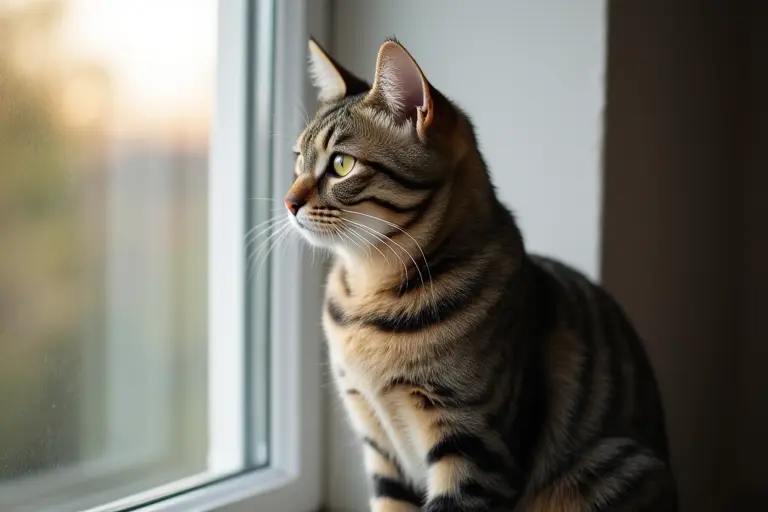
My cat has watched me stress-eat an entire sharing bag of crisps at 11pm on a Tuesday. I don't need her to acquire language to know what she thinks. But if she could articulate it, she would, probably with the same energy she uses when she knocks things off the counter: deliberate, direct, entirely without regret.
The things they don't know
This is where the scenario gets philosophically interesting rather than just emotionally awkward.
There are things your pet cannot possibly understand about their own situation. They don't know they're going to the vet until they're in the car and the journey is already the wrong length. They don't understand why some weeks you disappear for seven days and then come back. They don't know what "neutered" means in any context beyond their own body. They have no concept of lifespan, of the fact that a 13-year-old dog is, by most reckonings, in the final chapter of their story.
Would you tell them?
This is the question I keep coming back to. If your pet could understand you, genuinely understand and not just follow verbal cues, would you explain what's coming? Would you try to give them some framework for the things that must be confusing: the vet visits, the long absences, the occasional crying that has nothing to do with them?
Or would knowing somehow make it worse? Animals may experience anxiety and grief, but they don't seem to experience anticipatory dread the way humans do. A dog is not lying awake at 3am catastrophising about mortality. There is something almost merciful about that.
What cats would actually say
I'll speculate anyway. Not because I think it would be warm.
Cats maintain the emotional register of someone who agreed to move in with you for practical reasons and has found the arrangement largely acceptable. If your cat could talk, I suspect they would be interested in discussing their territory, their preferences, and any recent changes to the household routine they found objectionable. They might express what they feel towards you, but I'd expect it to land somewhere between "fond" and "resigned."
Cats communicate plenty as it is. The slow blink that ethologists generally read as a sign of trust. The chirruping at birds. The specific vocalisation that adult cats produce almost exclusively when communicating with humans; they don't meow at each other that way, so it seems to be something they developed for us specifically, which is either touching or very strange depending on your mood.
What a cat probably wouldn't do is offer reassurance. If you were hoping for "actually, I love you deeply and I'm sorry I knocked your glass over, I knew what I was doing," that conversation is not coming.
The gifts of not understanding
There's a version of this hypothetical that goes badly. You find out your dog is in more pain than you realised and has been for some time. You find out your cat is not happy about the new kitten, and not in a minor way. You discover your rabbit has been terrified of something in the house for two years and that you are, in fact, the thing.
Animal emotional lives are not simple. Pigs have been shown to display pessimistic cognitive biases when in poor welfare conditions — effectively a measurable form of depression. Elephants grieve. Crows hold grudges against specific humans and warn their flockmates. The idea that animals are going along contentedly and just can't express it might be true for your particular pet, or it might be a comfortable assumption you've never had to test.
One day of truth would test it.
What I'd actually ask
I'd want to know what their day is like when I'm not there. Not to feel guilty — well, partly to feel guilty — but because I genuinely find it one of the stranger mysteries of living with another creature. What does an eight-hour stretch of absence look like from the inside of that experience? Do they wait? Do they sleep and lose track of time entirely? Is there something that functions like loneliness, and if so, does it ache or just sit there flatly?
I'd ask if they have preferences I've missed. Particular places they'd like to go, particular things they'd like to stop happening, things they enjoy that I've never thought to offer.
And I'd want to know, with a genuine uncertainty I don't think I could resolve any other way, whether they're glad to be here. Not as a performance. Not because they're hungry and I'm the food person. Whether, underneath all the evolutionary programming and the learned responses and the simple mechanics of an animal going about its day, there's something that functions like contentment.
Maybe that's too much to ask of one conversation.
Probably we'd end up talking about the food.