The Earth is spinning right now at about 1,670 kilometres per hour at the equator. You don't feel it because everything around you is moving at the same speed: the air, the ground, the buildings, you. It's only when something stops matching that speed that the physics becomes visible and, in this case, catastrophic.
So let's stop it. Instantly. Full stop, no spin.
The first thing to understand is that "stop" doesn't mean just the ground stops. The ground stops. Everything else doesn't.
The first few seconds
You'd be thrown eastward at 1,670 km/h. Not pushed — thrown. Every person, every car, every unanchored object on the planet becomes a projectile moving eastward at hypersonic speed relative to the suddenly stationary ground. Buildings don't collapse inward; they're sheared off their foundations in the direction of rotation. Mountain ranges would act as impact surfaces for atmosphere and debris moving at speeds only slightly slower than the shock front of an explosion.
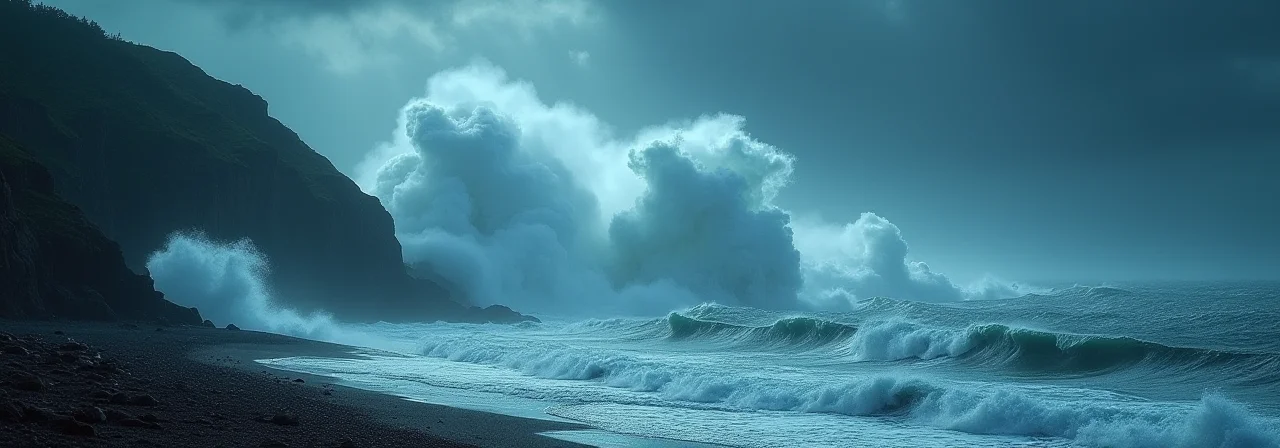
The atmosphere itself takes a while to decelerate. Air doesn't stop with the ground. The result is global winds of 1,670 km/h at the equator, roughly the speed of a high-velocity rifle bullet, scrubbing the surface clean of anything not embedded in bedrock. The Sahara moves. Literally moves.
Surviving the first few seconds requires being inside solid rock at depth. Nothing at the surface survives intact.
This is before we even get to the oceans.
The water problem
Water, being a liquid, is worse. The oceans have enormous momentum and nowhere to go except east, piling up against continental coastlines while draining from the western sides. The resulting megatsunami — and "megatsunami" doesn't really capture the scale, since this is effectively all of the Pacific Ocean moving at once — would be several kilometres high along eastern coastlines. The Americas get hit first and hardest. Significant portions of North and South America's eastern landmasses disappear under water.
Then the equilibrium reshapes entirely.
A non-spinning Earth loses the centrifugal effect that currently bulges the oceans slightly at the equator. Without spin, gravity pulls everything toward a true sphere. The water redistributes: the equatorial regions lose ocean coverage, and a single enormous ocean forms around the poles. Geographers have modelled this: the result is two large landmasses, one in each hemisphere's mid-latitudes, surrounded by a planet-wide polar sea. Most current coastlines, cities, ports, and agricultural zones would be underwater.
The geological timescale for this redistribution is thousands of years. On that timescale, whatever remains of civilisation has relocated to higher ground and adapted. The immediate aftermath is far less forgiving.
Day and night as they'd actually work
A stationary Earth still orbits the Sun. That orbit takes 365 days. Which means a day/night cycle now takes one year. Six months of sunlight, six months of darkness, with a weeks-long twilight zone migrating slowly around the planet.
The sun-facing side heats up to around 100°C over those six months. The dark side drops to -150°C. Neither is compatible with agriculture, and only the narrow twilight band, perpetually chasing the terminator between light and dark, remains survivable without serious engineering.
The wind patterns that exist now because of spin disappear. The Coriolis effect, which drives hurricanes, trade winds, and the jet streams that distribute heat around the planet, goes quiet. You'd get direct convection currents instead: hot air rising over the sunlit hemisphere, cold air sinking on the dark side, with the twilight zone receiving constant gale-force winds as the two meet. It's not identical to current weather. It's in some ways more predictable and in every other way more extreme.
The magnetic field question
Earth's magnetic field comes from the movement of liquid iron in the outer core, and that movement is partly driven by the planet's spin. Without rotation, the dynamo weakens and eventually collapses. The timescale on this is disputed among geophysicists, probably hundreds of thousands of years, possibly longer, but the endpoint is a planet without a magnetic field.
Without that field, the solar wind strips the upper atmosphere. Mars lost its magnetic field roughly 4 billion years ago and has now lost most of its atmosphere. Earth would follow the same trajectory, just starting the process now rather than in deep geological time.
In the near term, human activity would notice the rising radiation levels first. In the far term, if anything still exists on "far term" timescales, the atmosphere erodes and the planet becomes uninhabitable without permanent shielding.
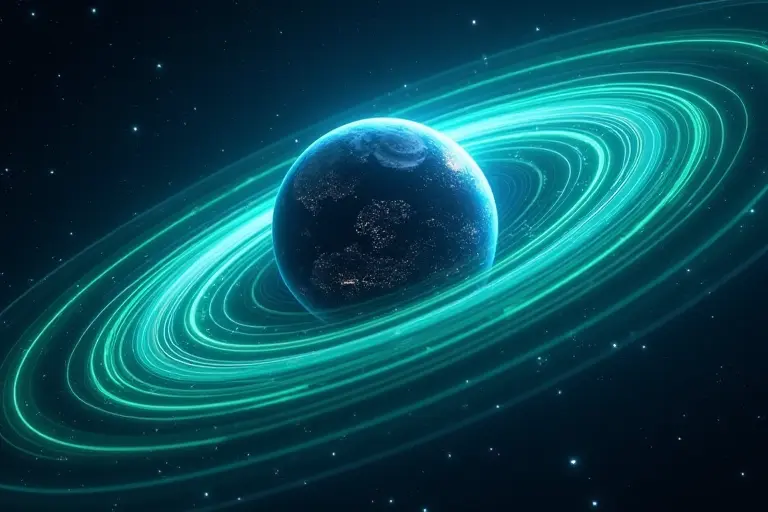
This is the slow horror underneath the immediate catastrophe. The spinning kills you on day one. The magnetic field failure threatens to kill everything that survives on a geological schedule.
What doesn't kill you
The Moon, oddly, doesn't care much. It orbits Earth based on Earth's mass, not its spin. The orbital mechanics are unaffected. The Moon stays. Tides continue, though they change character because the relationship between tidal forcing and Earth's rotation changes: tides are currently fixed relative to the Moon's position; on a non-spinning planet, tidal bulges would sit more or less stationary directly under the Moon rather than being dragged around by rotation.
Gravity doesn't change. The mass of the Earth is identical. You don't float away, the atmosphere doesn't burst outward, and the planet doesn't break apart. The basic physics of standing on a rocky surface remains intact. That's a very thin silver lining given everything else happening, but it's technically on the list.
The honest assessment
This scenario can't be made survivable through planning. You can't build a bunker for 1,670 km/h ambient winds and a multi-kilometre ocean wave. The initial event kills virtually everything above bedrock, everywhere on Earth, within minutes. What remains, bacteria, deep-sea organisms, things in mines and caves, perhaps some seeds, would eventually colonise whatever landmasses the ocean redistribution leaves exposed. Given a few million years, life would probably adapt to the year-long day-night cycle the way life has adapted to everything else it's been handed.
But this isn't the asteroid that killed the dinosaurs. The asteroid left much of the planet's surface intact and most of its biosphere traumatised but present. Stopping the spin is closer to resetting the slate entirely.
The scale of it is genuinely hard to hold in your head. Every city, every forest, every coral reef, every person. All of it, in the first four minutes.
What I keep coming back to is the relative gentleness with which we exist on this rotating rock. The spin is so ordinary that it's effectively invisible, categorised alongside breathing and heartbeat as background noise. But 1,670 km/h is not nothing. That's the speed at which the ground beneath you is permanently and silently committed to moving. The fact that everything around you is moving at the same speed makes it feel like standing still.
You're not standing still. You never were.