You probably don't think about the Moon much. It's there, it does its thing, it looks nice when it's full. Maybe you've photographed it with your phone and been disappointed by the tiny white dot you got back. But the Moon is doing more work than any celestial body has a right to, and most of it happens without anyone noticing.
So let's remove it. Instantly. One night it's there, the next it isn't. No explosion, no slow drift outward. Just gone.
What breaks?
The tides collapse
This is the obvious one, but the scale of it catches people off guard. The Moon is responsible for roughly two-thirds of Earth's tidal forces. The Sun handles the rest. Remove the Moon and you don't lose all tides, but you lose most of them. What remains are weak solar tides, perhaps a third of what we currently experience.
That sounds manageable until you think about what lives in the space between high and low tide. Intertidal zones are some of the most biologically productive habitats on the planet. Entire ecosystems of crabs, mussels, anemones, seabirds and wading species depend on the rhythm of water advancing and retreating twice daily. Flatten that rhythm and you've just pulled the rug out from under millions of species simultaneously.

Coastal erosion patterns change. River estuaries behave differently. Mangrove forests, which rely on tidal flushing, start to stagnate. The fishing industries built around tidal knowledge become obsolete overnight.
Nights get dark. Properly dark.
A full Moon reflects enough sunlight to cast shadows. It provides about 0.25 lux of illumination at ground level. That's not much by indoor standards, but for a nocturnal predator trying to spot a mouse in a field, it's everything.
Remove the Moon and every night becomes a new-moon night. Starlight alone gives you roughly 0.001 lux. You can't see your hand in front of your face at that level. Nocturnal hunters that rely on moonlight to spot prey are suddenly blind. Prey species that time their activity around dark moon phases to avoid being seen lose that advantage too, because it's now permanently dark regardless.
The entire predator-prey dynamic of the nocturnal world reshuffles. Some species benefit. Most don't. The ones adapted specifically to moonlit hunting vanish from their niches within a few generations.
On the human side, you'd notice it. Step outside on what would have been a clear full-moon night and the darkness is absolute. Before electric lighting, this would have reshaped entire civilisations. Even now, it'd be unsettling.
Earth's axial tilt goes haywire
Here's where it gets bad. Not immediately bad, not dramatically bad, but slowly and irreversibly bad.
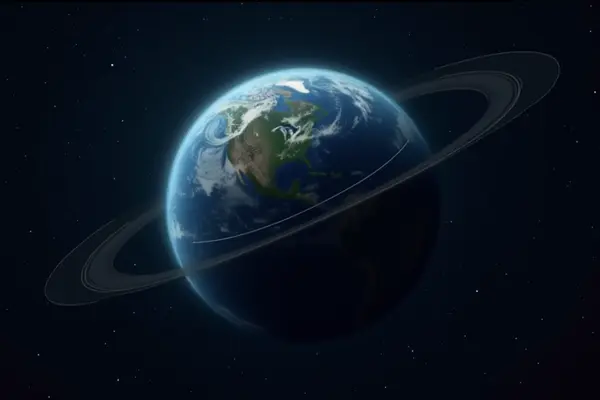
Earth's rotational axis is tilted at 23.4 degrees relative to its orbital plane. That tilt gives us seasons. The Moon's gravitational pull acts as a stabiliser, keeping that tilt from wandering too far. Without it, Earth's axial tilt would be free to oscillate chaotically over millions of years, potentially swinging anywhere between 0 and 85 degrees.
At zero degrees, you lose seasons entirely. The equator bakes, the poles freeze harder, and the temperate zones that currently grow most of the world's food become less productive. At 85 degrees, the planet essentially rolls on its side like Uranus. One hemisphere faces the Sun for months while the other sits in perpetual darkness. Ice sheets grow and melt in cycles that bear no resemblance to anything in Earth's geological history.
This wouldn't happen overnight. The timescale is tens of thousands to millions of years. But the trajectory starts immediately, and there's no mechanism to correct it. Mars, which lacks a large moon, has seen its axial tilt vary between 15 and 35 degrees over its history. Earth would do worse because it spins faster and has more angular momentum to redistribute.
Days get shorter. Then longer.
The Moon's gravitational drag on Earth slows our rotation by about 2.3 milliseconds per century. Remove that brake and Earth's day stops lengthening. Over geological time, days would actually shorten slightly as the planet redistributes mass without tidal flexing.
In the short term, you wouldn't notice. Two milliseconds per century is not a pace that ruins anyone's morning commute. But over millions of years, the accumulated difference matters for everything from atmospheric circulation patterns to ocean current distribution.
The cultural wound
I find this one oddly affecting. Every human civilisation in history has built mythology around the Moon. Lunar calendars predate written language. The words "month" and "Monday" come from it. Islam's calendar is purely lunar. Easter's date depends on it. The Chinese Mid-Autumn Festival, Diwali, Ramadan. Werewolves, lunacy, moonshine.
Remove the Moon and you don't just lose a rock in the sky. You lose the anchor point for thousands of years of storytelling, timekeeping, and meaning-making. Poets would have to find something else to stare at. They'd manage, but still.
What wouldn't change
The Earth wouldn't fly out of its orbit. The Sun's gravity holds us here, not the Moon's. We'd still orbit at the same distance, still have a 365-day year. Earthquakes and volcanic activity wouldn't meaningfully change either, despite what some fringe theories claim about lunar tidal triggering.
Satellite launches wouldn't care. GPS still works. Your phone doesn't need the Moon for anything. The practical machinery of modern life is almost entirely Moon-independent, which is perhaps the strangest part. We've built a civilisation that functions fine without the thing that made our planet habitable in the first place.
The slow unravelling
The honest answer is that Tuesday morning after the Moon vanished, most people wouldn't notice anything wrong. Tides would be smaller but still present. Nights would be darker but we have streetlights. The sky would look wrong, a noticeable absence where something bright used to be, and astronomers would be having the worst day of their professional lives. But daily life would continue.
The damage is all on longer timescales. Ecological collapse in intertidal zones over years. Nocturnal ecosystem disruption over decades. Axial tilt drift over millennia. Each one compounding, each one irreversible, and none of them fixable by any technology we can imagine.
We'd survive the morning. Whether we'd survive the century is a harder question. Whether anything recognisable as Earth's current biosphere would survive ten thousand years is harder still.
The Moon doesn't do anything flashy. It just holds everything in place. And that, it turns out, is the hardest job to replace.