Right now, at this exact moment, you're spinning. The ground beneath your feet is whipping around the Earth's axis at roughly 1,670 kilometres per hour if you're standing on the equator. You don't feel it. You never have. But what if, overnight, that spin dropped to half speed?
A full rotation would take 48 hours instead of 24. Your day would stretch to 24 hours of sunlight. Your night would last just as long. And everything you take for granted about weather, agriculture, your body, your entire civilisation, would quietly begin to fall apart.
The day that won't end
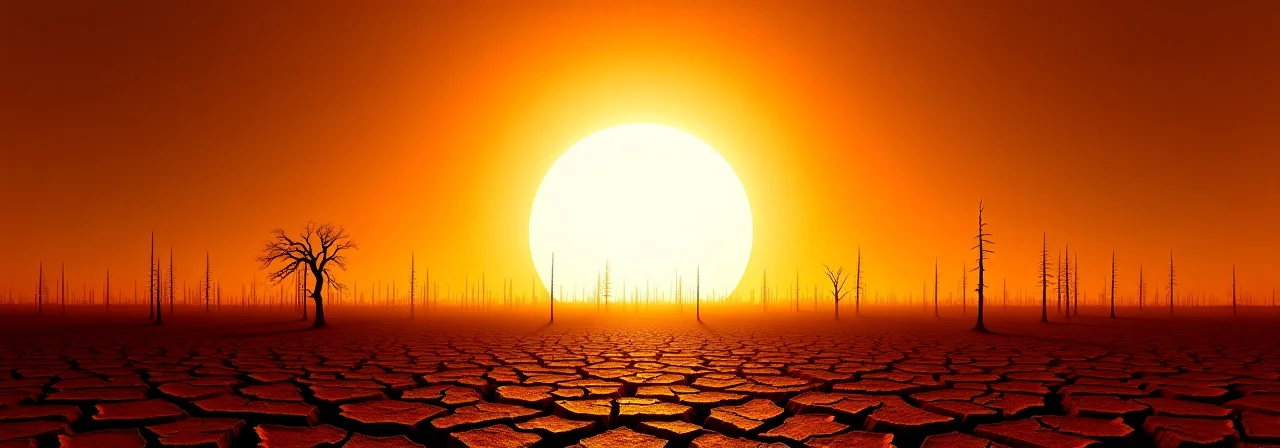
Twenty-four hours of continuous sunlight doesn't just mean extra time for a barbecue. It means the ground, the oceans, and the lower atmosphere absorb solar radiation for twice as long as they're used to. Surface temperatures in mid-latitudes would climb past 50°C during the long afternoon. Deserts would become genuinely unsurvivable. Parts of the Sahara already hit 56.7°C (the highest temperature ever reliably recorded, in Death Valley in 1913, was that exact figure). With double the heating window, those records shatter.
Then night arrives. And it just keeps going.
Twenty-four hours without sunlight. The ground radiates its heat into space, and nothing replenishes it. Temperatures in continental interiors plunge well below freezing. Moscow in January already hits -25°C. Give it a full day of darkness and you're looking at conditions that make Siberian winters feel temperate.
The tropics fare slightly better because ocean water holds heat longer than land. But "slightly better" is relative. Coastal areas would swing 30-40 degrees between day and night. Inland, the swings would be brutal.
Wind like you've never seen
Weather exists because the sun heats the Earth unevenly. The equator gets more energy than the poles, and the atmosphere tries to balance that out by moving warm air toward the poles and cold air toward the equator. The Coriolis effect, caused by Earth's rotation, curves these air movements into the familiar patterns we see on weather maps.
Halve the rotation and you halve the Coriolis effect. The jet streams weaken. Storm tracks shift. The trade winds that sailors relied on for centuries would slow and wander unpredictably. Weather forecasting, already unreliable beyond about ten days, becomes essentially guesswork.
But here's the worse problem. That extreme temperature difference between the sun-baked dayside and the frozen nightside creates colossal pressure gradients at the terminator (the line between day and night). Air rushes from the hot side to the cold side with tremendous force. You'd see persistent gale-force winds sweeping across every continent twice per 48-hour cycle, right at dawn and dusk, as the atmosphere tries to equalise.
These aren't gentle breezes. Think 150 km/h or more in exposed areas. Every single day.
Agriculture collapses in a season
Most crops evolved for roughly 12-hour light/dark cycles. Wheat needs specific day lengths to trigger flowering. Rice paddies depend on monsoon patterns that no longer exist. Fruit trees need winter dormancy periods calibrated to current seasons.
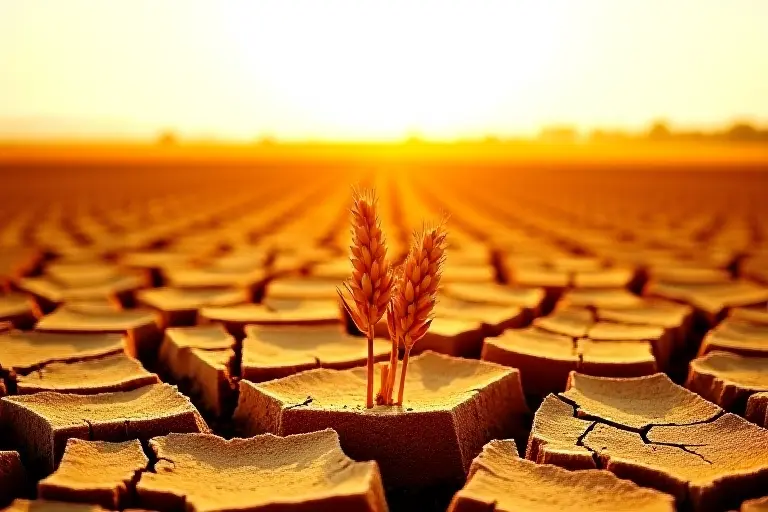
With 24 hours of continuous light, plants photosynthesize nonstop until they exhaust themselves. Leaves scorch. Soil dries out. Then 24 hours of darkness arrive, temperatures crash, and whatever survived the day wilts from frost.
Growing seasons don't just shift. They vanish.
The global food system produces about 11 billion tonnes of food annually. Nearly all of it relies on predictable day-night cycles and seasonal patterns. Greenhouses could theoretically compensate with artificial lighting and climate control, but you can't greenhouse-grow enough food for eight billion people. Not even close. You'd need to cover an area larger than France in climate-controlled glass, powered by an energy grid that's also struggling with the new conditions.
The ocean changes shape
This one surprises people. Earth isn't a perfect sphere. It's an oblate spheroid, wider at the equator than the poles, because the spin creates centrifugal force that pushes mass outward at the equator. The equatorial bulge is about 21 kilometres. That's not trivial.
Slow the spin and that centrifugal force weakens. The equatorial bulge shrinks. Water currently piled up around the equator by centrifugal force flows toward the poles. Sea levels at the equator drop. Sea levels at high latitudes rise.
We're not talking centimetres. Modelling suggests the redistribution could shift sea levels by tens of metres. Equatorial port cities like Singapore, Quito (which sits at 2,850 metres but near the equator), and Nairobi would see oceans recede. Meanwhile, cities like London, Helsinki, and Anchorage would face significant flooding as polar oceans deepened.
New continents of exposed seabed would appear around the equator. New seas would swallow Arctic and Antarctic coastlines. The map of the world redraws itself.
Your body on a 48-hour clock
The human circadian rhythm runs on an approximately 24.2-hour internal clock, kept in sync by sunlight. Force it onto a 48-hour cycle and your biology rebels.
Studies from Soviet-era bunker experiments (where volunteers lived in isolation without time cues) showed that humans left to their own devices drift to roughly 25-hour cycles. Nobody drifted to 48. Your body simply doesn't know what to do with a day that long.
You'd experience something like permanent jet lag. Hormonal cycles would destabilise. Melatonin production would become erratic. Sleep deprivation would be universal because you'd need to sleep at least twice during each 48-hour period, but the environmental cues would be all wrong. Half the time you'd be trying to sleep in blazing daylight. The other half you'd be awake in total darkness.
Depression rates would spike. Cognitive performance would drop. Reaction times would worsen. An entire civilisation of people operating on broken internal clocks is a civilisation that makes bad decisions constantly.
What survives
Some organisms would cope better than others. Deep-ocean life barely registers the day-night cycle anyway. Bacteria in hot springs and deep rock formations wouldn't notice. Cockroaches, predictably, would probably be fine.
Certain plants from extreme latitudes already handle bizarre light cycles. Arctic poppies grow in 24-hour summer daylight. Some Antarctic mosses survive months of darkness. These species would have a head start, but they're not exactly the foundation of a global food chain.
Humans would survive. We're stubborn like that. But the civilisation we've built depends on stable climate, predictable agriculture, and functioning ecosystems. All three would be in freefall. Within a decade, you'd see mass migration toward the coasts (for thermal stability), the abandonment of continental interiors, and a global population that could probably sustain a fraction of its current number.
The quiet part
What strikes me about this scenario is how invisible Earth's rotation is to daily life. You wake up, the sun rises, it crosses the sky, it sets. It's so reliable that most people never think about the machinery behind it. But that 24-hour cycle is the metronome everything else is tuned to. Crops, weather, sleep, tides, ocean currents, the shape of the planet itself.
Slow it down by half and you haven't just changed the clocks. You've pulled the rug out from under four billion years of evolution.