
A standard LEGO brick, the 2x4 stud classic that's been in production since 1958, weighs 2.3 grams and measures 31.8mm long, 15.8mm wide, and 11.4mm tall. It is made of ABS plastic (acrylonitrile butadiene styrene), which has a tensile strength of about 40 megapascals. For comparison, structural steel comes in at roughly 400 megapascals. A LEGO brick is about one-tenth as strong as steel.
Now build a world out of them.
Housing
LEGO houses would go up fast. Absurdly fast. No bricklaying, no mortar, no waiting for concrete to cure. You snap pieces together. A team of four people could assemble a modest two-bedroom house in a day if the pieces were delivered pre-sorted. Flat-pack furniture is already heading in this direction; LEGO construction is just the logical extreme.
The structural integrity, though. A real house carries its own weight plus wind loads, rain, snow, and the accumulated mass of everything you own. ABS plastic at LEGO scale can handle surprisingly large loads (a single 2x2 brick can bear about 432 kilograms before it deforms) but that's a static load on a single point. A whole wall of LEGO bricks under wind shear, rain saturation, and thermal expansion behaves differently.
Walls would flex. You'd hear it on windy nights, a faint clicking and creaking as thousands of stud connections adjusted under load. Not dangerous, necessarily, but unsettling. The house breathes. The house moves. The house sounds like someone is gently disassembling your bedroom wall while you sleep.

Renovations, on the other hand, would be spectacular. Want to add a conservatory? Pop off the back wall, extend the footprint, snap on a new wall. Kitchen too small? Rearrange it. Literally pick up the counter and move it. Knock-through between the lounge and the dining room? You don't need a sledgehammer. You need your hands and about ten minutes.
Estate agents would have to adapt. "Three-bedroom semi in its current configuration" because the new owner could make it a four-bedroom detached by Tuesday.
The barefoot problem
Let's get this out of the way. In a world made of LEGO, every floor surface is LEGO. Every pavement. Every road. Every patch of ground where you might conceivably step.
Stepping on a LEGO brick barefoot is, per square millimetre, one of the most painful non-injury experiences available to the human body. The pressure from a single stud on the sole of your foot concentrates about 3.3 megapascals on an area rich in nerve endings. There's a reason it's a universal shared experience. Almost everyone who has ever owned LEGO has stepped on a piece in the dark and made a noise that worried the neighbours.
In a LEGO world, this is just the ground. This is what "outside" feels like. Shoes become the most important item of clothing. Barefoot parks, paddling pools, beaches: impossible. The entire cultural concept of "taking your shoes off at the door" reverses. You take your shoes off nowhere. You sleep in shoes. Podiatry becomes one of the most in-demand medical specialities.
Sand, that soft granular substance you associate with holidays, doesn't exist. Beaches are LEGO plates as far as the eye can see. The concept of a barefoot walk on the sand becomes the stuff of legend, told to children who suspect you're making it up.
Infrastructure
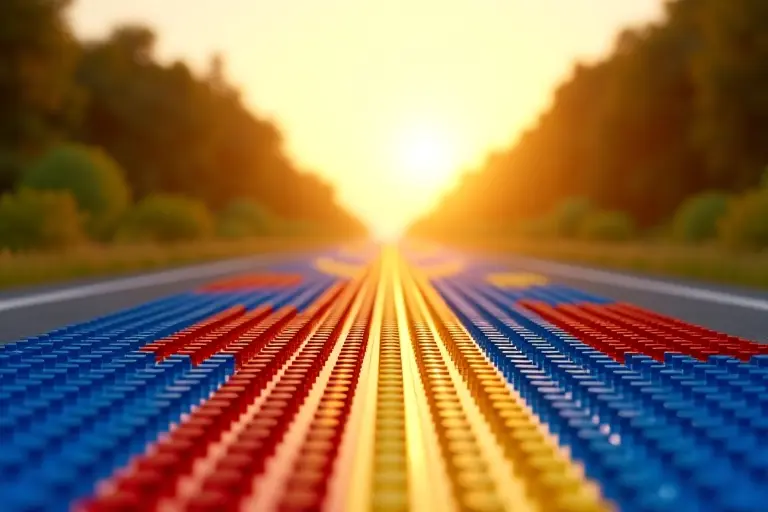
Roads would be modular. Potholes, the bane of every British driver and the subject of approximately 40% of all local council complaints, become trivially fixable. A pothole is just missing bricks. Snap in new ones. Done. The repair takes thirty seconds.
The problem is that the bricks can also be removed. Road theft becomes the crime of the century. Someone nicks a stretch of the A1 overnight. Not the tarmac, which would require heavy machinery. Just the bricks, which can be pulled out by hand and used to build a shed. Councils install anti-theft studs, which are just LEGO bricks glued down, which defeats the entire point of LEGO.
Bridges work, actually. LEGO's interlocking system handles compression reasonably well. The Millau Viaduct, currently the tallest bridge in the world at 343 metres, couldn't be built in LEGO. But smaller bridges, footbridges, canal crossings, these are plausible. They'd need to be much chunkier than their steel-and-concrete equivalents, and they'd creak in ways that test your courage, but they'd hold.
Water infrastructure is where the whole thing falls apart, almost literally. LEGO bricks are not watertight. The stud connections leave gaps. Pipes leak. Roofs leak. Anything that needs to hold or redirect water is fundamentally compromised. You'd need some kind of sealant between every connection, which adds time, cost, and defeats the "just snap it together" advantage.
Plumbing would be the most respected trade in the country. More respected than it already is, which is saying something.
The economy
Construction costs collapse. The materials are standardised, modular, and require no specialist tools. Labour costs drop because assembly is intuitive. A child can build with LEGO; a trained adult can build with LEGO extremely quickly. The construction industry, which in the UK employs about 2.4 million people, shrinks dramatically.
But manufacturing booms. You need a staggering number of bricks. The LEGO Group currently produces about 36 billion elements per year. That's enough for toys. It is nowhere near enough for buildings, roads, and infrastructure. You'd need production scaled up by a factor of several million. ABS plastic comes from petroleum. The oil industry pivots from fuels to construction materials. OPEC becomes less relevant for transport and more relevant for housing.
Colour becomes an economic signal. LEGO produces bricks in over 60 colours. In a built environment made entirely of LEGO, your choice of colour is an aesthetic statement that's visible to everyone. Wealthy neighbourhoods coordinate their palettes. Poorer areas use whatever's available, producing a visual chaos that's either charming or depressing depending on your disposition.
All-white houses emerge as a status symbol. Then someone points out that white LEGO bricks yellow with UV exposure, and within five years every all-white house looks like stained teeth. The backlash is immediate.
Natural disasters
Earthquakes are interesting. A LEGO building subjected to seismic forces would flex rather than fracture. Where concrete cracks and steel bends, LEGO bricks pop apart. The building doesn't collapse in the traditional sense; it disassembles. You don't get crushed by rubble. You get buried under a pile of loose bricks. Still bad. But survivably bad, most of the time.
Post-earthquake reconstruction takes days, not years. You literally pick up the pieces and put them back together. Japan, which currently spends billions on earthquake-resistant engineering, might actually prefer LEGO construction for low-rise buildings. Quick to build, quick to disassemble, quick to rebuild.
Fire is the disaster that ends the thought experiment. ABS plastic melts at about 105°C and ignites at around 380°C. A LEGO house fire doesn't burn like a timber fire. It melts. The walls deform, sag, drip. The fumes are toxic. A single kitchen fire could take out a house in minutes, and the molten plastic resolidifies into shapes that can't be reused. Your house doesn't burn down. It melts into a single enormous fused lump of plastic.
Fire regulations in a LEGO world wouldn't be regulations. They'd be religion. Candles would be illegal. Open-plan kitchens with gas hobs would be viewed the way we currently view asbestos. Every house would have a sprinkler system that activates if the internal temperature exceeds about 80°C, which in a British summer is almost never, but in a LEGO world with no insulation and direct sun on coloured plastic surfaces, might be more often than you'd think.
What you'd miss
Glass. There's no LEGO glass. Windows are either open holes or translucent plastic panels that scratch if you breathe on them. The view from your bedroom window has a permanent slight haze, like looking through a shower screen. You get used to it, the way you get used to anything, but every so often you'd see a photograph of what the world looked like before, through clear glass, and you'd feel a small, specific grief for something you probably never appreciated when you had it.