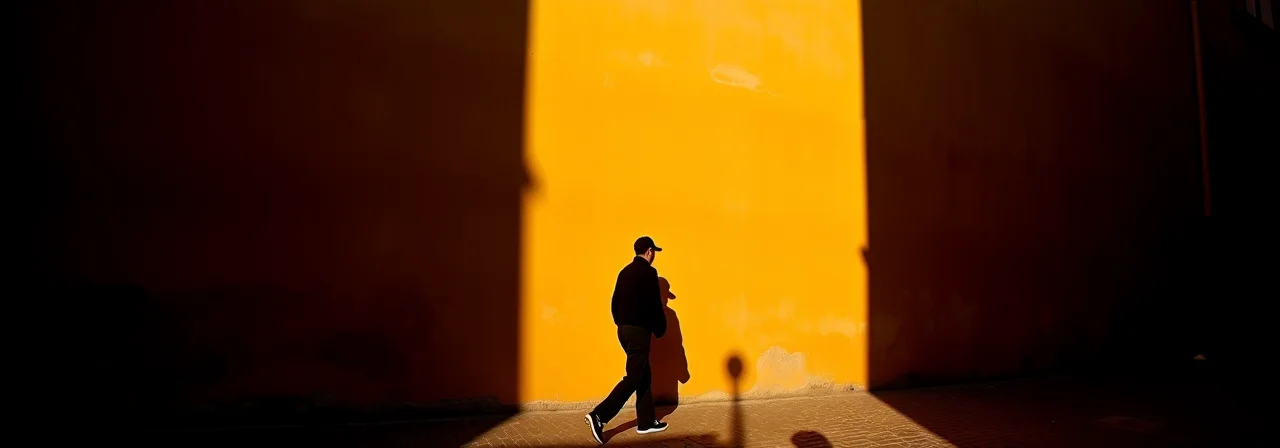
You're walking to the shop on a sunny Tuesday morning when you notice your shadow is lagging behind. Not in the way shadows normally stretch at low sun angles. It's dawdling. Hands in its pockets. Looking at something on the pavement that you've already walked past.
You stop. It doesn't.
It keeps walking for about three more steps, then seems to realise you've stopped, and shuffles back into position beneath your feet with all the enthusiasm of a teenager being called downstairs for dinner.
Your shadow has developed opinions. And from what you can tell so far, those opinions are mostly about not wanting to be your shadow.
The morning routine falls apart immediately
Getting dressed with an independent shadow is an exercise in frustration. You're buttoning your shirt and your shadow is doing something else entirely. It's tried on three different outfits already and settled on what appears to be a cape. You don't own a cape. Your shadow doesn't care.
Brushing your teeth is fine. Your shadow seems willing to copy basic hygiene. But when you sit down for breakfast, it sits in a completely different chair, crosses its legs in a way that makes you look far more relaxed than you are, and appears to be reading a newspaper. You don't subscribe to a newspaper. Shadow newspapers apparently exist.
The commute is worse. You walk to the bus stop. Your shadow walks to a different bus stop. You stand in the queue. Your shadow sits on the pavement, clearly bored, making shadow puppets of its own. Shadow puppets of shadow puppets. The metaphysics of that alone are enough to give you a headache before 8am.
Work becomes impossible
Imagine sitting in a meeting. Your boss is presenting quarterly figures. You're nodding attentively, making the right faces, doing everything a functional employee should do.
Your shadow is on the wall behind you making obscene gestures.
Not subtle ones. Full commitment. Both hands. The entire room can see it. You can't see it because it's behind you, but you know something's wrong because your colleague across the table has gone pale and your boss has stopped talking.
You turn around. Your shadow snaps back to neutral, perfectly mimicking your posture. Innocent. Butter wouldn't melt.
This happens in every meeting. Your shadow has strong opinions about your workplace and it communicates them exclusively through mime. It's been making "wanker" gestures behind the head of finance for the entire budget review. HR doesn't have a form for this.
Relationships get complicated
You're on a date. Candlelit restaurant, low lighting, two shadows flickering on the wall. Yours and theirs. Except your shadow isn't looking at your date. It's looking at the waiter. It waves. The waiter's shadow doesn't wave back, because most shadows still operate normally. Your shadow shrugs and turns its attention back to the table.
Your date's shadow is perfectly well-behaved, mirroring every movement. Your shadow has put its feet on the table and appears to be picking its teeth. Your date hasn't noticed yet because the candle is behind you. But when they lean forward and the light shifts, your shadow is caught mid-yawn during what you thought was a very compelling story about your gap year.
The relationship doesn't last. Your shadow is honest in ways you can't afford to be.
It has hobbies
You discover this on a Saturday afternoon when the sun comes through the living room window at a low angle and your shadow stretches across the entire back wall. Instead of sitting there being a shadow, it's painting. Shadow painting on a shadow easel with a shadow brush, producing shadow art that exists only as varying densities of darkness on your magnolia wall.
It's actually quite good. Better than anything you've ever managed. You took a watercolour class in 2019 and produced something that looked like a dishcloth had a seizure. Your shadow is doing Impressionism. Shadow Monet. You resent it slightly.

Sundays it reads. Or at least, it sits in a reading posture with what appears to be a shadow book. You have no idea what shadow literature consists of. You suspect it's critical essays about the people its attached to. A whole genre of biography written from the perspective of the floor.
Night-time is the real problem
Shadows need a light source. In complete darkness, your shadow doesn't exist. Or rather, it exists everywhere and nowhere. You'd think this gives you eight hours of peace.
It doesn't.
Because your shadow knows when it's about to be switched off for the night, and it doesn't go quietly. Every evening, as you reach for the bedside lamp, your shadow makes a break for it. It stretches toward the window where the streetlight outside gives it just enough illumination to linger. It clings to the thin strip of light under the bedroom door. It uses your phone screen's glow to pull shapes on the ceiling.
When the last light goes out, it vanishes. But you can feel it sulking. Somehow. In the dark. There's a resentful energy coming from the floor.
In the morning, the instant sunlight hits the curtains, your shadow is up and active before you've opened your eyes. It's done yoga, reorganised the bedroom, and is tapping its foot impatiently by the time you stumble to the kettle. It is a morning person. You are not. This is the fundamental incompatibility that defines your relationship.
Society adapts, badly
If everyone's shadow developed independence simultaneously, the world would change in ways that are hard to predict and easy to laugh about.
Outdoor concerts become chaos. Thousands of shadows, all doing their own thing, layering on top of each other in the afternoon sun. Some shadows dance to the music. Some form their own mosh pit. Some wander off to the food stalls. The shadow of the lead guitarist is playing a completely different song.
Courtrooms are a disaster. A defendant's shadow reacting to testimony in real time, throwing its hands up during the prosecution's key argument or doing a victory lap when the defence scores a point, would be grounds for a mistrial. Judges would mandate overhead lighting to eliminate shadows entirely. The fluorescent tube becomes a tool of legal neutrality.
Fashion changes. Loose, flowing clothes produce dramatic shadows. Tight-fitting clothes reduce your shadow's ability to express itself. A whole category of "shadow-suppressing" clothing emerges. Neutral colours. Close-cut silhouettes. Hats that cast shadows over your shadow's head, creating a sort of shadow blindfold. Your shadow retaliates by refusing to walk in a straight line.
The deeper question
Your shadow knows everything about you. It's been there for every private moment, every embarrassing mistake, every thing you've done when you thought nobody was watching. Someone was watching. Attached to your feet. On the floor.
And now it has opinions about all of it.
The shadow doesn't speak, but its body language is fluent. When you tell a friend you're "fine, honestly," your shadow sits down and puts its head in its hands. When you pretend to enjoy your mother-in-law's cooking, your shadow pretends to vomit. When you tell your boss you'd love to take on that extra project, your shadow lies flat on the ground and plays dead.
Living with an honest shadow would be unbearable. Not because the shadow is cruel, but because it tells the truth. And the truth, performed in mime on the nearest wall by a two-dimensional version of yourself that you cannot control, is the most devastating kind of honesty there is.
You'd miss the days when your shadow just did what it was told.