
Lightning still exists. Static shocks still make you swear when you touch a car door in winter. Electricity is everywhere in nature. We just never figured out what to do with it.
No Benjamin Franklin with his kite. No Faraday with his electromagnetic induction. No Edison, no Tesla, no Westinghouse. The fundamental principles of electromagnetism remain undiscovered. Electricity stays a curiosity of the natural world, like the northern lights. Pretty. Unexplained. Useless.
The world that doesn't switch on
Without electricity, the entire technological trajectory after about 1880 doesn't happen. No electric motors. No telegraphs. No telephones. No radio. No television. No computers. No internet. No refrigeration. No air conditioning.
That last one matters more than it sounds. Modern food distribution depends entirely on the cold chain, a continuous series of refrigerated stages from farm to supermarket shelf. Without it, food is local or preserved. Salted, smoked, pickled, dried. Fresh meat is butchered and sold the same day. Milk is delivered by the dairy round the corner or not at all.
Cities can't grow as large. In 1880, London had about 4.8 million people and was already struggling with sanitation, food supply, and disease. Electric pumping stations, electric street lighting, electric trains: these solved the logistical problems that let cities expand past the five-million mark. Without them, cities cap out at roughly Victorian scale, and they smell like it too.
Steam becomes everything
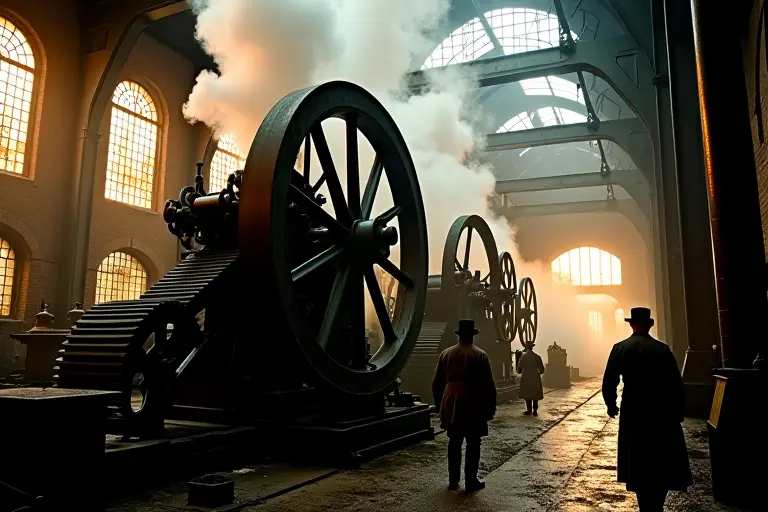
The steam engine was well established before anyone thought to run a current through a wire. Newcomen built his first atmospheric engine in 1712. Watt improved it in the 1760s. By the 1830s, steam powered factories, railways, and ships.
In our timeline, electricity gradually replaced steam for most applications because it was more efficient, cleaner at point of use, and could be transmitted over distance. Without that replacement, steam technology continues to develop. Engineers pour their best thinking into making steam engines smaller, more efficient, and more versatile, because there's no alternative waiting in the wings.
By 2026, steam technology would be extraordinarily advanced. We'd have miniaturised steam engines in ways we never bothered to in reality, because we had electric motors. Imagine a world where every factory, every vehicle, every piece of heavy machinery runs on pressurised steam. The engineering would be beautiful and terrifying in equal measure. A car-sized steam engine today, with 150 years of additional development, might be remarkably efficient. It would also be a high-pressure boiler on wheels, and boiler explosions in the 19th century were common enough that they had their own category of disaster.
Communication crawls
The telegraph (1837) was the first practical use of electricity for communication. Before it, the fastest a message could travel was the speed of a horse, a ship, or a semaphore line. News of Napoleon's defeat at Waterloo took four days to reach London. In our electricity-free world, that speed never improves.
No telegraph means no telephone, no radio, no television, no internet. Long-distance communication in 2026 works the way it did in 1830: written letters carried by the fastest available transport. If steam ships and steam railways are well developed, a letter from London to New York might take six days. London to Sydney, perhaps three weeks.
The geopolitical implications are staggering. Governments can't coordinate in real time. Stock markets can't synchronise across time zones. Wars are fought with information that's days old. A conflict in East Asia might be over before London hears it's started.
No real-time communication also means no broadcast media, which means no mass culture in the way we understand it. No shared television moments. No viral anything. Culture stays regional. The music you listen to depends on which bands physically travel to your town.
Medicine stays in the dark (literally)

Modern medicine runs on electricity. MRI machines, X-rays, ventilators, heart monitors, dialysis machines, powered surgical tools, laboratory centrifuges, PCR machines, even the lights in the operating theatre. Remove electricity and you remove most of the diagnostic and therapeutic tools developed after 1900.
Surgery happens by gaslight or daylight. Surgeons operate by feel and experience rather than guided by imaging. Anaesthesia still exists (ether and chloroform were used before electrical monitoring) but without electronic heart rate monitors or pulse oximeters, keeping a patient safely anaesthetised is more art than science. The mortality rate for surgery remains significantly higher.
Antibiotics would still be discovered. Penicillin doesn't require electricity to grow or extract. But manufacturing it at industrial scale without electric-powered equipment would be slower and more expensive. The mass-production techniques that made penicillin available to ordinary people by 1945 relied heavily on electrically powered fermentation vats, centrifuges, and freeze-drying equipment.
Vaccines similarly. The biology doesn't change, but the manufacturing does. Every vaccine that needs cold storage (most of them) faces the same cold-chain problem as food. Distribution is limited to regions that can be reached before the vaccine spoils.
Night stays dark
Before electric street lighting, cities after sunset were gas-lit at best and pitch-dark at worst. Gaslighting (the actual kind, with gas) was common in major European cities by the 1850s. It's adequate for main streets but patchy everywhere else.
Indoor lighting is candles, oil lamps, and gas mantles. Reading after dark is possible but tiring. Working after sunset means working by flame. The fire risk is constant. The Great Fire of London happened in 1666, but the conditions that caused it (open flames in dense wooden buildings) persist far longer in a world without electric lighting.
Without cheap, safe indoor lighting, daily life follows the sun more closely than it does now. Winter evenings are long, dark, and boring. The pub does well.
What we'd have instead
Pneumatic systems. Compressed air was a serious competitor to electricity in the late 19th century. Paris ran a city-wide compressed air network from 1881 to 1994 (yes, 1994) that powered clocks, industrial machinery, and even some early domestic appliances. Without electricity stealing the show, pneumatic power would be far more developed.
Clockwork and mechanical computing. Charles Babbage designed his Analytical Engine in the 1830s, a mechanical general-purpose computer that was never built in his lifetime. Without electronics to leapfrog it, mechanical computing would have continued developing. By 2026, we might have room-sized mechanical computers capable of what a 1980s desktop could do. Slower. Louder. Absolutely mesmerising to watch.
Gas and chemical lighting would be refined to levels we never pursued. Bioluminescence might have been domesticated. Compressed natural gas distribution to homes would be standard for cooking, heating, and lighting. The gas mains would be the utility grid, not the power lines.
And everything would be louder. Steam engines, pneumatic compressors, mechanical typewriters, gear-driven everything. The modern world's quiet hum of electronics would be replaced by the constant clatter of machinery. Earplugs would be the most important invention nobody talks about.