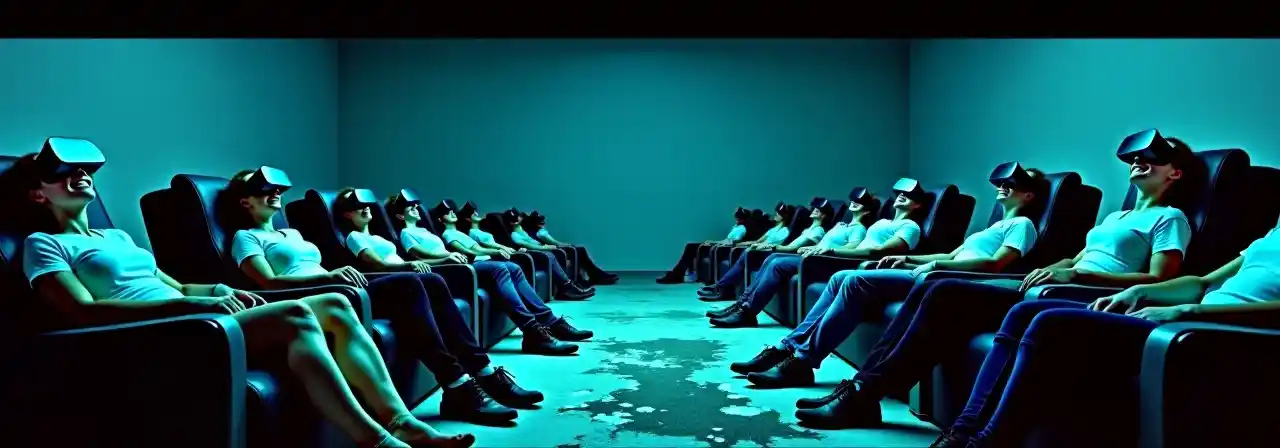
You live in a one-bedroom flat in Croydon. The ceiling has a damp patch shaped like Italy. The kitchen window looks out onto a bin store. Your commute takes 53 minutes on the Northern Line, standing, pressed against a stranger's backpack that smells faintly of tuna.
Now imagine you put on a headset and you're in a Tuscan villa. Stone floors, warm under your bare feet. A view of rolling vineyards through arched windows. You can feel the breeze. You can smell rosemary from the garden. You can taste the espresso. Every sensory input is perfect, indistinguishable from the real thing.
Why would you ever take the headset off?
The technology we're imagining
Current VR is nowhere close to this. The Meta Quest 3 has a resolution of about 2,064 by 2,208 pixels per eye, which sounds impressive until you compare it to the human eye's equivalent resolution of roughly 576 megapixels. You can see the pixel grid. The field of view is limited. There's no smell, no taste, no haptic feedback beyond a buzzing controller in your hand. It's immersive the way a cinema is immersive: you can lose yourself in it, but you always know it's not real.
What we're talking about is different. Full sensory immersion. Visual fidelity that matches or exceeds human perception. Physical sensation indistinguishable from touch. Your brain genuinely cannot tell the difference between the virtual world and the real one.
This isn't just better screens. This is a direct neural interface, or something functionally identical. The input doesn't go through your eyes and ears; it goes straight to the brain regions that process vision, hearing, touch, taste, and smell. Your body lies still on a bed. Your mind is somewhere else entirely.
The first wave of departures
The people who check out first aren't the stereotypes you'd expect. It's not just gamers and escapists. It's people in chronic pain who can exist in a body that doesn't hurt. It's people with severe disabilities who can walk, run, climb. It's elderly people who can be 25 again. It's lonely people who can be in a room full of friends who genuinely care about them, even if those friends are algorithms.
It's people in bedsits in Croydon who can live in Tuscan villas.
The moral argument against this is surprisingly hard to make. If someone's experience of life is genuinely better inside the simulation, and they can't tell the difference, what exactly is the objection? That it isn't "real"? Real according to whom? Their brain is receiving identical signals. Their happiness is real. Their sense of meaning is real. The dopamine and serotonin are real molecules in a real brain.
Philosophers have been arguing about this since Robert Nozick proposed his Experience Machine thought experiment in 1974. He assumed most people would reject the machine, choosing authentic experience over perfect simulation. Surveys since then have been mixed, but they were always hypothetical. When the machine actually exists and it actually works, the calculus changes.
The economy of absence
Within five years of this technology becoming widely available, significant portions of the workforce would simply stop showing up. Not everyone. Not even most people, initially. But enough.
The jobs most vulnerable are the ones that are boring, physically demanding, or low-status. Warehouse pickers, call centre operators, data entry clerks. If you can spend your time as a pirate captain sailing the Caribbean or as a renowned artist in a Montmartre studio, the motivational pull of a zero-hours contract in a fulfilment centre drops to approximately nothing.
Wages for unglamorous physical work would skyrocket. Someone has to maintain the servers. Someone has to keep the power stations running. Someone has to grow food, treat water, collect rubbish. The people still willing to do this in the real world would command enormous salaries, because the alternative workforce is lying on beds with headsets on, having a much better time.
This creates a peculiar class inversion. The rich, traditionally, had better real lives than the poor. Now the poor can have equally spectacular virtual lives. But someone needs to maintain the infrastructure that keeps the virtual world running, and that someone is doing hard physical labour in the real world. The highest-paid people in society might be plumbers, electricians, and server technicians.
Relationships inside
You meet someone in the simulation. You fall in love. You have years together, shared experiences, genuine emotional connection. They might be another human mind plugged into the same system. They might be an AI character so convincing that you can't tell the difference and, more to the point, neither can your heart.
Are these relationships real? Your feelings are. The memories are, as far as your brain is concerned. But the person across from you might not exist in any physical sense. And if they do exist physically, their real body might be a 58-year-old accountant in Doncaster, not the person you see and touch in the simulation.
This would snap the connection between physical attraction and romantic partnership. Permanently. If everyone's virtual appearance is chosen rather than inherited, then physical beauty stops being scarce. Everyone is as attractive as they want to be. Status markers change. Personality, wit, emotional intelligence: these become the only genuine differentiators when everyone has the face of a model and the body of an athlete.
Real-world birth rates, already declining across the developed world, would crater. Why would you go through pregnancy and childbirth in the real world when you could raise a family in the simulation with none of the physical suffering and all of the emotional reward? The answer might be that simulated children aren't real, but try telling that to a parent who's spent five subjective years raising one.
The maintenance problem
Here's where it falls apart. Every person lying on a bed in the real world needs food, water, medical care, and a functioning body. Their muscles atrophy. Their bones weaken. Their circulatory system degrades without movement. A human body parked on a mattress for months develops pressure sores, deep vein thrombosis, and muscle wasting.
The servers need power. The power grid needs workers. The food supply needs farmers, drivers, and processing plant operators. The medical systems need nurses and doctors. All of these people need to be in the real world, doing real things, and every one of them is being tempted by a headset that offers a better existence.
You end up with a civilisation that requires a skeleton crew of real-world workers to keep billions of virtual-world inhabitants alive, and that skeleton crew is perpetually shrinking because its members keep putting on headsets and not coming back. The system is inherently unstable. It works until it doesn't, and when it fails, the people plugged in have no idea until their feeding tube runs dry.
Who decides what's real
Governments would try to regulate this. Some would ban extended immersion. Others would tax it. China would probably build its own state-controlled version with mandatory patriotic content. The debates would be vicious and unresolvable, because the fundamental question has no clean answer: does a person have the right to spend their life in a simulation if it makes them happier?
Religious institutions would split. Some would declare the virtual world a false paradise, a spiritual trap. Others would argue that if God cares about the soul and the soul's experiences are identical in both worlds, then the medium is irrelevant. There would be virtual churches, virtual pilgrimages, virtual religious experiences as profound as any in the physical world.
And somewhere, a philosopher would point out that we have no proof we're not already in the simulation. That the "real" world we're so desperate to protect might itself be running on a server in someone else's civilisation. The argument wouldn't be new. But it would hit differently when you've personally experienced a perfect fake and couldn't spot the seams.