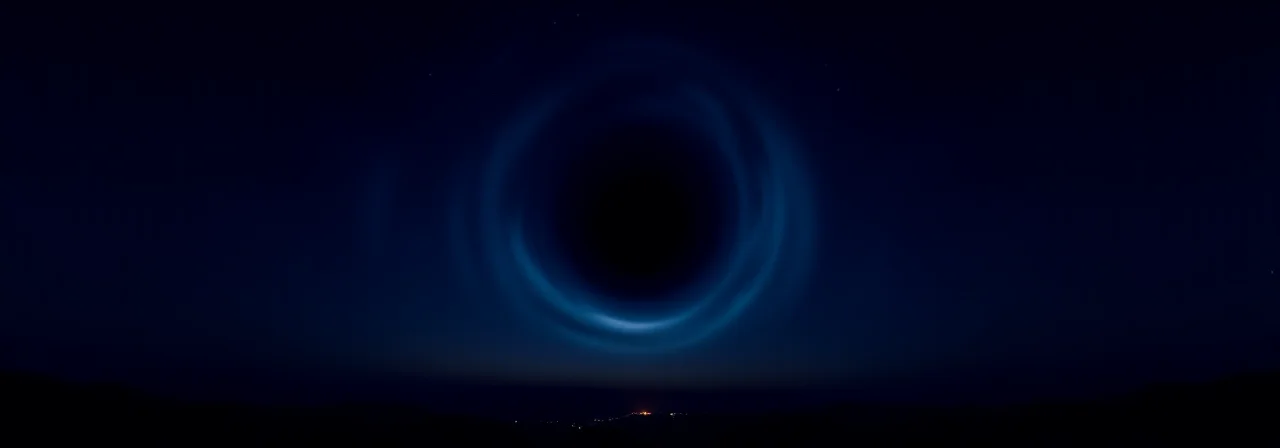
Not a supermassive one. Not the kind at the centre of galaxies, millions of times the mass of our sun. Something smaller. Let's say a black hole with the mass of our Moon, about 7.34 × 10²² kilograms, appears at roughly the distance of the Moon. Where the Moon currently is, in fact. The Moon is gone. There's a black hole instead.
You wouldn't see it. A black hole with the mass of the Moon would have an event horizon about 0.2 millimetres across. Smaller than a grain of sand. Invisible against the night sky. But you'd know something was wrong almost immediately, because the tides would stop making sense.
The tides go first
A Moon-mass black hole at the Moon's distance would produce identical tides to our current Moon. Same mass, same distance, same gravitational pull. So far, nothing changes. The oceans rise and fall on schedule. Surfers are happy.
But here's the thing about our scenario. I said "near Earth," not "at the Moon's distance." So let's move it closer. Let's put it 50,000 kilometres away. That's about one-eighth of the current Earth-Moon distance.
Now it gets interesting.
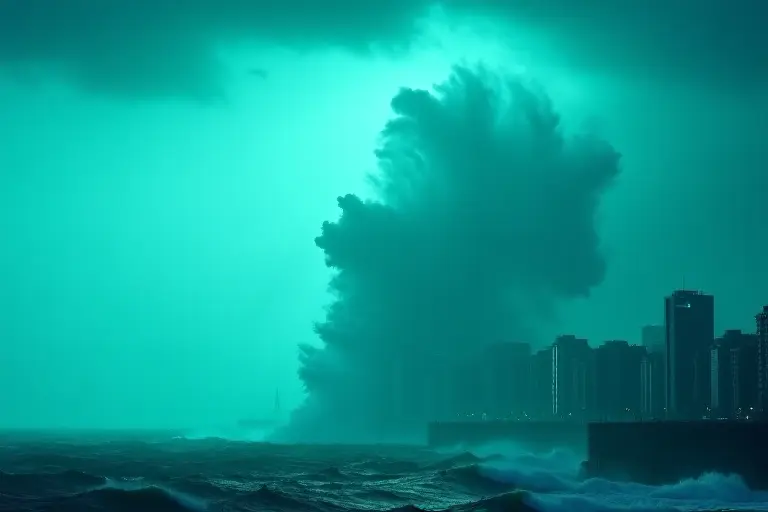
Tidal force scales with the inverse cube of distance. Bring the same mass eight times closer and tidal forces increase by a factor of 512. The oceans don't just rise and fall. They surge. Coastal cities experience tidal waves tens of metres high, twice a day, on a schedule that's technically predictable but practically unsurvivable.
Getting closer
Let's keep pushing. Move the black hole to 10,000 kilometres from Earth's surface. That's roughly the altitude of GPS satellites. Still well outside the atmosphere, but close enough that tidal forces begin tearing at the planet's crust.
The rock beneath your feet is not as solid as it feels. Earth's crust is a thin shell, 30 to 50 kilometres thick, floating on a mantle of semi-molten rock. Hit it with sufficient tidal stress and it flexes. Then cracks. Earthquakes would ripple across the hemisphere facing the black hole. Volcanic activity would spike as magma chambers, compressed and released by the tidal pumping, found new routes to the surface.
The atmosphere would distort too. Air, being fluid, responds to tidal forces more readily than rock. A bulge of atmosphere would stretch toward the black hole. Wind speeds in the upper atmosphere would become extreme, though at ground level you might only notice a persistent, unnatural breeze in one direction.
Spaghettification (the real term)
Astrophysicists actually call it that. Spaghettification. The process by which tidal forces stretch an object along the axis pointing toward the gravitational source while compressing it along the perpendicular axes. You get pulled into a long, thin strand. Like spaghetti.
For a Moon-mass black hole, you'd need to get within a few hundred kilometres of it for spaghettification to affect a human body. At that range, the gravitational pull on your feet (assuming you're falling feet-first) is measurably stronger than the pull on your head. The difference stretches you. Gently at first. Then not gently.
Your body can handle about 10 to 12 g of sustained acceleration before losing consciousness, and perhaps 50 g before structural failure (bones breaking, organs tearing loose). The tidal gradient near a Moon-mass black hole reaches those thresholds surprisingly quickly.
Nobody's getting spaghettified from Earth's surface at 10,000 kilometres. But anything falling toward the black hole is on a one-way trip to becoming the universe's most unpleasant piece of pasta.
What if it's closer still?
Put the black hole 1,000 kilometres above the surface. Low Earth orbit. Where the International Space Station used to fly.
At this distance, the tidal forces on Earth's surface are catastrophic. The side of the planet facing the black hole bulges outward. The crust fractures along fault lines that haven't moved in millions of years. The ocean on that side doesn't just surge. It lifts, forming a column of water reaching skyward, pulled toward a point in space too small to see.
On the opposite side of the planet, you'd feel lighter. Not because gravity has weakened, but because the tidal force is pulling the Earth away from you. Objects on the far side of the planet experience a net outward force. You weigh less. Things start to float that shouldn't.
The planet is being pulled apart like bread dough.
Would it swallow the Earth?
Not quickly. A common misunderstanding about black holes is that they act like vacuum cleaners, hoovering up everything nearby. They don't. A black hole's gravitational pull at a given distance is identical to any other object of the same mass at that distance. Our Moon-mass black hole pulls on Earth with exactly the same force our Moon used to.
The danger isn't suction. It's tidal disruption. The black hole wouldn't swallow Earth whole. It would shred it.
Material pulled from Earth's surface toward the black hole would form an accretion disc, spiralling inward, heating up through friction to extraordinary temperatures. X-rays and gamma radiation would flood the surrounding space. The atmosphere on the black-hole-facing side would be stripped away, molecule by molecule, feeding the disc.
From a distance, it would look almost beautiful. A tiny, impossibly bright ring of superheated material around an invisible point, with streamers of rock and water spiralling into it from the disintegrating planet below.
Time gets strange
General relativity predicts that time runs slower in stronger gravitational fields. Near our Moon-mass black hole, this effect is measurable but small. You'd need to get within a few metres of the event horizon for time dilation to become dramatic.
But it's there. A clock falling toward the black hole would tick slower as observed from Earth. An observer falling in would notice nothing unusual about their own time. They'd just look back at Earth and see everything speeding up, the planet's destruction playing out in fast-forward as they fell.
From Earth's perspective, the falling observer would appear to slow down, their image reddening and dimming as light struggled to escape the gravitational well. They'd never appear to cross the event horizon. They'd just fade, frozen on the boundary, a smear of redshifted light.
In reality, they crossed the horizon ages ago. They just can't tell you about it.
The honest assessment
A black hole appearing near Earth is, in terms of the physics, quite straightforward. There's no mystery about what happens. Tidal forces disrupt the planet, material falls inward, and Earth ceases to exist as a recognisable body over a timescale that depends on distance.
What makes it different from other extinction scenarios is the speed. An asteroid gives you months or years of warning. A supervolcano gives you geological hints. A nearby black hole appearing from nothing gives you no warning at all, and depending on how close it appears, somewhere between hours and minutes before the effects are unsurvivable.
The only comfort, and it's thin, is that there's no known mechanism for a black hole to spontaneously appear in our solar system. They form from collapsing stars, and there are no candidates close enough to threaten us. The nearest known black hole, Gaia BH1, is about 1,560 light-years away and minding its own business.
For now.