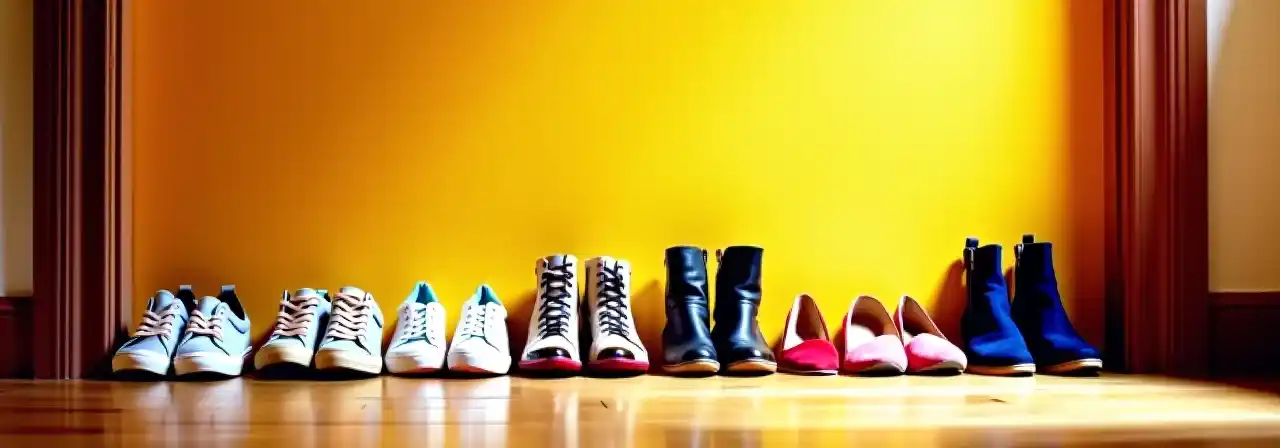
You're getting ready for work. You reach for your black brogues. The left one sighs. Not metaphorically. An audible, world-weary sigh, like a supply teacher on a Friday afternoon.
"Those trousers again?"
You look down. The brogue is looking back at you, or at least angled in your general direction. "You wore those trousers on Monday. It's Thursday. People notice."
The right brogue says nothing. It's been giving you the silent treatment since you stepped in that puddle on Tuesday and didn't apologise.
This is your life now. Every pair of shoes you own has opinions, and absolutely none of them are keeping those opinions to themselves.
The morning routine
Getting dressed becomes a negotiation. Your trainers want to go for a run. They always want to go for a run. They've been sitting in the cupboard since last Saturday and they're passive-aggressive about it. "No, it's fine," says the left trainer. "We'll just sit here. In the dark. Again. While those ridiculous loafers get all the pavement time."
The loafers, for their part, consider themselves above this sort of bickering. They speak in measured tones about appropriate occasions and the importance of a good first impression. They're the shoes your mother would have wanted you to wear. They know this. They mention it.

Your wellies only speak up when it rains, at which point they become insufferably smug. "Who's laughing now?" they say, every single time, as if the joke gets funnier with repetition. It does not.
And then there are the slippers. Your slippers have checked out entirely. They refuse to acknowledge the existence of Monday through Friday. When the alarm goes off at 6:30, they grip the carpet with whatever force a slipper can muster and stage a silent protest against the very concept of employment. You have to physically pry them off your feet while they mutter about how nobody appreciates the domestic arts any more.
The commute
Your shoes have to walk on the ground. They have feelings about this. Strong feelings.
Gravel is apparently an act of war. Cobblestones are "the paving equivalent of a cheese grater." Your brogues, which are leather-soled, treat every pavement crack as a personal insult. Chewing gum on the pavement triggers a tirade that lasts from the train station to the office.
Puddles are a diplomatic incident. Step in one accidentally and your shoes don't speak to you for hours. Step in one deliberately and you're looking at a full relationship breakdown. The left shoe tells the right shoe it warned you. The right shoe says it's not angry, just disappointed.
"Just disappointed" is, as any parent knows, significantly worse than angry.
Public transport presents its own challenges. Your shoes are on the floor of a bus, a tube carriage, a train. They can see what's down there. They would very much like to stop seeing what's down there. Your smart shoes develop a phobia of the Northern line that no amount of reassurance can fix.
The wardrobe wars
Your shoes have opinions about each other. This is where it gets properly difficult.
Your formal shoes look down on your trainers. Literally, because they're taller, and figuratively, because they consider sportswear the clothing equivalent of eating crisps for dinner. Your trainers think your formal shoes are uptight relics who wouldn't know comfort if it walked up and introduced itself.
Sandals are universally despised by the other shoes. They're "not even trying," according to your boots. "At least put a back on," your brogues say. Your flip-flops, the lowest rung of the footwear hierarchy, have simply stopped engaging with the discourse. They live in the back of the cupboard and communicate only in resigned flapping sounds.
Your hiking boots believe they are the only shoes with genuine purpose. They talk about "the trail" the way some people talk about CrossFit. They have been worn twice. They bring up both occasions constantly.
The one pair everyone agrees on? The novelty Christmas slippers your aunt bought you. They have antlers. Nobody wants to be seen near them. They sit in the wardrobe like a social pariah at a dinner party, making everyone uncomfortable by simply existing.
The workplace
Office dress codes take on a new dimension when your shoes can file complaints. Smart casual means your shoes spend the entire day in a state of confused anxiety. Are they smart? Are they casual? What if they're judged and found wanting? Your office shoes develop something that looks a lot like impostor syndrome.
Meetings are a nightmare. Eight people around a table means sixteen shoes under it, all muttering. Your brogues are judging the intern's trainers. The CEO's handmade Oxfords are holding court. Someone's Crocs are sitting in the corner being actively shunned.
The Crocs don't care. Crocs have never cared. This is both their greatest strength and the reason no other shoe respects them.
The dating problem
They say you can judge a person by their shoes. In this world, the shoes judge the person right back.
First dates become three-way conversations. You're trying to seem interesting and confident while your shoes provide live commentary on your performance. "Sit up straighter," hisses your left shoe. "You're making us look bad." Your date's shoes are doing the same thing from across the table, which means there's a sub-conversation happening at floor level that neither of you can fully hear but both of you suspect is unflattering.
Your shoes remember every date. They develop preferences. "We liked the one from March," your boots say. "This one walks too fast." Your trainers, who were worn on the March date, become unbearable about it. "We were there for the good times," they say. "We were there at the beginning."
Breaking up is worse. Your shoes are emotionally invested. They grieve. Your slippers refuse to leave the house for a week. Your trainers try to cheer you up by being relentlessly upbeat, which, from a shoe, is just a kind of relentless springiness that makes every step feel inappropriately bouncy for your emotional state.
The existential question
At some point, you sit down and have a genuine conversation with a shoe. Not about trousers or puddles or the horrors of the Northern line. A real conversation. About purpose. About what it means to be a shoe. About whether they're happy.
They're not, mostly. They were made to be worn, and they are worn. That's it. Their entire existence is defined by your choices. Where you go, they go. What you step in, they step in. They have opinions about everything and control over nothing.
Your oldest pair, the ones you've had since university, the ones with the worn heels and the cracked leather that you can't bring yourself to throw out, they're philosophical about it. "We've had a good run," they say. The pun is intentional. Shoes, it turns out, love puns. Every single pair. It's the one thing they all agree on.
You put them back in the cupboard carefully. Close the door. From behind it, muffled but distinct, you hear seventeen different opinions about whether you closed it too hard.