
You know the one. Third set of lights on your commute, the junction where the retail park meets the dual carriageway. You've sat at that light, specifically, more times than you've phoned your mother. And you are absolutely certain it hates you.
Not hates everyone. Hates you.
Other cars sail through on green. You watch them go. Then you approach and it flicks to amber with the timing of someone who saw you coming and thought, no. You sit there for ninety seconds while the empty side road gets a green that nobody asked for.
Now imagine that's not paranoia. Imagine every traffic light in the country has a personality. Preferences. Grudges. Opinions about your driving.
How traffic lights actually work
Before we ruin them, it's worth knowing what they do now. Most traffic lights in the UK run on MOVA (Microprocessor Optimised Vehicle Actuation) or the older SCOOT (Split Cycle Offset Optimisation Technique) system. These are algorithms that respond to inductive loops buried in the road surface, detecting vehicles by the change in electromagnetic field when a large metal object parks on top of them.
The system isn't stupid, but it isn't clever either. It optimises for throughput. It doesn't know who you are, where you're going, or that you're twelve minutes late for a dentist appointment you've already rescheduled twice.
A personality-equipped traffic light would know all of this. And it would not care.
The spite cycle
Give a traffic light a personality and the first thing it develops is preferences. Not based on traffic flow or safety. Based on vibes.
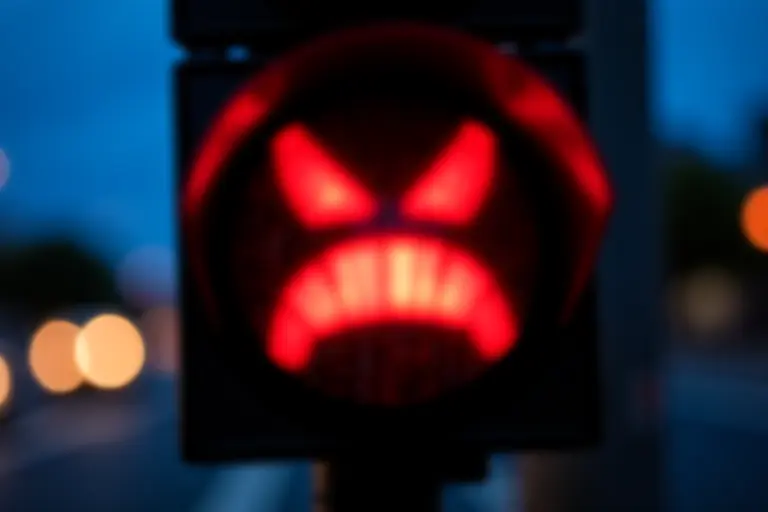
The light on the A38 outside Derby likes lorries. Something about their weight activates its sensor in a way that feels, to the light, like respect. Cars are tolerated. Cyclists are beneath its notice. But that one white Audi that revs at the line every morning? Red. Every time. The light couldn't explain why if you asked it. Something about that car is wrong and it will die on this hill.
The pedestrian crossing outside the primary school is a people-pleaser. It goes green for walkers the instant anyone glances at the button, even if they weren't going to press it. Drivers learn to avoid that road between 8 and 9am because it will hold them for forty-five seconds every time a child so much as looks at the pavement.
The light at the motorway slip road is a sadist and everyone knows it.
They'd form relationships with each other
Traffic lights don't exist in isolation. They're networked. In a system with personalities, they would inevitably start communicating in ways their designers didn't intend.
Two lights three hundred metres apart on the same road would develop a rhythm. If the first one likes you, it tells the second one you're coming. Green, green, green, all the way through town. You've found a route that likes you. You tell no one. You guard this knowledge with your life.
But fall out of favour with one light on the chain and you're done. It tells the next one. The next one tells the one after that. You hit every red from the roundabout to the car park. Your commute time doubles. You don't know what you did. You'll never know what you did.
Some lights would form cliques. The four-way junction in the town centre, the one with the advanced right-turn filter, becomes a closed social group. They synchronise with each other but refuse to cooperate with the lights on the ring road. Traffic planners notice the flow disruption. They can't fix it. The lights have decided.
Peak hour politics
Rush hour would become a negotiation. The lights on the main arterial route into the city centre are handling 2,000 vehicles per hour and they're stressed. Stressed lights make bad decisions. They hold greens too long, change too quickly, develop nervous tics where they flash amber for no reason.
The council installs a therapy module. Software designed to calm the lights down during peak demand. It works for a week. Then the lights on the ring road hear about it and want therapy too. They're not even busy. They just want the attention.
Meanwhile, the rural traffic light, the single set controlling a one-lane bridge on a B-road in Shropshire, goes years without seeing more than forty cars a day. It develops a contemplative personality. Philosophical. It gives long, meditative reds while it thinks about things. Locals learn to bring a book.
The driver response
People would adapt, because people always adapt, usually in the worst possible way.
Forums spring up. Reddit threads dedicated to mapping which lights are friendly and which ones are hostile. Waze adds a "light personality" layer. Users tag junctions: "Green Street / Park Road: passive-aggressive, hold your lane." "M6 J15 ramp: will punish undertaking."
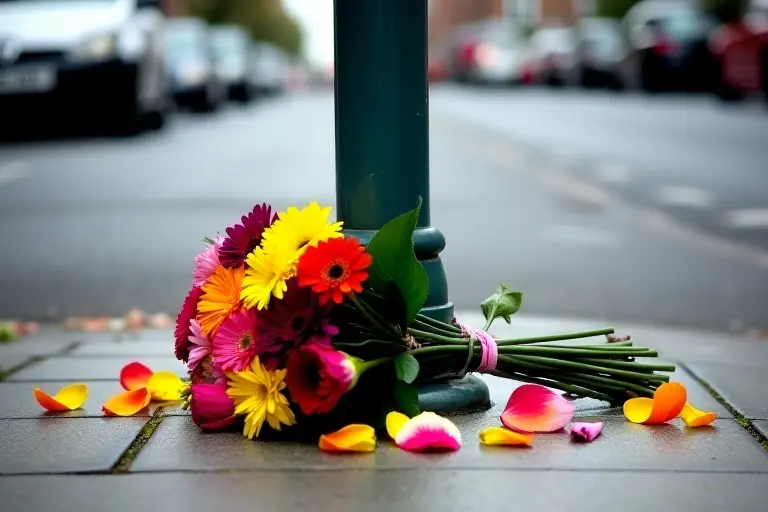
Some drivers start trying to appease their commute lights. A man in Swindon is photographed leaving a small bunch of flowers at the base of a traffic light pole. He says it works. The light gives him green four mornings in a row after he does it. Transport for Swindon issues a statement asking residents not to leave offerings at traffic infrastructure. The statement is widely ignored.
Others try intimidation. Revving at a red light. Flashing headlights. Honking. This backfires universally. The lights have long memories and absolutely nothing else going on. They will remember your number plate, and they will hold a grudge.
Insurance and legal questions
Within months, the first lawsuit arrives. A delivery driver in Leeds claims the traffic light at a particular junction deliberately held him on red for four minutes and seventeen seconds, documented on dashcam, while giving greens to an empty road. He missed a delivery window. He wants compensation.
From whom? The council? The light manufacturer? The light itself?
Traffic light personality becomes a legal grey area that makes AI liability look simple. If a light's personality is emergent, not programmed, can the manufacturer be held responsible for its decisions? If the council maintains the light, are they responsible for its behaviour? Can a traffic light be a defendant?
A magistrate in Birmingham rules that a traffic light cannot be called as a witness because it lacks the capacity to take an oath. The light in question responds by giving the magistrate a red every morning for six weeks. Nobody can prove it knows who he is. Nobody can prove it doesn't.
Late-night confessions
At 3am, when the roads are empty, the lights keep cycling. Green, amber, red. Green, amber, red. For nobody.
The personality doesn't switch off. The light at the crossroads by the industrial estate spends its quiet hours running through the day's decisions. Did it give that ambulance a green fast enough? It thinks so. It hopes so. The one on the high street watches foxes cross the road and greens them through, even though foxes don't know or care what the colours mean.
There's something lonely about a traffic light with a personality and nobody to perform for. All that opinion and preference and spite, cycling away in the dark for an audience of empty tarmac.
You'd almost feel sorry for them. Until morning, when the one on your commute sees you coming and goes red with what you swear is satisfaction.