On the morning of 18 June 1815, roughly 140,000 men stood in muddy fields south of Brussels with every intention of killing each other. By nightfall, Napoleon had lost. The French Empire collapsed, the Bourbons were restored, and Europe's borders were redrawn at the Congress of Vienna in a way that held, more or less, for a century.
But the battle was close. Genuinely, painfully close. If Grouchy had arrived instead of Blücher. If the rain had stopped six hours earlier. If Napoleon had attacked at dawn rather than waiting for the ground to dry. Any one of these changes could have flipped the result.
So what happens if Napoleon wins at Waterloo?
The afternoon that changes everything
Wellington's Anglo-allied army breaks. The Prussians, arriving too late or held off by Grouchy's corps, can't shore up the crumbling line. The Duke of Wellington, who later admitted the battle was "the nearest-run thing you ever saw in your life," is killed or captured.
Brussels falls within days. The Coalition's Seventh force in Belgium is shattered. Napoleon has, for the moment, won.
But winning a battle isn't winning a war, and Napoleon knew this better than anyone.
The coalition fractures
The Seventh Coalition was enormous: Britain, Prussia, Russia, Austria, and half the minor states of Europe. Its strength was unity. Its weakness was that unity was expensive, exhausting, and politically fragile. The previous six coalitions had all collapsed when members lost the will to keep fighting.
A decisive French victory at Waterloo wouldn't destroy these armies, but it would buy Napoleon something he desperately needed: time. And time meant negotiation.
Austria's position was already ambiguous. Emperor Francis I was Napoleon's father-in-law (Napoleon had married his daughter Marie Louise in 1810). Metternich, Austria's chief minister, had spent years trying to negotiate a contained France rather than a destroyed one. A resurgent Napoleon offering generous peace terms to Austria might well have split the Coalition down the middle.
Russia, meanwhile, was 2,000 kilometres away and had already burned its own capital to beat Napoleon three years earlier. Tsar Alexander I was committed to the cause in 1815, but Russian commitment had limits. A stalemate in Western Europe with no clear path to Paris would test those limits hard.
France's borders
Napoleon's realistic goal after Waterloo wasn't world domination. It was the Rhine frontier. France's "natural borders" along the Rhine, the Alps, and the Pyrenees had been a French strategic obsession since the Revolution. The 1814 Treaty of Paris had stripped France back to its 1792 boundaries, which Napoleon considered an insult.
With a battlefield victory in hand, Napoleon could have demanded the Rhine provinces, Belgium, and possibly Savoy. These weren't wild claims by the standards of the day. France had held them for twenty years. An entire generation had grown up French-speaking and French-administered in Aachen, Liège, and Geneva.
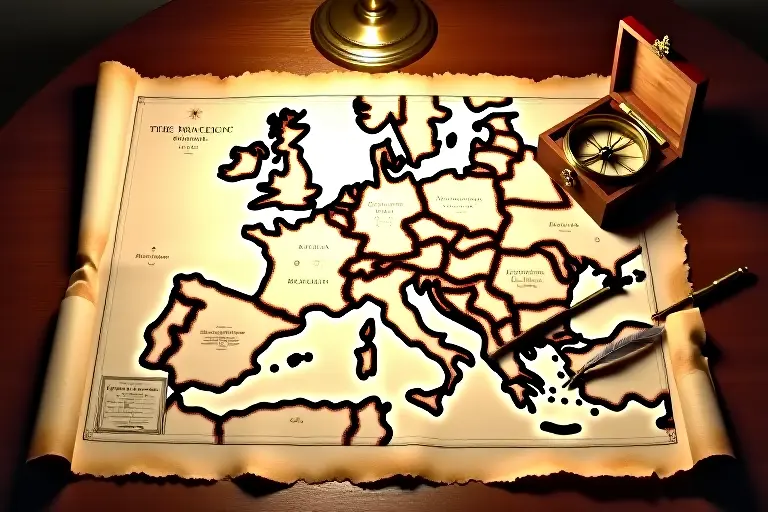
Belgium as an independent nation simply wouldn't exist. It was created in 1830 partly because the Congress of Vienna had awkwardly bolted it onto the Netherlands, a union nobody wanted. If France keeps Belgium, that problem never arises. No Belgium means no Brussels as an international capital. The EU, if it eventually forms, parks itself somewhere else. Strasbourg, maybe.
Germany doesn't unify
This is the big one.
German unification in 1871 was driven by Prussia, specifically by Bismarck exploiting a series of wars to forge a unified German state under Prussian leadership. But Prussia's rise to dominance depended on the post-Waterloo settlement. The Congress of Vienna gave Prussia the Rhineland, which contained the coal and iron deposits that fuelled its industrialisation. Without Waterloo, without the Congress, Prussia doesn't get those territories.
A France that holds the Rhine also blocks Prussian expansion westward. Prussia remains a mid-sized German state, powerful but not dominant. The German Confederation stays fragmented. No unified Germany in 1871 means no Kaiser, no Prussian militarism as a continental threat, and a completely different trajectory for European politics.
It also means the Franco-Prussian War of 1870 probably doesn't happen. That war produced the Treaty of Versailles (the 1871 one, not the famous 1919 one), which humiliated France and set up the resentment cycle that fed into 1914.
The two wars that might not happen
I need to be careful here because "Napoleon wins therefore no World Wars" is a seductive but oversimplified chain. History doesn't work like dominoes. But the chain of causation is at least plausible.
No unified Germany means no German Empire. No German Empire means no naval arms race with Britain. No arms race means no entangling alliance system pulling everyone into a continental war over an assassination in Sarajevo. World War One, in its specific form, becomes very difficult to construct.
And without the First World War, you don't get the conditions that produced the Second. No Versailles Treaty of 1919, no war reparations crushing Weimar Germany, no economic desperation creating fertile ground for fascism.
That doesn't mean Europe lives in peace. It almost certainly doesn't. The 19th century would still have nationalism, imperial competition, and colonial wars. But the specific catastrophe of 1914-1945 required a specific set of preconditions, and several of those preconditions trace back to what happened after Waterloo.
Napoleon's empire doesn't last
Here's the cold water. Even if Napoleon wins the battle, his regime had structural problems that a single victory couldn't fix.
France was exhausted. Twenty-five years of near-continuous warfare had hollowed out a generation of men. The economy was strained. Napoleon's return from Elba was popular in parts of France but deeply divisive in others. The royalists, the liberals, the republicans, the Catholics who opposed him, they hadn't vanished. They were waiting.
Napoleon was 45 in 1815 and already suffering the health problems (likely stomach cancer or a peptic ulcer) that killed him six years later. Even with a victory at Waterloo, he probably dies in the mid-1820s. His son, Napoleon II, was five years old and living in the Austrian court. A regency would follow, with all the instability that implies.
The Napoleonic empire, version two, probably lasts ten to fifteen years. It ends with Napoleon's death, a succession crisis, and possibly another revolution. France cycles through governments roughly as it did in reality, just with different borders and different grudges.
What actually changes
The lasting difference isn't Napoleon's empire. It's the map. A France that holds the Rhine frontier for even a decade reshapes European power dynamics in ways that persist for centuries. Germany stays fragmented. Belgium doesn't exist. The Netherlands is smaller. Switzerland might look different. Italy's unification, which in reality was influenced by the post-Vienna settlement, follows a different path.
Language shifts too. Another generation of Rhineland children growing up speaking French means the linguistic border between French and German moves east and stays there. Cologne might be as French-speaking today as Montreal is. Or it might not. Language is stubborn, and people have a habit of speaking whatever they want once the soldiers leave.
The British Empire carries on regardless. Britain's power was naval, not continental, and a French victory at Waterloo wouldn't have touched the Royal Navy. If anything, a stronger France on the continent might have pushed Britain further toward its empire, accelerating colonial expansion in Africa and Asia.
One battle. One afternoon of rain and mud and 47,000 casualties. It's strange to think that the shape of modern Europe, the existence of entire nations, might have come down to whether a French marshal read his orders correctly and turned left instead of right on a road in Belgium.