Johannes Gutenberg introduced his movable-type printing press to Europe around 1440. Within fifty years, an estimated 20 million volumes had been printed. By 1600, that number was somewhere between 150 and 200 million. For perspective, in the centuries before Gutenberg, the entirety of Europe probably contained a few hundred thousand hand-copied manuscripts, most of them locked inside monasteries.
Remove the printing press from history and that's where they stay.
The scribes keep their monopoly
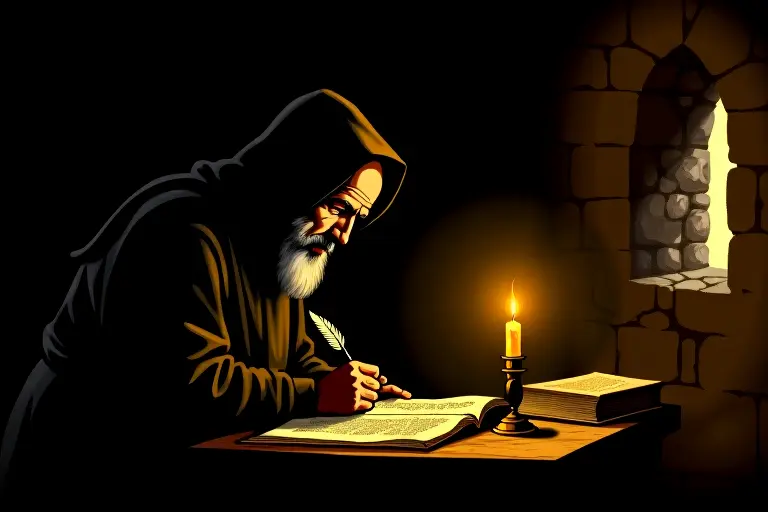
Before Gutenberg, producing a book meant a scribe copying it by hand. A single Bible took roughly three years of continuous labour. The materials (vellum, made from calfskin) cost the equivalent of a labourer's annual salary. Books were objects of enormous value, chained to library desks, accessible only to clergy and the very wealthy.
Without the press, this doesn't change. The monasteries remain the primary centres of knowledge reproduction. Literacy stays confined to the priestly class, the aristocracy, and a thin sliver of the merchant class who need it for trade records. The average person in 1500 can't read. Without the press, the average person in 1800 still can't read.
Education for common people becomes almost pointless. Why teach a farmer's child to read when there's nothing to read? The feedback loop between literacy and available text never kicks in. Printing created demand for literacy which created demand for printing. Cut the loop and both stagnate.
The Reformation doesn't happen
Martin Luther nailed his 95 Theses to a church door in Wittenberg in 1517. That act, in itself, wasn't special. Priests posted theological disputes on church doors regularly. What made Luther different was the printing press. Within two weeks, his Theses had been translated from Latin into German and printed in thousands of copies. Within two months, they'd spread across Europe.
Without printing, Luther's complaint stays on a door in a mid-sized German town. Maybe a few dozen people read it. Maybe it gets hand-copied a few times and circulates among academics. It does not trigger a continent-wide religious revolution because it physically cannot reach enough people fast enough.
The Catholic Church maintains its monopoly on Christianity in Western Europe. No Protestantism. No Anglican Church. No Puritans, which means no religiously motivated exodus to the Americas in the form we know it. Henry VIII still wants his divorce, but without an existing template of theological rebellion, his break with Rome becomes a purely political act with less ideological weight behind it.
Science slows to a crawl
The Scientific Revolution depended on one thing above all: scientists reading each other's work. Copernicus published De Revolutionibus in 1543. Newton published Principia Mathematica in 1687. Darwin's On the Origin of Species came out in 1859. Each of these books reached thousands of readers within months of publication, sparking debate, criticism, replication, and further discovery.
Without the press, Copernicus writes his heliocentric theory and maybe thirty people ever see it. Hand-copied manuscripts travel slowly and expensively. A natural philosopher in Edinburgh might not learn about an experiment conducted in Florence for years, if ever. The collaborative, cumulative nature of science, where each generation builds on the published work of the last, breaks down when "published" means "exists in four handwritten copies."
Science doesn't stop entirely. People still observe, still experiment, still think. But the pace slows by orders of magnitude. The gap between Copernicus and Newton, roughly 150 years, might stretch to 500. The Industrial Revolution, which required both accumulated scientific knowledge and a literate workforce capable of operating complex machinery, gets pushed back centuries.
Democracy has a harder birth
Pamphlets won the American Revolution. Thomas Paine's Common Sense, published in January 1776, sold roughly 500,000 copies in its first year to a colonial population of 2.5 million. One in five people read it directly. It was the most widely distributed political document in American history up to that point, and it made the case for independence in plain language that ordinary people could follow.
Without printing, political ideas spread through speech. Oratory, sermons, town criers, word of mouth. These work, but they're local. You can rouse a town with a speech. You can't rouse a continent. Revolutionary sentiment stays fragmented, regional, easy for central authority to contain. The coordinated, simultaneous spread of democratic ideals that printing enabled simply doesn't happen at the same speed or scale.
Monarchies and theocracies last longer. Not forever, probably. Oral cultures did develop democratic traditions in ancient Greece and various indigenous societies. But the mass democracies of the modern world, with their constitutions, their bills of rights, their informed electorates, all depend on mass literacy. And mass literacy depends on cheap text. And cheap text depends on the printing press.
What we'd have instead
Oral tradition would remain dominant far longer. Memory specialists, storytellers, and reciters would hold social status equivalent to professors. Information that today exists in reference books would exist in people. Kill the person, lose the knowledge. It happened constantly in the pre-print world and it would keep happening.
Handwritten books would still be produced, and wealthy patrons would still commission them. Universities (Oxford was founded around 1096, well before printing) would still exist as centres of learning, but they'd serve a tiny elite. The idea that a cobbler's son could educate himself by reading borrowed books is a post-Gutenberg fantasy.
Maps would be rarer and less accurate. Navigation would rely more heavily on oral instruction and personal experience. Scientific illustration, which drove advances in botany, anatomy, and engineering, would be limited to one-off drawings that couldn't be precisely duplicated.
Art would be different too. Albrecht Durer's woodcuts made him famous across Europe precisely because they could be printed in thousands. Without that, visual art stays local. You see what's in your church, your town, your lord's manor. The concept of a pan-European artistic movement barely exists when artists in different cities have no reliable way to see each other's work.
The world in 2026
If you follow this thread far enough, the world today is unrecognisable. No mass literacy means no newspapers, no novels, no shared written culture. Science advances at a fraction of its actual pace. The Industrial Revolution might be happening now instead of 250 years ago. Democracies are rare. Theocratic and monarchical power structures dominate. Global population is probably much lower, since the agricultural and medical advances that enabled population growth all depended on the rapid spread of knowledge.
We might be living, technologically and socially, in something resembling the 17th century. A world of scribes and kings and very beautiful handmade books that almost nobody can read.
Gutenberg didn't invent knowledge. But he made copies cheap, and cheap copies changed everything.