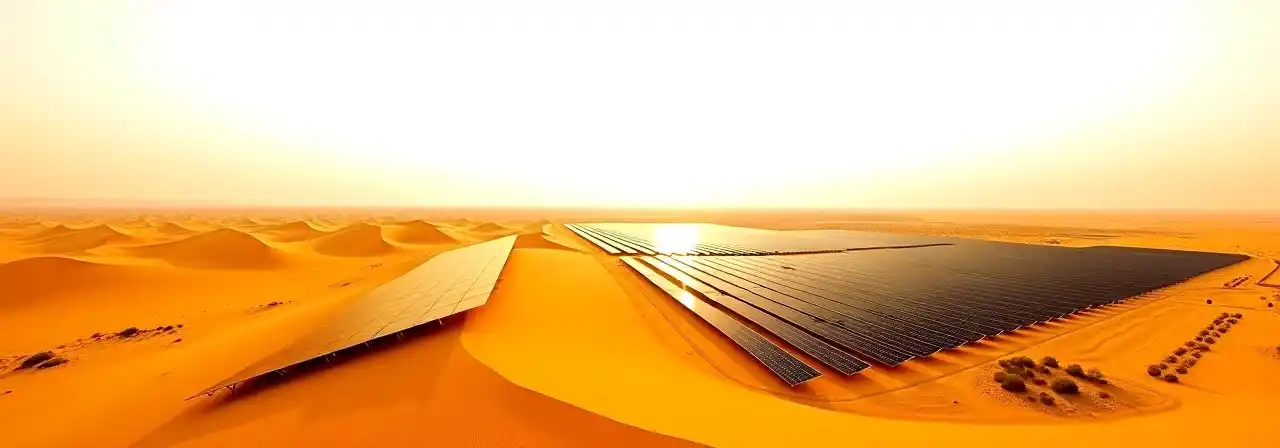
The Sahara Desert receives about 22 billion gigawatt hours of solar energy per year. The entire world uses roughly 180,000 terawatt hours of energy annually. Cover just 1.2% of the Sahara in solar panels and you generate enough electricity for every home, factory, vehicle, and server farm on Earth.
1.2%. That's a square about 340 kilometres on each side. Smaller than Germany. A patch of sand in a desert the size of the United States. The maths works. The engineering is feasible. The reasons it hasn't happened are almost entirely human.
The engineering
Solar panel technology is mature. Current commercial panels convert about 22% of incoming sunlight to electricity, and the Sahara gets between 2,500 and 3,000 hours of peak sunlight per year compared to about 1,500 in southern England. The raw generating potential is enormous.
But generating electricity in the middle of a desert and delivering it to London, Berlin, Lagos, or Mumbai are two very different problems.
High-voltage direct current (HVDC) transmission lines lose about 3% of their energy per 1,000 kilometres. From the central Sahara to southern Europe is roughly 3,000 kilometres, so you're losing about 9% in transit. That's acceptable. Undersea HVDC cables already connect Norway to the UK (the North Sea Link, 720 kilometres, operational since 2021) and Morocco to Spain across the Strait of Gibraltar.
The infrastructure cost would be staggering but not absurd. The International Energy Agency estimated in 2023 that global annual investment in clean energy had reached $1.8 trillion. A Saharan solar installation covering 115,000 square kilometres, with associated transmission, would cost in the region of $5 to $10 trillion over a decade. That's a lot of money. It's also roughly what the world spent on fossil fuel subsidies between 2015 and 2023.
The sand problem
Deserts are hostile to technology. Sand abrades surfaces. Temperatures swing from over 50 degrees Celsius in the daytime to near freezing at night, stressing materials through thermal expansion and contraction. Sandstorms bury equipment. Dust accumulates on panels and cuts output by 20-30% if not cleaned regularly.
Cleaning panels in the Sahara means water, and water in the Sahara is precisely the thing you don't have. Robotic dry-cleaning systems exist and are used in Gulf state solar installations, but scaling them to an area the size of a small country is a manufacturing and maintenance challenge on its own.
Panel degradation in desert conditions is faster than in temperate climates. Where a panel in southern England might last 30 years, a panel in the Sahara might need replacing after 20. That means a permanent manufacturing and replacement pipeline running indefinitely. You're not building a solar farm. You're founding a solar civilisation.
The geopolitics
Here's where it falls apart.
The Sahara is not one country. It spans Algeria, Libya, Egypt, Tunisia, Morocco, Mauritania, Mali, Niger, Chad, and Sudan. Several of these countries are politically unstable. Some are in active conflict. None of them have any particular reason to hand control of the world's energy supply to a European-led infrastructure project.
If you're Algeria and you control 30% of the world's electricity, you are the new Saudi Arabia. You don't sell that power cheaply. You don't sell it to countries you have diplomatic disputes with. You use it as leverage. Every trade negotiation, every UN vote, every territorial disagreement now has an energy dimension.
Europe spent decades trying to reduce its dependency on Russian natural gas. Replacing that dependency with North African solar electricity is just swapping one vulnerability for another with better weather.
The Desertec Industrial Initiative tried this. Launched in 2009, backed by major German corporations including Siemens, Deutsche Bank, and Munich Re, it proposed exactly this concept: Saharan solar power transmitted to Europe via HVDC. By 2014, most of the founding companies had left the consortium. The technical challenges were solvable. The political ones weren't. Getting twelve countries with competing interests to agree on infrastructure routing, pricing, and governance proved impossible.
Desertec didn't fail because of engineering. It failed because humans are involved.
The ecological impact
The Sahara looks lifeless from satellite images, but it isn't. It supports about 500 plant species, 70 mammal species, 90 bird species, and various reptiles adapted to extreme conditions. The fennec fox, the addax antelope, the Saharan cheetah (yes, there are still cheetahs in the Sahara, about 40 of them) all depend on this ecosystem.
Covering 115,000 square kilometres in solar panels changes the local environment. Panels create shade. Shade reduces surface temperature. Reduced temperature changes air circulation patterns. A 2018 study published in Science found that large-scale Saharan solar installations could actually increase regional rainfall by up to 50 millimetres per year, as altered surface temperatures affect the West African monsoon.
More rain in the Sahara sounds good. But ecosystems adapted to extreme aridity don't respond well to sudden moisture increases. Species that evolved for desert conditions get outcompeted by species that prefer wetter environments. You're not restoring the Sahara. You're creating a new ecosystem from scratch, with unpredictable consequences.
The dust question
Saharan dust feeds the world. Every year, roughly 182 million tonnes of dust blow westward from the Sahara across the Atlantic Ocean. About 27.7 million tonnes of that land in the Amazon basin, where it provides phosphorus that the rainforest's poor soils desperately need. Without Saharan dust, the Amazon's nutrient cycle weakens.
Solar panels covering a significant chunk of the western Sahara would disrupt dust generation in that region. Less dust means less phosphorus crossing the Atlantic. Less phosphorus means slower growth in the Amazon. You've solved the global energy crisis and accidentally starved the world's largest rainforest.
This isn't a theoretical concern. Climate scientists have been studying the Sahara-Amazon dust connection since the 1990s. It's one of those planetary-scale feedback loops where touching one thing on one continent affects something apparently unrelated on another continent 5,000 kilometres away.
So why think about it at all
Because the maths is too good to ignore. The energy is there. It falls on empty sand every day. The technology to capture and transmit it exists. No new physics is needed, no speculative breakthroughs, no fusion reactors or orbital solar platforms. Just panels, cables, and an area of desert that's doing nothing except baking.
The obstacles are politics, logistics, and the uncomfortable reality that the countries sitting on the resource have no obligation to share it on terms that suit the countries that need it. That's not an engineering problem. It's a people problem. And people problems, in the history of energy, tend to get solved only when the alternative becomes intolerable.
We're not there yet. But the sand isn't going anywhere, and neither is the sun.