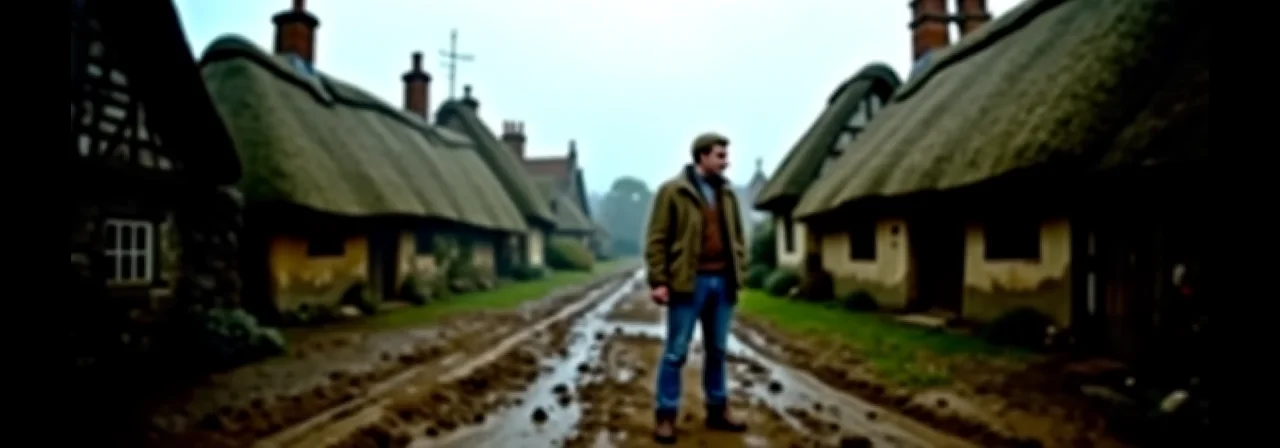
You wake up in a field. You're wearing what you went to bed in. It's cold, it smells of manure and woodsmoke, and there's a cow standing on your foot.
You're in England. Roughly 1350, give or take a decade. You know this because of the strip farming, the wattle-and-daub houses, and the fact that everyone you can see is wearing undyed wool and looks significantly shorter than you. Also, someone just died of what appears to be a skin infection, and nobody seems especially surprised about it.
Good luck. You'll need it.
Day one: the language barrier
The first problem isn't disease, violence, or starvation. It's that you can't communicate with anyone. Middle English, the language spoken in 14th-century England, is not modern English with funny spelling. It's a different language. Chaucer wrote in it, and even with modern footnotes most English speakers can't read Chaucer without a glossary.
Here's a sentence from the Canterbury Tales, written in the 1390s: "Whan that Aprille with his shoures soote, The droghte of March hath perced to the roote." You can sort of parse that if you squint. Now imagine it spoken at full speed by someone with a regional accent from a dialect that varies by county, because standardised English doesn't exist yet. The printing press won't arrive for another hundred years.
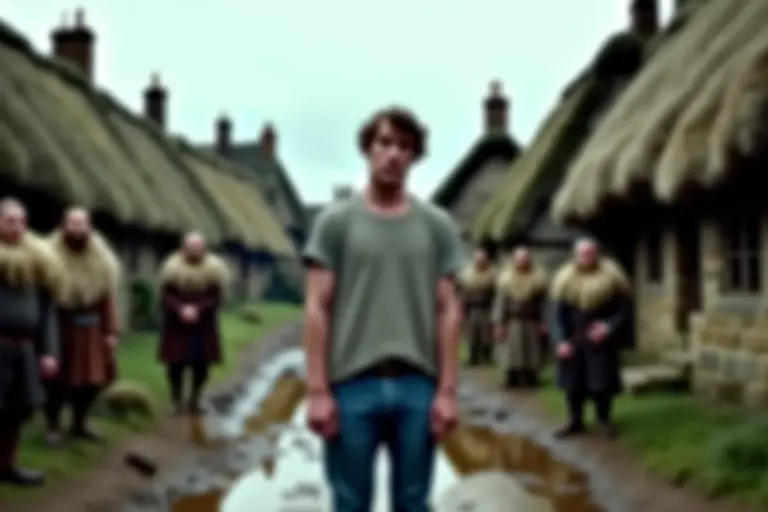
Your modern English sounds equally bizarre to them. You speak too fast. Your vocabulary is littered with words that won't be coined for centuries. Try explaining where you're from without using the words "country," "city," "government," or "modern," none of which exist in their current sense.
For the first few weeks, you're functionally mute. You can gesture, point, and mime. You're the village idiot, and not in the sympathetic sense.
The hygiene situation
Medieval people weren't as filthy as Victorian historians liked to claim. They washed their hands before meals, bathed more regularly than their 17th-century descendants, and understood that wounds should be kept clean. Public bathhouses existed in most towns.
That said, sanitation by modern standards is nonexistent. Human waste goes into cesspits, streams, or the street. Water sources are contaminated. Approximately 30% of medieval urban wells tested by archaeologists show dangerously high levels of faecal bacteria. Food handling practices would get a modern restaurant closed within the hour.
Your modern immune system has never encountered many of the pathogens circulating in medieval England. You've been vaccinated against some of them. You haven't been vaccinated against most intestinal parasites, and those are everywhere. Within two weeks, you almost certainly have some combination of dysentery, giardia, or roundworm. Medieval people had these too, but they'd been exposed from birth and their gut flora had adapted. Yours hasn't.
You're going to spend a lot of time squatting behind hedges feeling sorry for yourself.
What your modern knowledge is actually worth
In every time-travel fantasy, the protagonist revolutionises the past with their knowledge of science, medicine, and technology. Let's examine how well that works in practice.
You know that germs cause disease. Excellent. Now explain germ theory to a 14th-century peasant. You don't have a microscope (the first useful one is 300 years away). You can't show them bacteria. You're asking them to believe in invisible creatures that cause illness, which sounds exactly like the demonic possession theory they already have, except less convincing because at least the priest has a book.
You know about antibiotics. Can you make penicillin? You know it comes from mould. Bread mould? Fruit mould? Which mould? How do you extract the active compound? How do you dose it? You're not a biochemist. Your knowledge of penicillin is "mould plus magic equals medicine." That's not enough.
You could improve sanitation. Boil water, separate waste from drinking sources, wash hands with soap. This is genuinely useful advice, and you could probably communicate it through mime within a few months. But convincing an entire village to change its daily habits based on the advice of a strange-sounding foreigner who can barely speak the language is a sales pitch that would challenge a modern marketing department, let alone one person with a vocabulary of about forty Middle English words.
Your useful skills
Can you farm? Not with a wooden plough pulled by an ox. Can you weave? Not on a medieval loom. Can you shoe a horse, forge a nail, thatch a roof, brew ale, card wool, or slaughter a pig? No? Then you have no marketable skills in a medieval economy.
You can probably do basic arithmetic better than most villagers. That's something. Numeracy was rare. If you can count, measure, and keep tallies, you might find work as a clerk or assistant to a merchant, assuming you learn enough language to be useful. But literacy in 1350 means reading Latin, because almost everything written down is in Latin. The literate class is the clergy. You are not clergy.
Physical labour is your most likely employment. Breaking rocks, hauling timber, digging ditches. The work is brutal by modern standards. A medieval agricultural labourer burned an estimated 4,000 to 5,000 calories per day. Your office-conditioned body is going to struggle with the first week and suffer through the first month. Medieval people were shorter but significantly stronger than modern sedentary adults. You will be the weakest person on the farm.
The social problem
Medieval England is a feudal society. Every person belongs somewhere in a hierarchy anchored to land ownership. The lord owns the land. The villeins work it. Freemen have some rights. Serfs have almost none. You have no place in this system. No lord, no tenancy, no guild membership, no parish, no family. You are a vagabond.
The Statute of Labourers, passed in 1351 after the Black Death had killed roughly 40-60% of England's population, made it illegal to be an able-bodied person without employment. Vagabonds were imprisoned, branded, or worse. You're not just an outsider. You're a criminal by the act of having nowhere to be.
If you're a woman, the situation is worse in every possible dimension. Women's legal status in 14th-century England was defined entirely through relationships with men: father, husband, lord. An unattached woman with no family, no dowry, and no identifiable origin is at best an object of suspicion. At worst, you're accused of witchcraft, which in the 14th century usually means a fine or penance but occasionally means something considerably more permanent.
The Black Death
If you've arrived in 1350, you've arrived at the worst possible moment. The Black Death reached England in June 1348 and killed between 1.5 and 2 million people out of a population of roughly 5 million by 1351. That's 30 to 40 percent of everyone in the country, dead in three years.
Yersinia pestis, the bacterium that causes plague, is transmitted by flea bites and, in its pneumonic form, by coughing. You have no immunity. Nobody does. Medieval physicians thought it was caused by bad air (miasma) and treated it with aromatic herbs held to the nose. The actual treatment is streptomycin, which won't be discovered for another 594 years.
Your odds of surviving a plague outbreak with no antibiotics, poor nutrition, intestinal parasites, and a body already weakened by manual labour are not good. They're not zero. Sixty percent of the population survived. But they were adapted to a world of endemic disease in ways your pampered immune system is not.
How long do you last
Honestly? If you're healthy, lucky, and willing to do hard physical work without complaining, you might last months. Maybe years. People are resilient, and medieval communities, especially ones depleted by plague, needed labour badly enough to tolerate a strange newcomer who talked funny.
But the fantasy of the modern person thriving in the past, building a power base through superior knowledge, introducing technology centuries ahead of schedule? That's fiction. Your knowledge is abstract. You know that steam power works but you can't build a steam engine. You know about crop rotation but you've never held a plough. You know the Earth goes around the sun and if you tell anyone they'll think you're either touched by God or possessed by the devil, and which one depends on whether the local priest likes you.
The honest answer is that a modern person dropped into medieval England would be cold, sick, confused, illiterate, unskilled, and frightened. You would survive by doing what medieval people did: working with your hands, eating what you could get, keeping your head down, and trying very hard not to die before spring.
That's not a failure of modernity. It's a reminder that the gap between knowing things and being able to do things is, and always has been, enormous.