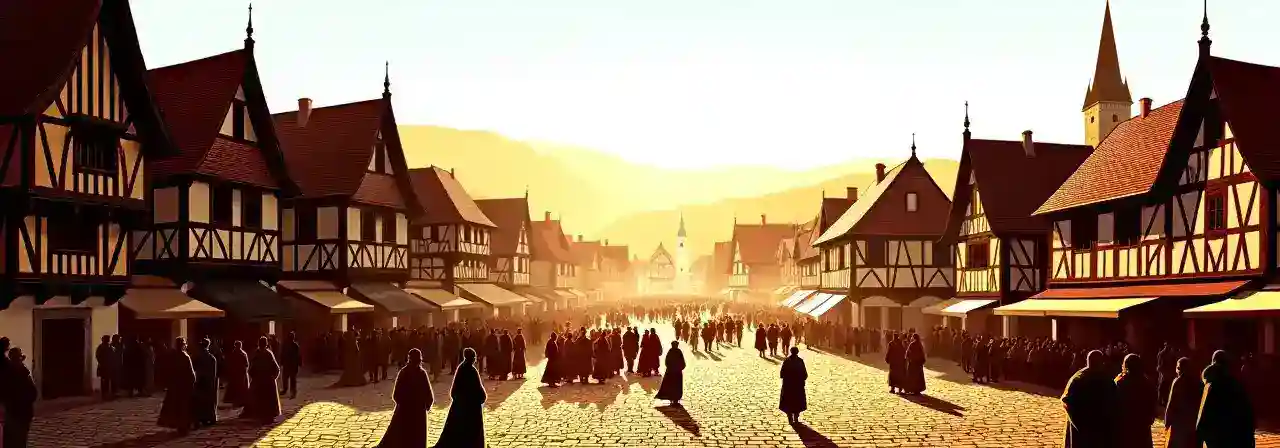
Between 1347 and 1353, the Black Death killed somewhere between 75 and 200 million people across Eurasia. In Europe alone, it wiped out roughly a third of the population. Some regions lost half. In parts of England, entire villages simply ceased to exist. Parish records stop mid-sentence. Tax rolls go blank.
Take all of that away. Yersinia pestis stays in its Central Asian rodent reservoirs and never hitches a ride on a flea, on a rat, on a Genoese trading ship. Europe keeps its 75 million people. No mass graves. No flagellant processions through the streets. No plague doctors in beak masks.
And quite possibly, no Renaissance. No Reformation. No rise of the middle class. No end to feudalism for another few hundred years.
The Black Death was the worst catastrophe in recorded human history. It was also, arguably, the event that created the modern world.
Feudalism locks in
Before the plague, medieval Europe ran on a simple economic model: land was plentiful, labour was cheap, and lords held all the power. Peasants worked the land because they had no alternative. There were always more peasants than positions, which meant lords could dictate terms. Wages were low because they could be. Mobility was restricted because it didn't need to be otherwise. Why pay more or offer better conditions when there's a queue of desperate families behind every serf?
The plague changed this overnight. Kill a third of the workforce and suddenly labour is scarce. Surviving peasants could demand higher wages. They could leave one lord's estate and find better terms at another, because every estate in England was desperately short-handed. The Statute of Labourers in 1351, which tried to freeze wages at pre-plague levels, was a panicked attempt to hold the old system together. It failed spectacularly.
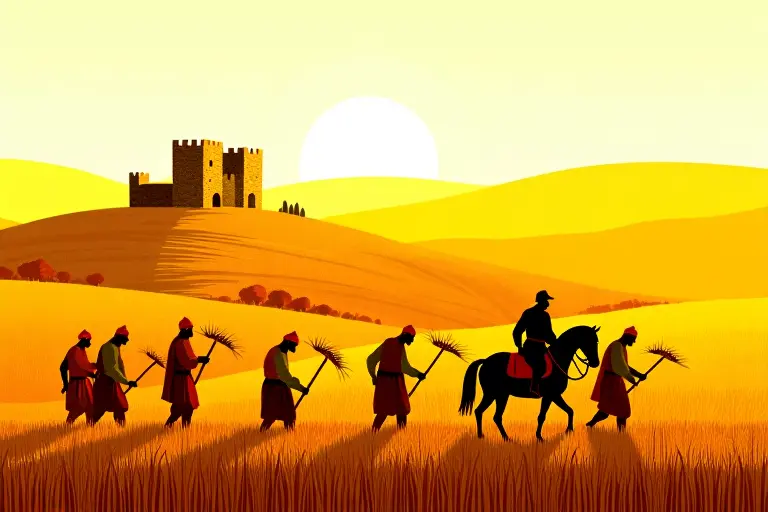
Without the plague, none of this pressure exists. The labour surplus continues. Serfdom doesn't weaken, it solidifies. The feudal contract between lord and peasant, already centuries old by the 1340s, keeps grinding forward with no external shock to disrupt it.
The Peasants' Revolt of 1381 doesn't happen because there's nothing to revolt about. Peasants have no leverage, no sense that things could be better, no experience of higher wages to compare against. Wat Tyler stays in Kent doing whatever Wat Tyler was doing before he decided to march on London.
The church stays unquestioned
The medieval Catholic Church told people the plague was God's punishment for sin. When a third of the clergy died alongside everyone else, and when prayer proved exactly as effective as not praying, that narrative took a serious hit. Faith didn't collapse, but trust in the institution did. People started asking questions. Lay piety movements grew. The idea that you might have a direct relationship with God rather than one mediated through a priest who might die next Tuesday gained traction.
John Wycliffe translated the Bible into English in the 1380s, arguing that people should read scripture themselves. The Lollard movement that followed was a direct ancestor of the Protestant Reformation 150 years later. Without the plague, the Church's authority remains largely intact. The population is obedient, tithing, and not yet ready to question a system that hasn't visibly failed them.
Martin Luther might still have nailed his theses to the door in Wittenberg in 1517. But the ground wouldn't have been prepared in the same way. The Reformation relied on populations already sceptical of ecclesiastical authority, already accustomed to questioning the Church's monopoly on truth. Without that prior erosion, the 95 Theses might have been an academic dispute, not a continental revolution.
The Renaissance arrives late, if at all
The Italian Renaissance is often traced to Florence in the early fifteenth century. What's less often discussed is how directly it was funded by the economic upheaval following the plague. Wealthy survivors inherited concentrated fortunes. A smaller population meant higher per capita wealth. Skilled artisans could command better prices. Merchant families like the Medici accumulated enormous wealth in a post-plague economy that rewarded survivors disproportionately.
Patronage of art and learning requires surplus wealth and a cultural climate open to new ideas. Without the plague, Europe's wealth remains distributed across a much larger population. The feudal system keeps most of it locked in land. The merchant class, smaller and less powerful, doesn't accumulate the kind of money that builds cathedrals and commissions Botticelli.
Humanism, the intellectual movement at the heart of the Renaissance, was partly a response to mass death. When a third of the people you know die in three years, you start thinking differently about what human life is for. The shift from theological to humanist thinking, from "life is preparation for the afterlife" to "life has value in itself," was accelerated by the sheer scale of mortality.
Without it, medieval scholasticism continues to dominate European thought. Universities remain focused on theology and Aristotelian philosophy. The explosion of art, science, and secular thought that defined the fifteenth century happens later, slower, and differently.
England stays medieval longer
England's post-plague trajectory was particularly dramatic. The labour shortage forced wages up by 40 to 50 per cent within a generation. Serfdom effectively ended by 1500 because it became economically impossible to enforce. A new class of yeoman farmers emerged, owning or leasing land, accumulating modest wealth, sending sons to newly accessible grammar schools.
This was the soil the English middle class grew from. Without it, the class structure of 1340 persists. England remains a society of lords and peasants with very little in between. The wool trade still exists but its profits flow upward more completely. The enclosure movement, which later transformed English agriculture, has less economic pressure behind it.
Parliament, which gained significant power partly because post-plague monarchs needed to negotiate with an increasingly assertive commons, remains a weaker institution. The balance between Crown and Parliament that eventually led to constitutional monarchy shifts later, if it shifts at all.
Exploration slows
This one is counterintuitive. You'd think a larger population would mean more explorers, more ships, more colonisation. But the drive to explore was partly economic. European economies after the plague were looking for new trade routes, new resources, new markets, to replace what was lost and to satisfy a wealthier but smaller population's demand for luxury goods.
Without that economic pressure, the urgency behind the Age of Exploration diminishes. Portugal might still send ships down the African coast, but the timeline stretches. Columbus's pitch to Ferdinand and Isabella in 1492 relied on the promise of trade revenue to fund a monarchy that needed money. A richer, more stable, less disrupted Spain might have said no.
The Americas still get colonised eventually. Europeans had the ships and the navigational knowledge. But "eventually" might mean the 1550s or 1600s instead of the 1490s, which changes the entire colonial map.
More people, fewer resources
Europe's population in 1340 was already straining against its food supply. Historians call it the Malthusian ceiling. The Great Famine of 1315-1317 had already killed millions. The climate was cooling (the start of the Little Ice Age), reducing crop yields. Without the plague's brutal reduction of population, Europe faces a slower, grinding demographic crisis instead of a sudden catastrophe.
More mouths, same amount of arable land, declining yields. The result is chronic food insecurity, more frequent localised famines, and a population that stays large but poor. The plague was a monstrous correction that nobody asked for, but it reset the population-to-resources ratio in a way that allowed survivors to live better.
Without it, fourteenth-century Europe looks more like fourteenth-century China after the same plague: enormous population, persistent poverty, slower technological development, and institutions that change gradually rather than being shattered and rebuilt.
A longer, darker middle ages
This is the uncomfortable conclusion. The Black Death was a horror beyond description. It killed children, parents, priests, kings. It dissolved communities. It left survivors with grief that generation after generation carried forward in art, literature, and cultural memory.
And it broke the medieval world open. The rigid hierarchies, the unquestioned church, the static economy, the intellectual stagnation of late scholasticism. All of it cracked under the pressure of losing a third of the population in six years. What grew in those cracks was the modern world.
Take the plague away and you get a Europe that's more stable, more populated, more orderly. You also get one that's more static, more hierarchical, more resistant to the changes that eventually produced democracy, capitalism, scientific inquiry, and individual rights. The old structures hold because nothing is strong enough to break them.
History doesn't repeat, but it does have a pattern: the things that destroy also create. The worst moments clear space for what comes next. The Black Death killed tens of millions. What survived was different, and in many specific, measurable ways, it was better. Not because the dying was good. Because what people built afterward was something the old world would never have allowed.