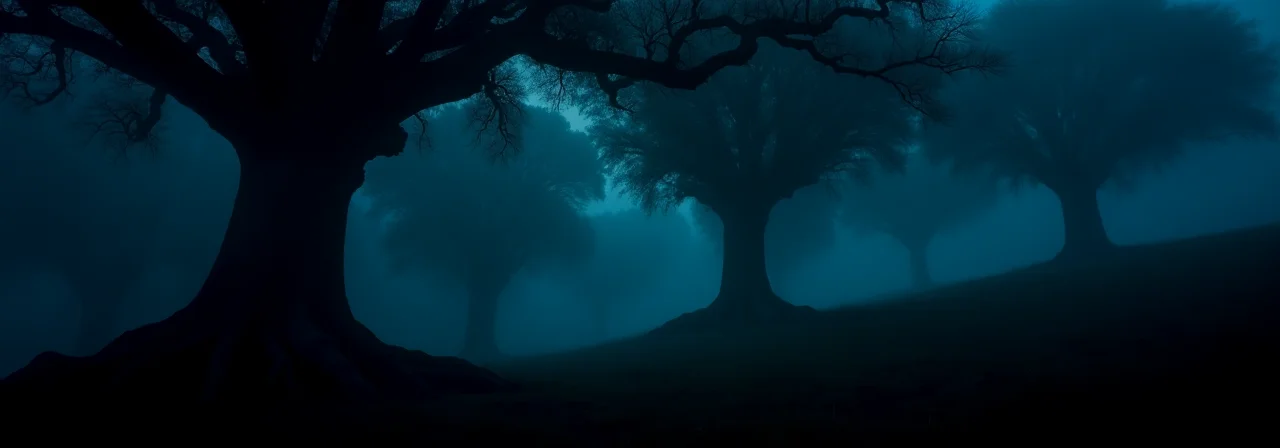
A mature English oak weighs about fourteen tonnes. Its root system spans an area roughly equal to its canopy, sometimes wider. It anchors into soil and rock with a grip strong enough to resist hurricane-force winds. It does not move.
Now give it legs. Or rather, give it the ability to uproot and relocate at will. Let it pull its roots from the ground, shift itself across terrain, and replant wherever it chooses. Not fast. Trees are patient organisms. Say walking pace for a sapling, slower for a large tree. An oak might manage a metre per hour. A birch, lighter and more flexible, perhaps three.
This sounds whimsical. It isn't. Walking trees would fundamentally alter ecosystems, agriculture, infrastructure, and the way humans interact with the natural world. And several of the consequences are genuinely frightening.
Forests become migratory
Trees currently stay where their seeds land. A forest is a fixed community, shaped by soil, rainfall, and sunlight over centuries. Walking trees change this entirely. A forest is no longer a place. It's a population.
Deciduous forests would migrate south in autumn, seeking warmth and light. Not as individual trees making individual decisions, but as a collective drift, the way starling murmurations move without any single bird leading. Trees at the southern edge of a forest get more sun, grow better, attract more trees. The whole mass shifts, slowly, like a glacier made of wood.
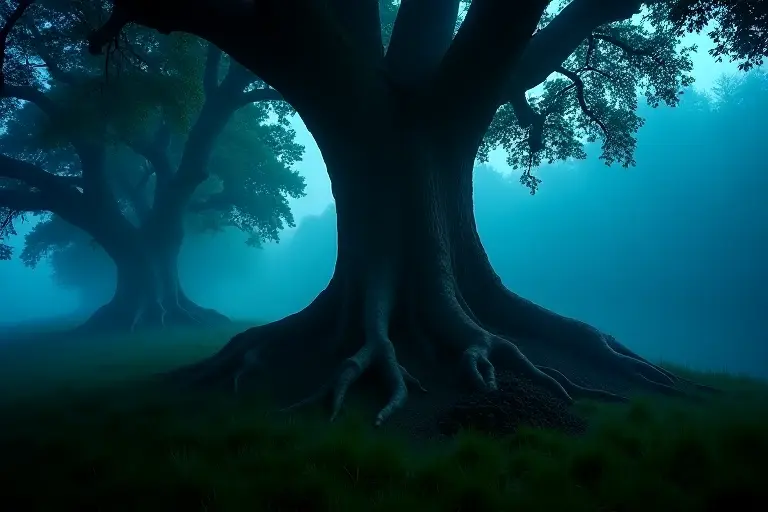
In spring, they'd move north again, following the lengthening days. Tundra that's been treeless for millennia would see forests arrive every summer and leave every autumn. The Arctic treeline, currently fixed by climate, becomes a moving front that advances and retreats with the seasons.
Ecologists would lose their minds. Every vegetation map becomes obsolete within a month. Nature reserves designed to protect a specific habitat discover that the habitat has walked to the next county.
Competition gets physical
Trees already compete viciously for light. In a fixed forest, they do it by growing taller than their neighbours, spreading canopies wider, dropping allelopathic chemicals into the soil to poison nearby seedlings. It's slow, silent warfare played out over decades.
Give them mobility and the competition becomes immediate. A tree being shaded by a taller neighbour can simply walk out from under it. Find a gap. Claim a patch of open ground. But so can every other tree. The result is a constant, creeping rearrangement as trees jostle for position like commuters on a packed platform.
Except commuters weigh seventy kilograms, not fourteen tonnes.
A mature oak relocating crushes everything in its path. Smaller trees, undergrowth, fences, garden walls, parked cars. It isn't aggressive. It's just very large and doesn't have eyes. The trail it leaves behind would look like something between a ploughed field and a demolition site, a churned line of broken soil and flattened vegetation where roots dragged through the earth.
Your garden is no longer yours
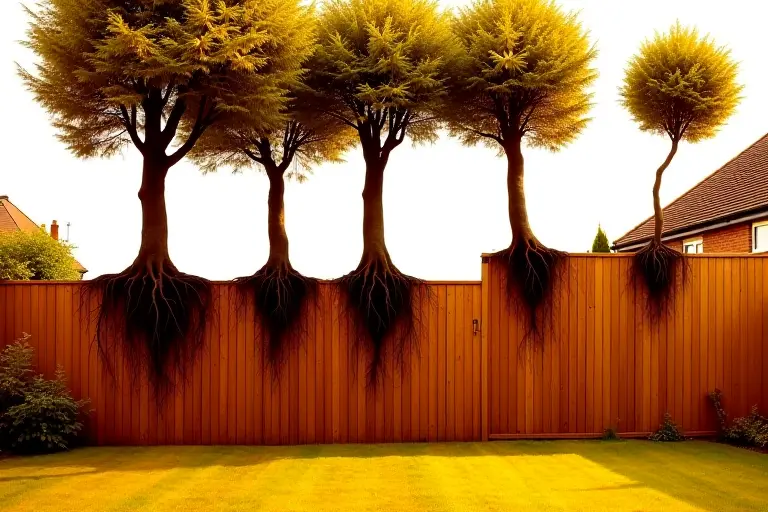
You planted a row of silver birches along your boundary five years ago. They've decided they prefer your neighbour's south-facing lawn. One morning you look out and they're gone. The fence they were screening is now visible, along with the six feet of bare earth where they stood yesterday.
Your neighbour, meanwhile, has gained three uninvited birches and is furious because they're blocking her vegetable patch. She calls the council. The council has no idea who's responsible when a tree trespasses. Property law was not written for organisms that change address.
Urban parks become unreliable. The avenue of limes you walked under every morning might relocate overnight. The ancient yew in the churchyard, a fixture for nine hundred years, could decide the soil is better across the road. Conservation orders become enforcement nightmares. You can't serve a preservation notice on something that won't stay in one jurisdiction.
Roads and buildings are under siege
Trees already cause billions of pounds in infrastructure damage every year through root growth alone, and they do it while standing still. Walking trees would tear up roads, crack foundations, sever underground pipes and cables, and upend railway tracks as a matter of routine. A single oak crossing a motorway would leave a trench across all four lanes.
Cities would need tree barriers. Not decorative bollards, but serious physical infrastructure capable of stopping a slow-moving fourteen-tonne organism. Imagine the M25 with anti-tree walls along both sides. Imagine the maintenance budget.
Buildings on the edge of any wooded area would need permanent defences. A forest that decides to expand into a housing estate wouldn't be stopped by anything short of a concrete wall, and given enough time the roots would probably work their way through that too. Trees are extraordinarily patient and extraordinarily destructive when they're growing through something. Walking would make them faster at it by orders of magnitude.
Logging becomes a hunt
The timber industry currently relies on the fundamental fact that trees don't run. You choose a tree, you cut it down, you haul it away. The tree has no input on this process.
Walking trees flee. Not quickly, but with purpose. A chainsaw starts up and every tree within earshot begins moving away. Not anthropomorphically, not with fear or intent, but as a tropism: negative response to vibration, the way roots already grow away from dry soil. The sound of a saw triggers movement. The forest retreats.
You'd need to approach silently. Hand axes instead of chainsaws. Or you'd need to surround your target, cutting off escape routes with barriers. Logging goes from industry to siege warfare. The economics change completely. Timber prices rise. Wood becomes a premium material instead of a bulk commodity.
And then there's the ethical question. People already argue about the moral status of trees. Give them visible behaviour, give them the appearance of fleeing from harm, and the public reaction would be visceral. Footage of a forest running from loggers would end the timber industry's social licence within a news cycle.
Night is when they move
Photosynthesis requires light. Walking requires energy. Trees would most likely move at night, when they're not photosynthesising and when the energy cost of movement can be spent without competing with growth. This means that every morning you wake up to a slightly different landscape. The treeline has shifted. The copse at the end of the road has drifted twenty metres east. Your apple tree is now in the front garden instead of the back.
You'd never see them move. You'd only see the results. Like snow that falls while you sleep, except instead of white powder covering everything, it's the slow rearrangement of every tree in your environment.
There's something deeply unsettling about large organisms that move when you're not watching. We're comfortable with the idea that the landscape stays where it is overnight. That trees are fixed points. Anchors. Remove that certainty and every walk through a wood after dark becomes an exercise in alertness. You wouldn't hear them. A tree moving at a metre per hour makes no sound you'd distinguish from wind. But they'd be moving around you, close, vast, and silent.
The soil never recovers
Tree roots hold soil together. They prevent erosion, maintain soil structure, support fungal networks that keep the ground fertile. A tree that stays in one place for two hundred years builds an ecosystem around its roots that supports thousands of species. Pull those roots out and walk to the next field and all of that collapses.
Walking trees would leave devastation behind them. Every vacated site would be a patch of loose, churned soil prone to erosion. The mycorrhizal networks that connect trees to each other and to the soil fungal community would be continuously ripped apart and reformed. The "wood wide web" that ecologists have spent decades studying would be in constant flux, like a telephone network where every subscriber changes their physical address every week.
Hillsides would be particularly vulnerable. A forest that walks off a slope leaves bare soil exposed to rain. Landslides follow. Rivers clog with sediment. Downstream flooding increases. The geomorphology of any landscape with mobile forests would be chaotic, unstable, and largely unpredictable.
We treat trees as part of the furniture. Background. Scenery. Things that are simply there, the way mountains are there and rivers are there. But trees are alive in a way that mountains are not, and the only thing keeping them as scenery is their inability to relocate. Take that away and they become the largest, heaviest, most numerous mobile organisms on the planet. There are roughly three trillion trees on Earth. If they all started walking, nothing we've built would be designed to cope with it.