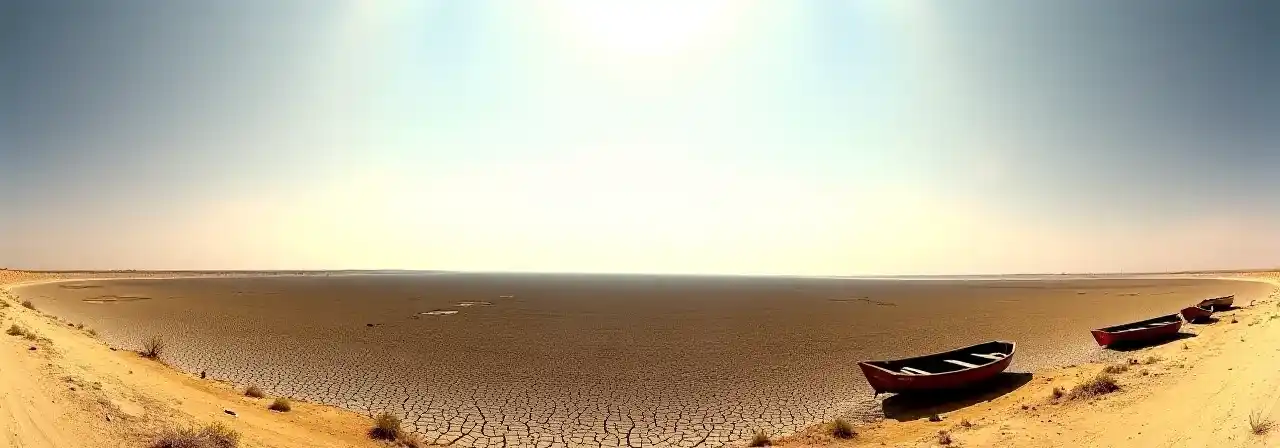
The taps go dry on a Tuesday morning. Not gradually, not with warning, not after a drought that builds over months. Just... nothing. You turn the handle and air hisses out. The same thing happens to every tap, every hose, every pump connected to every freshwater source on the planet.
Every river is empty. Every lake is a basin of cracked mud. Every underground aquifer, every glacier, every reservoir: dry. The 35 million cubic kilometres of fresh water that Earth normally holds, roughly 2.5% of all water on the planet, is gone.
The salt water is still there. The oceans are fine. But you can't drink the ocean.
The first 24 hours
Most people don't notice immediately. Your water pressure comes from a local storage tank or a pumping station, and those have some residual supply. Taps might trickle for an hour or two after the source runs dry. The first sign for most urban residents is a slow pressure drop, then nothing.
Supermarkets get stripped within hours. Not just bottled water. Anything liquid. Milk, juice, soft drinks, beer. People fill trolleys with cans of Coke because it's wet and that's what matters now. By noon on the first day, every shop within a 20-mile radius of any city is empty of anything drinkable.
Hospitals hit crisis within six hours. Dialysis machines need purified water. Surgery requires sterile saline. IV drips, sterilisation, basic hygiene: all dependent on water that no longer exists. Emergency generators keep the lights on, but there's no emergency water supply for most hospitals beyond what's already in the pipes.

The government announces rationing that evening. Military water trucks appear in city centres, distributing from strategic reserves. The UK's strategic water reserve is not large. It's designed for localised supply failures lasting days, not the total disappearance of every freshwater source simultaneously.
Day two: the body's deadline
The human body contains about 60% water by weight. You lose roughly 2.5 litres per day through breathing, sweating, and urination, more if it's warm, if you're active, if you're panicking (and you would be panicking). Without replacement, dehydration begins within hours.
At 1% body water loss, you're thirsty. At 5%, you have a headache, your heart rate is elevated, and you can't concentrate. At 10%, you can't walk. At 15-20%, depending on conditions, you're dead. For a 75 kg adult, that progression from thirsty to dead takes roughly three days. Less in hot weather. Less if you're exerting yourself. Less if you're very young or very old.
Three days. That's the commonly cited survival window without water, and it's generous. In a heatwave, it could be under two.
Desalination
The obvious answer. We have oceans full of saltwater. We have desalination technology. Build plants, remove the salt, distribute the water. Problem solved.
Problem not solved.
The world's total desalination capacity in 2024 is about 100 million cubic metres per day. Global freshwater demand is roughly 4 billion cubic metres per day. We can desalinate about 2.5% of what we need. Scaling up takes years. You have days.
Existing desalination plants are concentrated in the Middle East, with Saudi Arabia alone accounting for about 22% of global capacity. The UK has one major desalination plant, the Thames Gateway facility in Beckton, East London, which can produce 150 million litres per day. London's daily water demand is about 2.6 billion litres. That single plant covers less than 6% of one city's needs.
Desalination also requires enormous amounts of energy. Reverse osmosis, the most efficient method, uses about 3-4 kWh per cubic metre. Scale that to global demand and you need more electricity than the world currently generates. The power grid can't support it.
Agriculture collapses first
While people worry about drinking water, the real crisis is food. Agriculture consumes about 70% of all freshwater used globally. Irrigation systems are dry. Livestock can't drink. Crops wilt and die within days.
The global food supply chain operates on razor-thin margins. Supermarkets carry about three days of stock at any given time. Once that's gone, resupply depends on farms that no longer have water, processing plants that can't operate, and a logistics network that requires fuel (which requires water for refinery cooling).
Rice, which feeds about half the world's population, requires flooding. Wheat needs rain or irrigation at specific growth stages. Cattle need 50-80 litres of water per animal per day. Within a week of the fresh water disappearing, the agricultural system isn't struggling. It's dead.
The scramble for the sea
Coastal populations have the only realistic survival advantage. Boiling seawater and collecting the steam (basic distillation) produces fresh water, slowly. A simple solar still can produce about 1-2 litres per day per square metre of surface area. You need a minimum of 2 litres per day per person just to survive, more to do anything useful.
Inland populations have almost nothing. They're dependent on whatever bottled liquids they've stockpiled and whatever moisture they can extract from food. Fruits and vegetables are 80-95% water. Tinned food contains some liquid. But these are finite supplies measured in days.
Mass migration toward coastlines begins within 48 hours. Not organised migration. Desperate, chaotic, violent migration. Every road leading to the coast becomes jammed. Fuel runs out because petrol stations need electricity to pump, and the grid is collapsing because power stations need cooling water. People walk. Hundreds of millions of people, walking toward the sea.
Conflict
Water wars aren't hypothetical even in our world. Egypt and Ethiopia have nearly come to blows over the Grand Ethiopian Renaissance Dam on the Nile. India and Pakistan share tense agreements over Indus River water rights. California's water politics are legendary.
When there's no fresh water at all, every existing tension erupts simultaneously. Nations with desalination capacity become the new superpowers. Saudi Arabia, the UAE, Israel, and Kuwait have significant installed capacity. They can produce enough for their own populations (barely) and have something left over. That something becomes the most valuable commodity on Earth.
Countries without coastlines are in the worst position. Land-locked nations like Chad, Ethiopia, Mongolia, Bolivia: their populations have no access to seawater for even rudimentary distillation. They're entirely dependent on aid or conquest.
What survives
Not much. Not quickly.
The scenario is so extreme that modelling it properly is almost pointless. Within two weeks, most of the 8 billion people on Earth are dead or dying from dehydration, starvation, or violence. Within a month, functioning civilisation exists only in small pockets around desalination plants and coastal distillation operations, protected by whatever military force could hold itself together without a supply chain.
Long term, assuming the oceans remain and desalination technology survives, humanity could rebuild around a seawater-dependent economy. But the population that inherits that world is a tiny fraction of the current one. The carrying capacity of a planet with no natural fresh water and limited desalination energy is probably in the hundreds of millions, not billions.
We treat fresh water like it's infinite because it comes out of a tap whenever we want it. It is not infinite. It is 2.5% of the water on this planet, and of that, only about 0.3% is in accessible surface sources. The rest is locked in ice caps and deep aquifers. We live on the thinnest margin of a finite resource, and the tap could get a lot harder to turn before it ever goes completely dry.