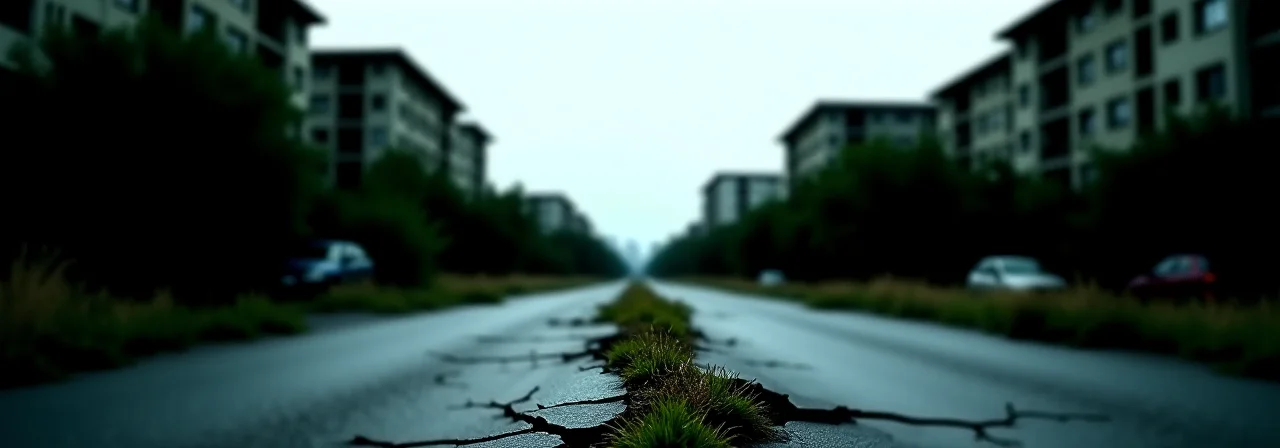
The fantasy version is brilliant. You wake up one morning and everyone is gone. No traffic. No queues. No one microwaving fish in the office kitchen. You walk into a Porsche dealership, pick the keys off the wall, and drive a 911 through an empty city centre at 140 miles an hour with the windows down.
That lasts about three days.
Then you realise the milk has gone off, the petrol stations need electricity to pump fuel, and the pharmacy on the corner has medication you'll eventually need but no one left to explain which ones. The fantasy curdles fast.
The first week is logistics
Most people, when they imagine being the last person alive, jump straight to the loneliness. But loneliness is a luxury problem. Your first week is pure survival logistics, and the list is less romantic than you'd think.
Electricity goes first. The UK's National Grid requires constant human management to balance supply and demand. Without operators, the grid frequency drifts outside its 49.5-50.5 Hz tolerance within hours. Automated systems start tripping generators offline. Within 48 hours, maybe less, the lights go out. Your fridge stops. Your freezer starts a slow, quiet thaw.
Water follows. Municipal water systems rely on electric pumps. Once the power dies, so does water pressure. You've got whatever is sitting in the pipes above you, plus whatever you can find in bottles. A supermarket's bottled water aisle buys you time, but not as much as you'd think when you're the only person restocking your supply.
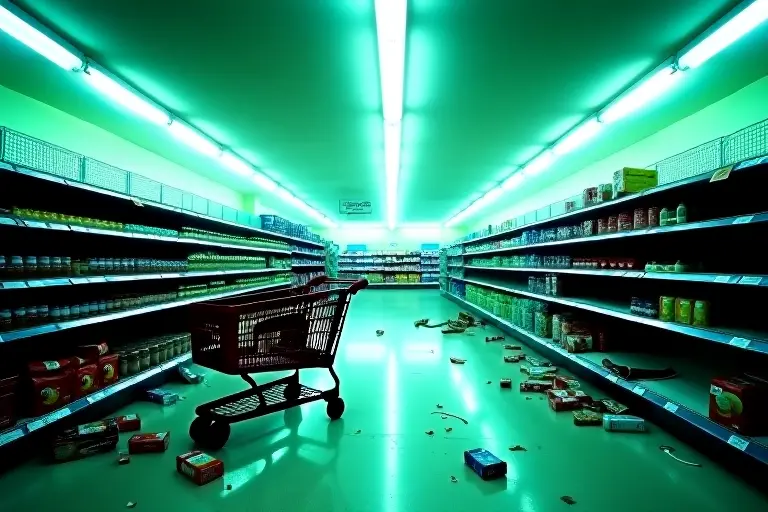
Then there's the matter of food. A supermarket contains roughly 30,000 to 40,000 products, but fresh produce starts turning within days without refrigeration. Tinned food lasts years, technically. The canning process kills bacteria, and as long as the seal holds, a tin of baked beans from 2026 will be perfectly edible in 2031. Not appetising, but edible.
So you're not starving. You're just eating room-temperature tinned peas by torchlight in a house that's getting cold. The Porsche fantasy didn't mention this bit.
The pet problem
Something nobody talks about enough: the animals left behind. The PDSA estimates there are around 12 million pet dogs in the UK alone. They're locked in houses. Their owners are gone. And they are getting hungry.
Some will break out. Others won't.
The ones that do escape form packs within weeks. Domestic dogs revert to pack behaviour remarkably quickly once the food bowls stop being filled. They're not wild wolves, but a group of hungry German Shepherds and Staffordshire Bull Terriers is not something you want to encounter while raiding a Tesco Express at dusk.
Cats, being cats, probably adjust faster than you do.
Loneliness hits differently than you'd expect
It's not sadness, exactly. Not at first. It's the absence of background noise. No cars outside. No distant conversations. No planes overhead. The silence is physical, like pressure on your ears. After a few days without hearing another human voice, your own starts to sound wrong. Too loud. Too present.
Studies on solitary confinement suggest serious psychological effects begin within days, not weeks. Craig Haney, a psychologist at UC Santa Cruz, documented anxiety, hallucinations, and cognitive deterioration in prisoners isolated for as little as ten days. And those people knew other humans existed. They could hear guards walking past. You have nothing.
You start talking to yourself. Then to objects. Then you start answering.
This is not madness. This is your brain, desperate for social input, manufacturing it. Humans are social animals in the most literal, neurological sense. Remove all social contact and the brain starts filling in the gaps with whatever it can find.
Infrastructure has a half-life
Modern civilisation is not a static thing you can just inhabit like a furnished flat. It's a machine that requires constant maintenance, and without it, everything degrades on overlapping timelines.
Roads crack within two years as water seeps into expansion joints and freezes. Tree roots break through tarmac within five. Without anyone clearing drains, urban flooding becomes routine after a single heavy winter. Within a decade, most buildings in temperate climates have water damage, mould, and structural compromise from freeze-thaw cycles alone.
Nuclear power stations are perhaps the most urgent concern. The UK's fleet of reactors has automated safety systems that trigger shutdowns when operators stop responding. But spent fuel pools still need cooling. The water in those pools boils off over weeks or months depending on the facility, and without replacement, you're looking at radioactive contamination spreading downwind. You won't see it. You won't smell it. You'll just get ill later and have absolutely no idea why.
This is the quiet horror of being the last person. Not the dramatic stuff. The slow poisoning by a world that was designed to be managed by eight billion people and is now managed by you, badly, with a torch and a tin opener.
What you'd actually spend your time doing
Forget the fantasy of reading every book in the British Library or learning piano in an abandoned concert hall. Your days are consumed by the grind of basic survival. Collecting water. Finding and transporting food. Chopping firewood once winter comes. Maintaining whatever shelter you've chosen. Monitoring your own health with no medical support and a dog-eared copy of the British National Formulary you took from a pharmacy.
You'd move out of the city eventually. Cities without maintenance become hostile environments: flooding, structural collapse, gas leaks from corroding pipes. Somewhere rural with a natural water source, farmland, and distance from industrial sites is the rational choice.
Gardening becomes the most important skill you never bothered to learn. Growing food is straightforward in theory and brutally difficult in practice when you've never done it. Seed viability, soil preparation, pest control, crop rotation. You'd spend your first growing season making every mistake possible and eating the results anyway.
The library problem
Here's what genuinely keeps me up at night about this scenario. Every piece of human knowledge, every medical textbook, every engineering manual, every agricultural guide, is sitting in buildings you can walk into. It's all there. But knowledge in books is useless without the ability to apply it, and one person cannot operate the supply chains that make modern technology possible.
You could read a textbook on antibiotics. You cannot manufacture amoxicillin in a farmhouse kitchen. You could study electrical engineering. You cannot rebuild a power grid alone. The gap between knowing and doing, when you're one person, is an ocean.
The knowledge of civilisation survives you. But without the people, it's just paper.
How long do you last?
Assuming no accident, no infection, no appendicitis (which would kill you, full stop, with no surgeon available), a healthy adult in a temperate climate with access to tinned food, clean water, and shelter could theoretically survive for decades. The practical ceiling is probably lower. A bad fall. An infected wound. A dental abscess that turns septic. The things that killed people routinely before modern medicine would kill you for the same reasons.
The average life expectancy in England before antibiotics, in the early 1900s, was around 50 years. You'd be operating under similar conditions, except without even the village doctor.
Freedom, it turns out, is not the same thing as independence. You can have all the freedom in the world and still be completely dependent on systems that no longer exist, maintained by people who are no longer there, solving problems you never knew you had.