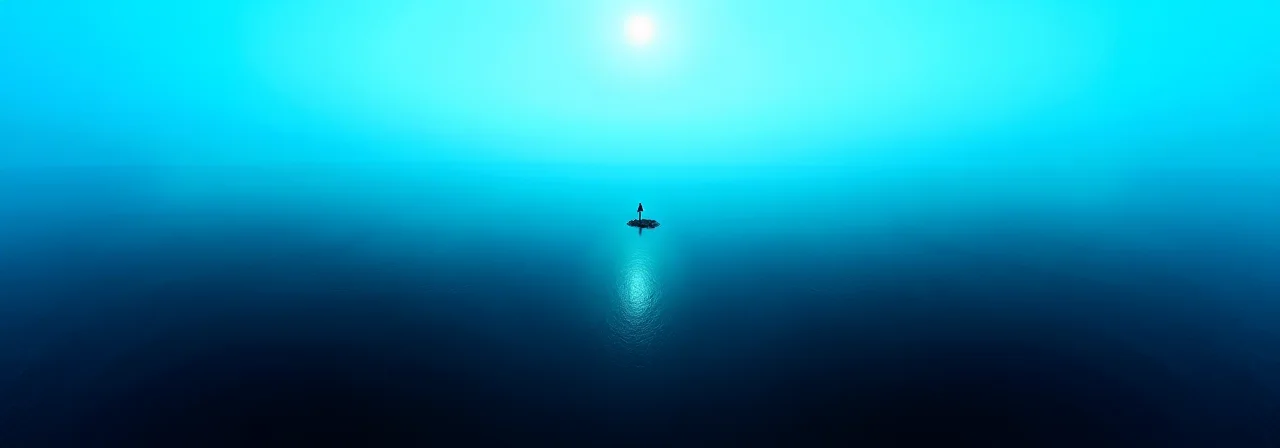
Your boat is gone. It sank, or you fell off it, or it was never particularly seaworthy to begin with. The details don't matter because the outcome is the same: you're floating in the open ocean with nothing but a life jacket, the clothes on your back, and an unobstructed view of the horizon in every direction.
No land. No ships. No aircraft. Just water, sky, and you.
The average person assumes the first threat is sharks. It isn't. The first threat, the second threat, and the third threat are all the same thing: water. Specifically, the fact that you're surrounded by billions of litres of it and can't drink any.
Dehydration kills you first
Seawater contains roughly 35 grams of dissolved salt per litre. Your kidneys can produce urine with a maximum salt concentration of about 20 grams per litre. To flush 35 grams of salt, your body needs to produce more urine than the volume of seawater you drank. You lose more water than you gain. Drinking seawater accelerates dehydration.
Without any fresh water, you have approximately three days before organ failure begins. In direct sunlight, with the salt spray coating your skin and the reflection off the water doubling your UV exposure, that timeline shrinks. Sweating loses water faster. Burns lose water faster. Heat exhaustion compounds the dehydration.
The world record for survival without fresh water at sea belongs to a Chinese sailor named Poon Lim, who survived 133 days on a wooden raft in the South Atlantic in 1942. He collected rainwater in a canvas tarp and caught fish with a hook fashioned from a nail. He had materials. He had ingenuity. And he had rain.
You, floating in a life jacket with nothing, have none of those advantages.
The sun is trying to kill you
Open ocean means no shade. None. The sun is directly overhead for six hours and only marginally less punishing for the remaining daylight hours. Water reflects roughly 6% of UV radiation back at you from below, so you're being irradiated from two directions simultaneously.
Severe sunburn sets in within hours. By the end of day one, any exposed skin is damaged. By day two, you're blistering. The burns themselves aren't lethal, but they accelerate fluid loss through the damaged skin and create infection risk in an environment where everything is covered in salt and bacteria.
Hypothermia is the night-time counterpart. Water conducts heat away from your body 25 times faster than air. Even in tropical waters around 26°C, prolonged immersion gradually lowers your core temperature. In temperate waters (15-20°C), hypothermia can set in within hours. In North Atlantic waters (5-10°C), you have perhaps 30 minutes to an hour before you lose the ability to swim.
The ocean tries to cook you during the day and freeze you at night. It's thorough like that.
Your brain turns against you
Dehydration affects cognition before it affects the body. By the time you've lost 2% of your body weight in water (about 1.5 litres for an average adult), your thinking becomes impaired. Concentration drops. Decision-making degrades. By 5% loss, you're confused, irritable, and prone to hallucination.
Isolation compounds this. The human brain is not designed for featureless environments. Sensory deprivation research shows that even healthy, hydrated subjects begin hallucinating after extended periods without varied stimuli. The open ocean is the largest sensory deprivation chamber on the planet. Same colour in every direction. Same sound (waves). Same temperature (wherever your body contacts the water). Same smell (salt).
Survivors of extended ocean ordeals consistently report hallucinations by day two or three. Ships that aren't there. Islands on the horizon that dissolve when you swim toward them. Conversations with people who aren't present. Your brain, starved of input and water, starts generating its own content. It's rarely helpful content.
What about food?
Technically, you're surrounded by it. Fish. Plankton. Seaweed. The ocean is full of calories. The problem is catching them with your bare hands while treading water in a life jacket.
Some survival manuals suggest that eating raw fish provides both calories and moisture, since fish flesh contains water. This is true but misleading. Digesting protein requires water. The net hydration benefit of eating raw fish without any additional fresh water is marginal at best and possibly negative. Your body uses water to metabolise the protein, offsetting what you gained from the fish's moisture content.
Turtle blood was the traditional survival drink of shipwreck survivors, if a turtle could be caught. It's lower in salt than seawater and provides some nutrition. Catching a sea turtle while floating in open water is, to put it gently, not straightforward.
The honest truth is that food is not your problem. A healthy adult can survive three weeks or more without food. You will die of dehydration long before starvation becomes relevant.
Currents decide where you go
You have no propulsion and minimal ability to steer. Your direction of travel is determined entirely by ocean currents and wind acting on whatever part of you sticks above the surface.
The major ocean gyres (large circular current systems) can carry floating objects enormous distances. The North Pacific Subtropical Gyre, which drives the Great Pacific Garbage Patch, circulates across an area of roughly 20 million square kilometres. Objects caught in it can take years to complete a circuit. You do not have years.
Coastal currents offer better odds. If you went overboard within 50 kilometres of a coastline, currents and wind might push you toward shore over a period of days. The English Channel is 33 kilometres across at its narrowest. People swim it in 7 to 20 hours. Drifting passively would take longer but is at least theoretically possible.
In the open Pacific or Atlantic, away from shipping lanes, the odds of drifting to land before dehydration kills you are close to zero.
Rescue is a numbers game
A human head floating at water level is visible from a ship's bridge at approximately 3 to 5 kilometres in calm conditions. In any kind of swell, that drops to under a kilometre. From the air, a person in the water is nearly invisible against the surface glare unless they're wearing high-visibility clothing or have a signalling device.
The ocean covers 361 million square kilometres. You occupy less than one square metre of it. Search and rescue aircraft can scan roughly 100 to 200 square kilometres per hour under ideal conditions. If nobody knows where you went in, the search area expands by thousands of square kilometres with every hour that passes.
Maritime rescue services know this arithmetic. It's why the first 24 hours after a person goes overboard are critical. After that, the search area becomes so large that finding someone is closer to luck than methodology.
What actually saves people
Flotation. If you have anything that keeps you out of the water, even partially, your survival time roughly doubles. A life raft, a piece of wreckage, an overturned hull. Anything that reduces immersion reduces heat loss and conserves energy.
Rain. Fresh water falling from the sky is the only reliable hydration source in open ocean. Survivors who lasted weeks or months almost universally credit rainfall. No rain, no survival past day four or five.
Shipping lanes. The English Channel sees roughly 500 vessel movements per day. The Strait of Malacca, about 300. Fall overboard on a busy route and someone will probably spot you. Fall overboard in the South Pacific, where the nearest shipping lane might be 2,000 kilometres away, and you're on your own.
Steven Callahan survived 76 days adrift in the Atlantic in 1982 in an inflatable life raft. He had a raft, solar stills for water, and a spear gun for fish. He lost a third of his body weight and was barely conscious when a fishing boat found him near Guadeloupe. He had equipment, skills, and extraordinary luck. Take away any one of those and the story ends differently.
If you're ever on a boat, wear the life jacket. Clip on the harness. Stay attached. Because once you're in the water with nothing, the ocean has a patience you don't.